New Manifest Regulations Postponed Once Again to 1 April 2021
[Circular
No.43/2020-Customs dated 30 September 2020]
Subject: Implementation of the Sea Cargo Manifest and Transhipment
Regulations.
Kind reference is invited
to Notification No.38/2018-Customs (N.T.) dated 11.05.2018 vide which the Sea
Cargo Manifest and Transhipment Regulations (SCMTR), 2018, were notified. The
SCMTR seek to bring about transparency, predictability of movement, advance
collection of information for expeditious clearance and supersedes the earlier
regulations viz. Import Manifest (Vessels) Regulations, 1971 and Export
Manifest (Vessels) Regulation, 1976. The new Regulations stipulate for advance
notice by authorized carriers for goods arriving in or being exported out of
India through gateway seaports and further movement between Customs stations.
They stipulate the obligations, roles and responsibilities for the various
stakeholders involved in movement of imported/export goods.
Based on the
feedbacks from the various stakeholders, the changes were incorporated and the
said regulations was made effective from 1st of August, 2019 with transitional
provisions under Regulation 15 till the 30th of September, 2020.
2. Considering the
disruptions caused due to Covid-19 Pandemic and non-readiness of the
stakeholders, Board has issued Notification No.94/2020-Customs(N.T.) dated
30.09.2020, vide which the transitional
provisions under Regulation 15(2) have been extended from 1st October, 2020 till 31st March, 2021 to enable submission of
manifests under erstwhile regulations. However, as per Regulation 15(1),
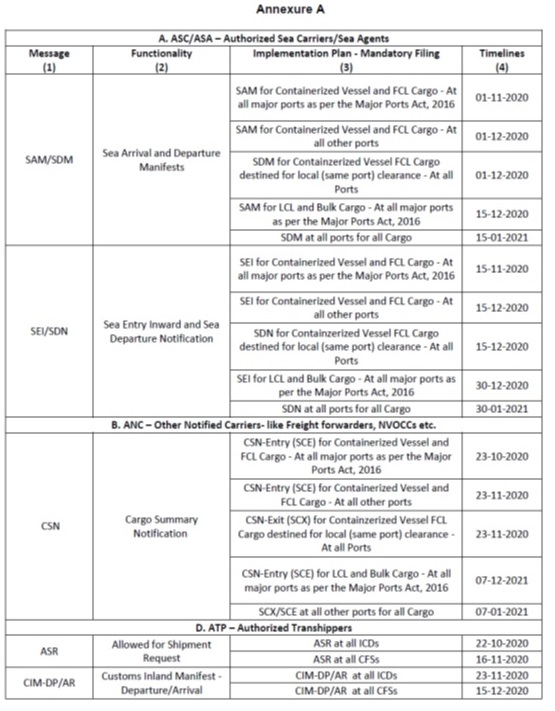
mandatory filing of different declarations in new format in a phased manner is
provided for as per the annexure A to this circular. Different timelines
are prescribed so that trade has sufficient time to comply with the new
regulations in a phased manner. Further, vide Regulation 15(2), the mandatory
compliance requirements for submissions of declarations and manifests under the
said regulations shall applied in full effect from 1st April, 2021.
3. Another procedural
relaxation is that the amount of bond and bank guarantee or postal security or
National Savings Certificate or fixed deposit, as required under Regulation
3(1A) has been reduced to Rs 5,00,000 /- from Rs 10,00,000 /-. It is also
informed that vide the above stated Notification No. 94/2020-Customs(N.T.)
dated 30.09.2020, in addition to Authorised Economic Operators (AEOs), ‘Customs
Brokers’ who are already licensed under the Customs Brokers Licensing
Regulations, 2018, who are authorised to issue delivery orders, are also
exempted from the requirement to furnish a fresh bank guarantee or postal
security or National Savings Certificate or fixed deposit , under proviso to
Regulation 3(1A) of the SCMTR.
4. It is informed
that Directorate General of Systems has taken several measures for handholding
the trade and all stakeholders for smooth transition to the SCMTR regime.
Directorate General of Systems has issued various guidelines related to the
registration process and filing requirements under the new Sea Cargo Manifest
and Transhipment Regulations (SCMTR) for different stakeholders such as
Shipping Lines, Freight Forwarders, Transhippers etc, who are integral to the
implementation of the said regulations. The guidelines can be found at the
following link (https://www.icegate.gov.in/SeaManifestRegulation.html). For the sake of
guidance and clarity, the procedural compliance requirements of the said
regulations is reiterated in the following paragraphs.
Registration of
Stakeholders:
5. The registration of different stakeholders
stipulated in regulation (1) of the SCMTR is a completely automated process
through ICEGATE Portal. The detailed guidelines available at https://icegate.gov.in/Download/Advisory_for_users_on_SCMTR_v2.0.pdf may be referred to
for more clarity on the registration process. It is noticed that while a
sizeable number of stakeholders have registered successfully on ICEGATE, there
remains a significant number who are yet to be onboarded due to lack of
reciprocity, despite various advisories. Board urges all the stakeholders to
immediately register on ICEGATE and apply from within their ICEGATE login to
operate under the new SCMTR. The categories of stakeholders who are required to
be registered are as follows:
a. Authorised Sea Carrier (Including Shipping
line) (ASC)
b. Authorised Sea Agent (Steamer/ Shipping
Agent) (ASA)
c. Authorised Carrier (other notified carriers)
(ANC)
d. Authorised Carriers for Inland Movement –
Transhippers (ATP)
The applicant can
edit or modify the details in already submitted application, if the same has
not been approved by the officer concerned. In case officer has already
approved the submitted application for registration, the applicant can submit
amendment for the already approved details.
Delivery of an Arrival
Manifest in relation to a Vessel:
6. Regulation 4 of
the SCMTR provides for the delivery of an arrival manifest in relation to the
vessel by Authorised Sea Carrier. This document now replaces the `Import
General Manifest` and is a legal requirement under Section 30 of the Customs
Act, 1962, the details of which are outlined under Regulation 4(2) of the
SCMTR. It is clarified that only the persons representing master of the vessel
(i.e Vessel Operator) viz. the Authorised Sea Carriers (ASC)/ Authorised Sea
Agents (ASA) are required to file the arrival manifest. The General declaration
and Cargo declaration are made available together in ICEGATE as Sea Arrival
Manifests (SAM) and other declarations in arrival manifest is made in ICEGATE
as Sea Entry inwards (SEI). The timeline for the mandatory parallel filing of
arrival manifest for different types of Vessel/Cargo is given in annexure A.
6.1. It is to be
noted that the General declaration and the Cargo declaration associated with
the arrival manifest, are mandatorily required to be delivered before the
vessel departs from the last port of call before arrival of vessel at the
Indian port. However, for non-containerized cargo the arrival manifest can be
filed at any point in time, but before arrival of vessel at the Indian port. In
case of SAM, amendments will not require any approval by the Customs officer if
filed within following timelines:
i. Short Haul Voyage (expected
arrival less than 48 hrs) – 6 hrs before expected arrival,
ii. Medium Haul Voyage (expected
arrival 48 – 96 hrs) – 24 hrs before expected arrival and
iii. Long Haul Voyage (expected
arrival after 96 Hrs) – 48 hrs before expected arrival.
However, if the
amendments are filed beyond the above timelines, they will require approval by the
proper officer. Such amendment approval would also be given online. For filing
a SAM, the vessel operator will have to give the details of the Container Bond
registered in the Customs Automated System. For the purpose of SCMTR, a new
national container bond has been introduced in the Customs System with the
category name CG. This bond, once registered at a port can be used for filing
SAM at any port across India.
6.2. Apart from
ASC/ASA above, other persons such as Freight forwarders, NVOCC, consolidator or
by whatever name they are called, who are party to Transport Document (viz.
Bill of Lading) and issue delivery order may also file their part of cargo
declaration directly with Customs as Cargo Summary Notification (CSN), instead
of giving it to the vessel operator. The CSN is a declaration filed with
Customs regarding the details of cargo covered under a Transport Document (viz.
Bill of Lading). On successful submission of this declaration, a unique CSN
number would be generated that will act as a reference number for the next
declaration by the consolidator or the vessel operator (VOA). It is clarified
that ASC/ASA can also prepare the arrival manifest by aggregating Cargo Summary
Notification (CSN) filed separately by other Authorised Carrier. Further, a CSN
can be filed not just by the other notified parties but also by the vessel
operator. A vessel operator can file CSNs for every transport document if it
has the necessary details and just refer the CIN numbers in the final arrival
manifest. Similarly, in case of Arrival or Departure Manifests filed for
subsequent movements, the CIN details may be referred, rather than filing the
details afresh. The timeline for the mandatory parallel filing of cargo
declaration for different types of goods is given in annexure A.
Delivery of a
Departure Manifest in Relation to a Vessel:
7. Similar to the
procedural requirements as in para 6 on the import side, the same requirements
are laid down on the export side under Regulation 5 of the SCMTR. For delivery
of a Departure manifest, the concerned stake-holders, viz. the Authorised Sea
Carriers (ASC)/ Authorised Sea Agents (ASA) would now be required to file Sea
Departure Manifests (SDM) and Sea Departure Notification (SDN). SDM is the
manifest required to be filed by Authorised Sea Carrier before departure of the
vessel from any Indian sea port. The SDM, can be updated any time before SDN is
filed without the approval of the officer.
7.1. SDN is the
declaration having final reconciliation summary of the cargo actually carried
by the vessel. SDN is filed by the Authorised Sea Carrier after the departure
of the vessel within 24 hrs of the departure of the vessel for containerized
cargo and 72 hrs for other cargo, which otherwise may attract late filing
penalty. These documents would comprehensively subsume and replace the `Export
General Manifests` and are expected to greatly reduce the various errors
associated with exports on payment of IGST refunds. As in para 6.2, the other
persons notified in this regard may file the Cargo Summary Notification (CSN).
As in the case of arrival manifest, it is clarified that ASC/ASA can also
prepare the departure manifest by aggregating Cargo Summary Notification (CSN)
filed separately by other Authorised Carrier. The timeline for the mandatory
parallel filing of departure manifest for different types of Vessel/Cargo is
given in annexure A.
Transhipment of Goods
within India by Train/Truck:
8. Transhipment under
the Regulation 7 of the SCMTR refers to any movement of Customs cargo between
two Customs stations inside the country. The person responsible for the
movement of the import/export goods within India is a Transhipper. There would
be only one authorized Transhipper responsible throughout the movement of the
transhipped cargo, irrespective of the modes of transport. The Transhipment
Bond is also required to be executed by the authorized Transhipper. For filing
declarations under the SCMTR, a transhipper should get registered in the
category of Authorised Transhipper (ATP), who is also a stakeholder who
requires registration as narrated in para 5 of this circular. Like a CG Bond,
even for the purpose of transhipment under the SCMTR, a new national
Transhipment Bond with category code `TG` has been made available in the
Customs System to avoid the necessity of registering different bonds at
different ports. The authorized transshipper is required to file arrival and
departure manifests for every stage of the inland movement of the cargo. The
manifests pertaining to the transhipment are made available in ICEGATE as
`Customs Inland Manifest (CIM) – Arrival (AR)/ Departure (DP)`. The manifests
will have to be filed for every vehicle (truck/train) carrying the cargo upto
and between inland Customs stations. The authorized carrier (i.e Transhipper)
is required to file CIM – DP/AR manifests before departure and upon arrival of
the conveyance at the respective Customs stations. However, while a declaration
will have to be filed before departure and upon arrival of the conveyance at
the respective Customs stations, the declarant will be able to link the
declarations made in the previous manifests for every cargo using the cargo
identification number (CIN) assigned to the cargo. Thus, the process would be
considerably eased to that extent. The ATP would also require to file the Allowed for
Shipment Request (ASR) for every shipping bill when ready for departure at the
port of export.
Amendment of Arrival
and Departure Manifests:
9. The declarant can
submit amendment for the already submitted declarations, as provided for under
Regulation 8 of the SCMTR. It may also be noted that both SAM and SDM can be
amended after filing.
Cargo Identification
Number:
10. To uniquely
identify the cargo and simplify the filing process, a system of CIN is
introduced in Customs Automated system. CIN is a unique identification number
assigned by Customs System to every cargo declared. In order to account for
every consolidation and segregation of cargo seamlessly, two types of CIN would
get generated:
I. PCIN – Primary Cargo
Identification Number: It is the identification number assigned by Customs
automated System to uniquely identify a cargo contained in single Transport
Document (like Bill of Lading) mentioning Actual Buyer and Seller in imports.
In exports, a PCIN would correspond to cargo covered under a single Shipping
Bill. Having a PCIN for every cargo facilitates smooth filing of different
declarations and removes duplicate filing effort, thereby simplifying the
processes.
II. MCIN- Master Cargo Identification
Number: Since multiple cargoes can get consolidated under a consolidated
Bill of Lading (BL), MCIN is the identification number assigned by Customs
automated System for all the cargo covered under a consolidated BL. Each MCIN
will be an aggregation of multiple PCINs. Referring to an MCIN in any
subsequent manifest would mean reference to all the underlying PCINs.
Mandatory Filing
Requirements on Parallel Basis:
11. Optional test
filing for all messages are available from October, 2020 and all the
stakeholders are hereby requested to start filing the messages as per the
guidelines issued by DG Systems.
12. The
implementation plan and timelines for mandatory compliance pertaining to
various stakeholders, and the documents to be filed by them are as per annexure
A to this Circular. The different stakeholders would be required to adhere to
the timelines as laid down in column 4 of the annexure A. Any stakeholder not
adhering to the implementation plan as per the time-lines of filing schedule
shall be liable to penalty as authorised under Regulation 13 of the SCMTR,
2018.
13. The detailed
guidelines and FAQs for different categories of stakeholders are available on
ICEGATE (https://www.icegate.gov.in/SeaManifestRegulation.html)
and may be kindly
referred to.
14. The Principal
Chief/Chief Commissioners of Customs are requested to issue Public Notices and
guide the trade suitably to ensure smooth implementation of the Sea Cargo
Manifest and Transhipment Regulations.
15. Any difficulties
faced in the implementation of this Circular may please be brought to the
notice of Board.
F. No.450/58/2015-Cus
IV