CBEC Sets up 23
Excise Zones for Audit Commissionerates, Issues
Guidelines
[CBEC Circular No. 985 dated 22nd September
2014]
Subject – Guidelines regarding Structure,
Administrative set up and Functions of Audit Commissionerates.
On implementation of cadre review there would be 23
Central Excise Zones and 4 Service Tax Zones with each zone having one or more
Audit Commissionerates. Each Audit Commissionerate would cover assessees
registered under the jurisdiction of 3 to 5 Executive Commissionerates.
Principal Chief Commissioner and Chief Commissioner shall assign the
jurisdiction of Audit Commissioner in the zone, decide
the location of Audit Commissionerates and its
subordinate offices. Following guidelines may be followed while finalizing the
location and organizational structure of Audit Commissionerate
and its subordinate offices, subject to deviations needed to cater to the local
requirements.
Location of Audit Commissionerate
2.1 The
headquarters and the subordinate offices of the Audit Commissionerates
could be co-located in metropolitan city based zones.
2.2 In
non-metropolitan city based zones, Executive Commissionerates
are spread over different cities therefore the headquarters of the Audit Commissionerates may be located in the city where zonal
office is located, and at least one of the Circles (subordinate office
explained later) may be located in the city where Executive Commissionerates
are located.
2.3 In cases
where there is more than one Audit Commissionerate in
the Zone, the location of the second or third Audit Commissionerate
and its subordinate offices may be decided based on the geographical
concentration of the taxpayers. However, the Headquarters of the Audit Commissionerate may be in the city where the Executive Commissionerate is located. This is to ensure that audit
officers work in close coordination with the Executive Commissionerates
and are accessible to the assessees.
2.4 LTU Audit -
Two LTU Audit Commissionerates have been created. LTU
Audit Commissionerate at Delhi shall have
jurisdiction over assessees registered with LTU
Delhi, Kolkata or Bangalore whereas LTU Audit Commissionerate
at Mumbai shall have jurisdiction over the assessees
registered with LTU Mumbai or Chennai. The assigning of audit to the
subordinate offices of these Commissionerates may be
carried out taking into account the location of cluster of assesses. While
assigning assessees to the subordinate office, assessees with same PAN number should be assigned to one
subordinate officer.
Configuration of Audit Commissionerate
3.1 Audit Commissionerate would comprise of a Headquarters similar to
an Executive Commissionerate and subordinate offices
proposed to be called Circles similar to a Divisions. The Circles would be
headed by a Deputy or Assistant Commissioner. The Circles would comprise of
Audit Groups equivalent to the Range offices which would have Superintendents
and Inspectors.
3.2 Audit
Commissioner would be Head of the Department and the headquarters would have
two Additional or Joint Commissioners, who are in turn would be supported by
two Deputy or Assistant Commissioners each.
3.3 The proposed
sections in the Headquarters are:
i. Planning and coordination section to look after scheduling and
support in conduct of MCM meeting, maintenance and updation
of Assessee Master File, maintenance of
Records/Registers and submission of reports to look after formation /
constitution of audit groups and deployment of officers matching skills with
audit requirement, maintenance of database of officer’s profile, training needs
of officers.
ii. Administration,
Personnel & Vigilance section to look after administrative matters,
transfer, leave, allowances, budgetary grants, vigilance matters etc.
iii. Technical section
to look after draft Show Cause Notices, audit follow up, court cases, Board’s
circulars, instructions etc.
iv. Risk Management
and Quality Assurance section to look after risk based selection of units, use
of Third Party Source of Information, maintenance of Audit database of units to
be audited, selecting themes/issues for audit, performance appraisal and
Quality Assurance
3.4 The aforementioned four sections of an Audit Commissionerate
can be manned by either 3 or 4 Deputy / Assistant Commissioners in the
Headquarters. In case of three Sections in Headquarters, the Technical and
Planning function can merge into one. The other Deputy / Assistant
Commissioners would be in charge of Circles. Each Audit Commissionerate
may have 6 to 7 Circles under its jurisdiction.
3.5 The Circles would
be assigned the geographical jurisdiction of either an entire Commissionerate or some Divisions of an Executive Commissionerate.
3.6 Division of
the jurisdiction of an Executive Commissionerate
between two Audit Commissionerates / Audit circles
should be avoided.
3.7 In addition
to geographically defined Circles, the Audit Commissionerates
may have functionally oriented Circles for conducting Theme/Issue based audit
(for example Insurance, telecom, Banking services or specific commodities etc) and its territorial jurisdiction should cover the
jurisdiction of the entire Audit Commissionerate.
Organisational Structure of Audit Commissionerates
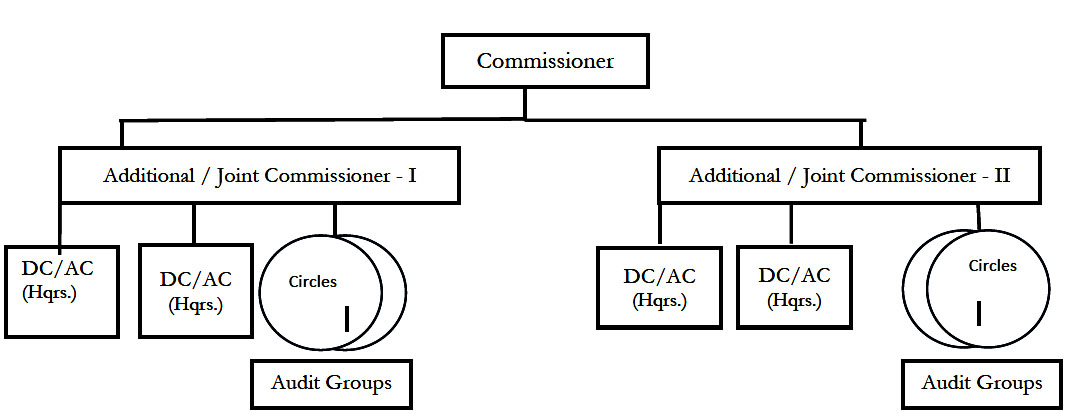
Staffing norms
4.1 Headquarters
shall be manned by one Commissioner, two Additional or Joint Commissioners and three
or four Deputy Commissioners.
4.2 Each Audit
Circle shall be headed by Deputy or Assistant Commissioner and will also
comprise of Audit Groups. The Audit Groups deployed for large units should
comprise of 2-3 Superintendents and 4-6 Inspectors. For Medium units the Audit
Group should include 1 - 2 Superintendents and 2 - 4 Inspectors. For Small
units the Audit Group should include, 1 Superintendent
and 1 - 2 Inspectors.
4.3 Groups for
Large units, Medium units and Small units should be in such number that the
following distribution of manpower deploymentin audit
groups is achieved.
a. 50% of manpower to Large units
b. 30% of manpower to Medium units
c. 10 % of manpower to Small units
d. 10% of manpower for planning, coordination and follow
up.
Functions of Audit Commissionerate
5.1 Monitoring
Committee Meeting (MCM) should be convened by Audit Commissionerate,
for which the Executive Commissioner or his representative will be invited to
attend. The decision with regard to settlement of an audit objections
after recovery of all dues or dropping of the unsustainable audit objections
shall vest with the Audit Commissioner. Approved audit objections including
those in which show cause notices are proposed to be issued should be conveyed
to the Executive Commissioner in the form of Minutes of the MCMs, who shall
respond to these objections conveying his agreement/disagreement within 15 days
of the receipt of the minutes of the MCM.
5.2 On points of
difference, further consultations may be held for a maximum period of 15 days.
In case the difference persists, the final decision to issue show cause notice
rests with the Audit Commissioner.
5.3 Audit Commissionerate shall issue the show cause notice, wherever
necessary, after the audit objections are confirmed in the MCMs. The show cause
notice shall be answerable to and adjudicated by the Executive Commissioner or
the subordinate officers of the Executive Commissionerate
as per the adjudication limits prescribed the Board. Audit function will end
with the issuance of show cause notice and further action including
adjudication and follow-up shall be the responsibility of Executive
Commissioner.
5.4 Litigation
after adjudication proceedings (including defending the order before the
appellate forums-Commissioner (Appeals)/Tribunals/Courts) shall be the
responsibility of Executive Commissioner. However, Audit Commissionerates
shall remain closely associated and provide inputs wherever required.
5.5 The function
of pre-audit/post-audits of refunds, rebates and brand rate fixation of
drawback shall continue with the jurisdictional Executive Commissionerate.
5.6 CERA audit
shall be attended by the Executive Commissionerate by
compiling necessary information and replying to the audit objections raised by
C&AG. Audit Commissioners will have no role either in compiling /
furnishing information to CERA or replying to the C&AG objections. However,
it is desirable that Audit Commissionerate is aware
of the objections raised by C&AG. Therefore, copy of the objections received
from CERA and replies furnished by the Executive Commissioner shall be
forwarded to the Audit Commissionerate by the
Executive Commissionerate.
5.7 Anti-evasion
functions shall continue with the Executive Commissionerates.
Audit Commissionerates may refer, with the approval
of the MCM, any case arising out of audit where detailed investigation is
necessary to the Executive Commissionerates.
5.8 Special
Audit shall be ordered by the Audit Commissionerates.
Section 14A / 14AA of CEA, 1944 and Section 72A of the Finance Act, 1994
provide for such special audits in the specified circumstances by Cost
Accountants / Chartered Accountants. The Audit Commissioners shall be the
competent authority to order Special Audit, either on their own satisfaction or
on a reference received from the Executive Commissioner.
5.9 Audit should
be so conducted that the assessee is least
inconvenienced. Documents as prescribed in the manual should be called and
preparatory work finalized ahead of audit. Audit should be completed
expeditiously and as soon as the Final Audit Report is prepared , it should
be ensured that a copy of the Final Audit Report including ‘NIL’ report is
dispatched or provided to the assessee under
acknowledgement to be kept in Assessee Master File.
5.10 Currently,
audit is undertaken for each tax separately even though the business and
financial records verified during the audit remains common for all the three
tax administered by the Board . In order to improve the efficiency of audit
process, it has been decided that coordinated and integrated audit covering two
or more taxes for assessees having common PAN shall
be carried out. Necessary legal enablement has been provided in the
notification conferring territorial jurisdiction to the Commissionerates
such that Service Tax Audit Commissionerates can
audit Central Excise assessees within a zone and
vice-versa. An assessee who is registered under
Central Excise, Service Tax and Customs need not be subjected to three separate
audits. The information about his various registrations is available and such assessees would be subjected to a complete audit by the
designated Audit Commissionerate. For this purpose
the Principal Chief Commissioner / Chief Commissioner will assign the audit of
an assessee to a particular Audit Commissionerate,
based on payment of Central Excise duty or Service tax whichever is higher.
Following the same principle OSPCA would be also be carried out by the
designated Central Excise or Service Tax Audit Commissionerate,
in an integrated manner.
5.11 It is
proposed to issue risk based audit norms in due course of time. In the interim
the existing audit norms may be used to ensure that audit functions continue
efficiently.
Transfer policy and capacity building
6.0 Audit
requires specialized skills in accountancy and handling of financial / SAP or
ERP related databases apart from domain knowledge of Central Excise, Service
Tax and Customs law and procedures. The officers need to gain knowledge of
compliance requirements under Income Tax, Companies Act, VAT laws to do a
comprehensive and meaningful audit. The officers who have gained expertise in
this regard are few. DG (Audit) in consultation with NACEN shall develop
appropriate modules for training of officers in audit functions and inform field
on further progress. As it takes time for officers to gain expertise in audit
techniques , appropriate transfer policy to be followed by Zones shall be
prepared by the DG, Audit with due approval of the Board so that the
department can adequately use officers for audit after they have acquired the
necessary skills . Suggested transfer policy shall be circulated by the DG , Audit after approval of the Board .
Removal of difficulty
7.0 Past
guidelines and instructions on the subject stand modified to the extent they
are in conflict with these guidelines . If there is
any difficulty in implementing the above guidelines , Principal Chief
Commissioners and Chief Commissioners are authorised
to issue appropriate instructions to be valid for temporary periods to remove
difficulty in setting up and operationalizing Audit Commissionerates . Issues which need to be addressed in the
Board may be forwarded to the Director General of Audit with suggestions for
further examination and seeking approval of the Board where needed .
[F.No. 206/03/2014-CX.6]