August
Imports Jump 37%, Exports Remain Flat; Trade Deficit Widens
Outbound shipments from India grew at the slowest
pace at $33 billion in August -- down 1 per cent compared to past year -- according
to preliminary data released by the government on Saturday, 3 Sept 2022.
Exports restrictions on items, such as wheat,
steel, iron pellets, as well as a delay in execution of orders due to fear of
slowdown in developed economies, have led to a flattening of exports. On a
sequential basis, exports fell 9 per cent from $36.27 billion in July.
On a cumulative basis, India exported goods worth
$192 billion during April-August period, up 17.1 per cent year-on-year (y-o-y).
Trade deficit eased to $28.68 billion, but remained
elevated in August. In July, the deficit had hit a record high of $30 billion.
Similarly, imports remained elevated at $61.68 billion in August, 45.09 per
cent y-o-y, as India “stocked up” coal and petroleum products for energy security,
commerce secretary BVR Subrahmanyam told reporters.
On a sequential basis, the value of inbound
shipments declined by 7 per cent.
Based on the current trends, and on a conservative
basis, Indian exports will cross $750 billion in FY23, compared to $676 billion
in FY22. A ‘conservative’ target of $450 billion has been set for the
merchandise exports, the commerce secretary said, adding that the department’s
internal target remains at $470 billion.
“Crude and coal dominated the increase in imports,
in line with the trend in recent months. The y-o-y dip in exports, led by
sectors such as engineering goods, gems and jewellery,
and yarns and textiles, suggests a cautious outlook for external demand going
ahead,” said Aditi Nayar, 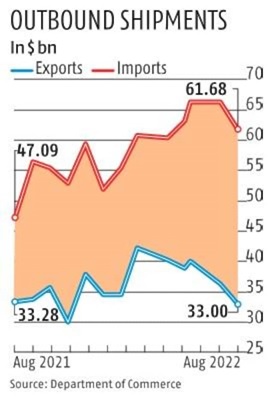 chief economist, ICRA.
Subrahmanyam highlighted that given the current global scenario, India is not in an uncomfortable position. However, there are
headwinds related to the conditions in developed nations and Christmas orders,
he added.
“Exporters’ order books are full, but the orders
are getting delayed in terms of execution. They have not been
asked to ship. That is the uncertainty that is there,” he said.
There was a contraction in some of the key drivers
of export growth in India. Engineering goods witnessed a 14.59 per cent contraction,
gems and jewellery by 4.08 per cent, and cotton yarn by 32.32 per cent, amid
tepid demand from Western nations. However, some items witnessed growth.
Petroleum products grew at 9.18 per cent, chemicals 8.03 per
cent, electronic goods 46.09 per cent, and rice 30.88 per cent.
For a number of global factors, growth in
engineering goods exports has come down in the last few months, said Mahesh
Desai, chairman, Engineering Export Promotion Council of India.
“Decline in demand from China and recessionary
trends in major economies in the West have contributed to the slowdown in
exports. The pace of growth also slackened due to export duty on certain steel
products including stainless steel products,” Desai added.
He further said, “At this point, a fair amount of
uncertainty remains due to the looming recession in major economies in the wake
of ongoing Russia-Ukraine conflict. Depending on the extent of recession,
Indian engineering exporters would be impacted but it is likely to more hit the
MSMEs which have grappled with back-to-back challenges
such as Covid crisis and the subsequent spike in raw
material prices