BEE’s
Star Labelling Program Results in Energy Efficiency Improvement of Split ACs by
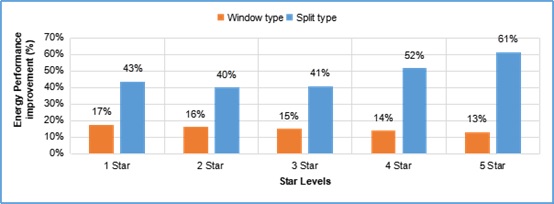
43% for 1-Star and 61% for the 5-Star level; For window ACs, the improvement is
17% for 1-Star and 13% for 5-Star level
·
The
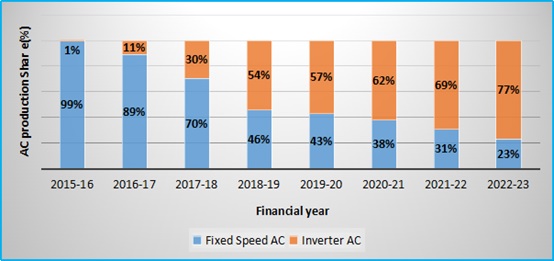
market share of energy efficient Inverter-based ACs increases from 1% to 77% in
last 8 years
·
The
Star Labelling Program for ACs is achieving its intended outcomes
·
Government
is committed to successfully implement ICAP, Abhay Bhare,
DG, BEE
India’s energy efficiency policies
have not only led to improvement in overall energy efficiency of Air-Conditioners
but also accelerated the deployment of highly Energy Efficient inverter technology.
As per the data from the Bureau of Energy Efficiency (BEE), Ministry of Power, for
split Room Air-Conditioners (RACs), the overall energy efficiency improvement is
43% for 1-Star and 61% for the 5-Star level. On the other hand, the overall energy
efficiency improvement for window RACs is 17% for 1-Star and 13% for 5-Star level.
Figure 1: Improvement
in 1 Star and 5 Star for Window and Split ACs
The interventions by the Central
Government have also led to increase in the market share of the more efficient,
Inverter RACs. In 2015, the market share of variable speed (commonly known as inverter)
RACs was less than 1% in the overall RAC market size of 4.7 million units. In June,
2015, BEE introduced a voluntary labelling program for Inverter RACs with a new
star rating methodology called Indian Seasonal Energy Efficiency Ratio (ISEER) which
was made mandatory from January 2018.
During the eight years from 2015-16
to 2022-23, the market share of the more efficient, variable speed (Inverter) RACs
increased from 1% to 99%, while that of the fixed speed RAC, reduced from 99% to
23% during the same period. The overall market for RACs reached 6.6 million units
by 2020-21. This market transformation towards efficient technology was possible
due to adoption of variable speed (Inverter) RAC policy, which offers benefits to
the consumers in terms of electricity and cost saving.
Figure- 2: Market Transformation of Fixed speed
and Variable Speed RAC
These interventions are part
of the India Cooling Action Plan (ICAP), which aims to provide an integrated vision
towards cooling across sectors encompassing inter alia reduction of cooling demand,
refrigerant transition, enhancing energy efficiency and better technology options
with a 20-year time horizon.
Responding to the progress made
in implementation of the Star Labelling program, Shri Alok Kumar, Secretary, Ministry
of Power said that program is achieving its intended outcomes. He added that the
Indian economy is growing at a rapid pace and so the demand for cooling is going
to increase multi-fold over next few decades. Under ICAP, a detailed action plan
has been chalked out. This will ensure that while we cater to our development needs,
we do it in an efficient manner. Shri Abhay Bakre, DG,
BEE said that the ICAP is a comprehensive plan covering all sectors and the government
is committed to successfully implementing the ICAP.
BEE has been revising the star
rating plans for split and window RACs to increase the stringency of the energy
performance thresholds, as shown in Table - 1 and Table - 2 respectively.
Table 1: Revisions in
star ratings plans for split type RACs
|
Star
level |
Jan
2009- Dec 2011 |
Jan
2012- Dec 2013 |
Jan
2014-Dec 2017 |
Jan
2018- June 2022 |
July
2022-Dec 2024 |
|
1
star |
2.3 |
2.5 |
2.7 |
3.1 |
3.3 |
|
2 star |
2.5 |
2.7 |
2.9 |
3.3 |
3.5 |
|
3 star |
2.7 |
2.9 |
3.1 |
3.5 |
3.8 |
|
4 star |
2.9 |
3.1 |
3.3 |
4.0 |
4.4 |
|
5 star |
3.1 |
3.3 |
3.5 |
4.5 |
5.0 |
As per Table 1, the extent of efficiency improvements for the
split type RACs have seen frequent and substantial revisions, in comparison to window
RACs due to technological and size constraints (see Table - 2). The improvement
made in the efficiency values (ISEER) for split RAC is presented below at figure
1.
Figure1: Improvement in
1 Star and 5 Star for Split ACs
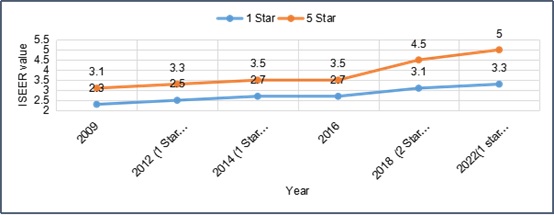
Table 2: Revisions in star rating levels for window/unitary
type RACs
|
Star
level |
Jan
2009- Dec 2013 |
Jan
2014 - June 2022 |
July
2022 - Dec 2024 |
|
1
star |
2.3 |
2.5 |
2.7 |
|
2 star |
2.5 |
2.7 |
2.9 |
|
3 star |
2.7 |
2.9 |
3.1 |
|
4 star |
2.9 |
3.1 |
3.3 |
|
5 star |
3.1 |
3.3 |
3.5 |
Background
The Bureau of Energy Efficiency
(BEE) launched the Star Labelling program for fixed-speed Room Air Conditioners
(RACs) in 2006 as a voluntary initiative, and the program became mandatory in 2009.
BEE revised the energy performance thresholds (Minimum Energy Performance Standard-MEP)
for RACs covered under the program on a biennial basis from 2009 - 2018.
In 2015, BEE launched a voluntary
labelling program for inverter RACs, and made the program mandatory in January,
2018. The labelling program for RACs now covers both fixed and inverter units under
the same labelling scheme. The split AC rating plan also includes the cassette and
floor standing/ceiling mounted type RACs.
The efficiency of a RAC is defined
in terms of the Energy Efficiency Ratio (EER), which is the ratio of the cooling
output (in Watts) to the total power input (in Watts) at standard rating conditions.
This means the higher the EER, the more efficient the air conditioner. In 2018,
BEE adopted an improved rating methodology that factors in variance in temperature
across the various climatic zones in India and operating hours. The new metric is
called the Indian Seasonal Energy Efficiency Ratio (ISEER), which is the ratio of
the cooling seasonal total load (in kWh) to cooling seasonal energy consumption
(in kWh).
The existing energy performance
norms for RAC were notified under mandatory regime in the year 2018. The initial
validity period for these norms was 1st January, 2018 to 31st December, 2019.
Further, in the year 2019, the
standards were extended by a period of 1 year beyond 31st December, 2019 in lieu
of lack of market readiness for the new standards. Therefore, the revised validity
period for these norms was changed as 1st January, 2018 to 31st December, 2020.
During 2020, in lieu of the impacts
of COVID-19 on RAC industry, BEE further extended the validity of these norms at
first by a period of 1 year beyond 31st December, 2020 to 31st December, 2021 and
then by 6 months to 30th June, 2022.
Subsequently, the revised star
rating tables were made applicable to unitary and Split type ACs with effect from
1st July 2022.The current validity period is 1st July 2022 to 31st December 2024.