Budget could Levy Two New Cesses - Covid and Defence Cess
Additional
revenue meant to cover Covid, defence
spends; States likely to demur
The Centre may consider introducing one or two new cesses this Budget, one to fund part of Covid-related
expenses and another to meet defence expenditure. A final
decision on the number of new cesses will be taken at
the highest level and closer to the Budget day, according to multiple sources.
But introducing cesses amid rising
demand by States to subsume cess and surcharge into basic
tax rates may not go down well with them.
The health allocation is bound to go up due to Covid, necessitating a new cess. While
normally the cess would have been applicable for all taxpayers,
it may not be appropriate at this moment, considering how much the lower-income
groups have been impacted by the pandemic. This leaves open the option of levying
a surcharge on the high-income group.
Alternatively, a cess on specific
expenditure can be imposed. This again is a difficult choice as the GST system discourages
any new cess on expenditure related to services.
Defence expenses
A second possible cess is for defence.
DK Srivastava, Chief Policy Advisor with EY India, said such
a cess may be considered once a recommendation for setting
up an earmarked fund for defence purposes is received
from the Finance Commission.
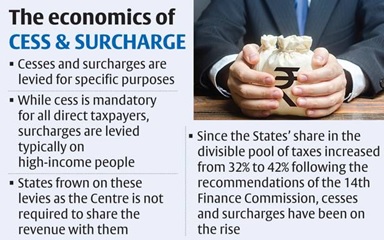
Cess and surcharge are levied for specific purposes. While every
direct taxpayer is required to pay cess, only specified
categories of taxpayers with high incomes are required to pay surcharge. The Centre
is not required to share the earnings from cess and surcharge
with the States.
No share for States
The principle of not sharing is causing great concern for
the States, whose finances have been battered by the pandemic. Thus, at a pre-Budget
consultation with Finance Minister Nirmala Sitharaman
on Monday, at least two States — Tamil Nadu and Telangana — urged the merging of
cess and surcharge with basic tax rates.
Tamil Nadu Deputy Chief Minister and Finance Minister O Paneerselvam said the levy of cesses
and surcharges deprives the States of their legitimate share of the Centre's tax
revenue. “All such cesses and surcharges should be merged
into the basic rate of tax, so that the States also receive their due share from
the additional revenue,” he said.
For similar reasons, Telangana Finance Minister T Harish Rao
asked the Centre to do away with the practice. His suggestion was that the Centre
should increase the rates of taxes where the States can get a better share.
The share of cesses and surcharges
in the revenue mix has been increasing, particularly after the recommendations of
the 14th Finance Commission, which raised the States’ share in the divisible pool
of taxes to 42 per cent from the earlier 32 per cent, observed EY’s Srivastava.
Cesses and surcharges, excluding the GST compensation cess, relative to the Centre’s gross tax revenues, have increased
6.3 percentage points, from 8.9 per cent in FY13 to 15.2 per cent in FY19. Revised
estimates show a further increase to 15.6 per cent in FY20.