Chennai
Customs Denies Duty Free Import from LDC Country due to Third Country Invoicing
Speaking Order for Denial of Duty
Free Tariff Preference for Least Developed countries Scheme notified vide Notification
96/2008 dated 13.08.2008 in accordance with the provisions of Rules of Origin
published vide Notification No. 29/2015-Customs Tariff (Determination of Origin
of Products under the Duty Free Tariff Preference Scheme for Least Developed
Countries) Rules, 2015
[Ref: Chennai Customs F.No. S.Misc. 546/2020-Gr.2 dated
17.11.2020]
The
Chennai based Importer imported Teak Sawn Timber from Togo under duty free
import from LDC countries. The goods were imported from Togo while the purchase
invoice was issued from UAE.
Under
Free Trade Agreement and importing under FTA countries, the provisions of rule
of origin must be compatible. In this case the Customs official denied duty
free rule of origin benefit due to third country invoice.
The
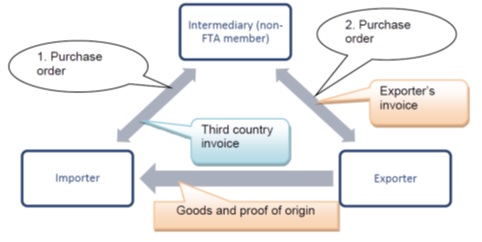
practice of Third country invoice is common in international trade to
involve an intermediary between the importer and the exporter. An extract from
World Customs Organisation (WCO) guidelines is giving
below.
Extract
from WCO Guidelines on Certification of Origin
Third country invoice (intermediary
trade)
It
is a common practice in today’s international trade to involve an intermediary
between the importer and the exporter. This practice must be recognized and the
related procedures must be in place. In trade involving an intermediary
residing in a third country, the invoice issued in the third country (a third
country invoice) would be submitted to the Customs of the importing country to
support the import declaration.
In
the case where third country invoicing is involved, the following guidelines
are provided to ensure the appropriate processing of intermediary trade.
Guideline:
(INTERMEDIARY
TRADE)
8.
Recognizing the current practices of trade, a proof of origin issued in the
country of origin should be accepted in cases where the commercial invoice is
issued in a third country, as long as it is discernible that the goods referred
to in the proof of origin and the invoice corresponds to each other and that
the goods satisfy the applicable rules of origin.
9.
When a declaration of origin is issued by an approved exporter for goods which
are traded via an intermediary business based in a third country, the
declaration of origin should be made out on a commercial document other than an
invoice1 which the approved exporter
issues on his/her own responsibility and which clearly identified the goods it
accompanies.