China Gains $460bn from
Commodity Slump
Picnic Over, Prices Rising Again
China got a $460 billion break
annually during the collapse in commodity costs, so this year’s rally in
everything from oil to iron ore is starting to erode the bonus of cheap
imports.
Rising prices take money from consumers who use
more food, energy and metals than any others in the world. It also increases
inflationary pressure, limiting the scope of the country’s central bank to
stimulate the economy through further monetary easing.
“Any significant upturn in commodity prices such as
oil and gas and iron ore would therefore have a net negative impact on the
Chinese economy,” Rajiv Biswas, Asia-Pacific Chief Economist at IHS Global
Insight, said in an e-mail.
Base metals like zinc and copper are off to their
best start since 2012, crude is set for its biggest monthly gain in almost a
year, and iron ore used to make steel has surged into a bull market after
touching a record low in December. While domestic producers of those raw
materials benefit, China is a net importer, so those gains mean higher costs
and more pressure on profit margins for industries already struggling with
slowing growth.
The following charts illustrate some of the costs
and benefits of the fledgling recovery in commodities for China.

Crude oil’s 35 percent plunge last year saved China
about $320 billion. The rest of the savings came from metals, coal and
agricultural commodities. The country gets about 60 percent of the oil it needs
from overseas. With prices slumping as low as $27 a barrel this year, refiners
have been on a massive buying spree, importing record amounts and filling
strategic stockpiles to an estimated 80 percent of operational capacity.
Prices have rallied more than 40 percent, near $40,
which may reduce China’s overall commodity bonus to about $440 billion on an
annual basis. While that reduction has little impact on the economy, prices
sustained at $55 to $60 would start to generate more serious headwinds, he
said. China would probably slow purchases if oil topped $70.
The rally isn’t all bad for China, partly because
it would increase the value of the inventory stockpiled when prices were lower.
Oil at $40 also helps the cash flow of domestic producers including PetroChina Co. and Cnooc Ltd.,
who have cut production because most need prices at about $50 to break even.
China’s steel mills lost money for most of last
year, even as the cost of iron ore plunged, because of a global glut and
weak demand. Now, iron
ore has surged 21 percent this year, including an unprecedented 19 percent jump
on March 7 to an eight-month high of $63.74 a metric ton. That’s putting more
pressure on an industry already battered by the worst margins since at least
2007. After years of economic expansion, China has more than 400 million tons
of surplus steel capacity.
The degree of pain from more-expensive iron ore
depends on whether steel prices can keep pace. Spot rebar in China has risen
about 18 percent this year, helping lift margins into positive territory for
the first time since May. An improvement in profits may encourage some
shuttered plants to resume output.
Prolonging the life of unprofitable mills is going
to complicate the government’s efforts to restructure the industry by closing
some down, though it would be good news for the 500,000 workers whose jobs are
at risk.
Either way, the recovery will be a boon to domestic
iron-ore mines hurt by a flood of cheap supplies from Australia and Brazil,
provided the rally lasts. Many, from Goldman Sachs Group Inc. to China Iron
& Steel Association, say this year’s price jump is a blip that isn’t
sustainable. According to the median of nine estimates in a Bloomberg survey,
prices will return to $41 in the second quarter.
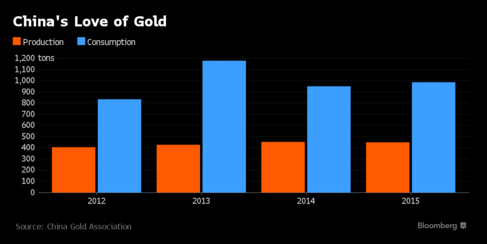
China’s
been buying gold in a big way, including during the precious metal’s three-year
slump through 2015. This year, prices are up 16 percent, touching a 13-month
high of $1,284.64 an ounce on March 11. In July, the central bank disclosed
that it had expanded gold holdings by 57 percent in six years as the nation
sought to diversify its foreign exchange reserves. The People’s Bank of China
has increased its hoard every month since then, and it reached about 1,788 tons
by the end of February. This year’s advance in bullion -- the best performance
of any raw material on the Bloomberg Commodity Index -- has increased the value
of those assets.
Only
about 2 percent of China’s reserves are in gold, compared with 67 percent for
Germany and 73 percent in the U.S., according to data from the World Gold
Council.
Last year,
China was the world’s largest consumer of gold jewelry at 783.5 tons, compared
with 654.3 tons bought by Indians. While the price rebound is going to make
everything from rings to necklaces more expensive, it’s a boon for miners in
what’s also the world’s biggest producing country. Zijin
Mining Group Co. shares have climbed 23 percent this year in Hong Kong after
losing 7.7 percent in 2015.