China's
New Power Structure Tightens Grip on Data, Tech, Finance
· Organizations to oversee China's
financial sector; a CCP-led commission charged with ensuring technological self-reliance;
a national data bureau to promote the country's digital economy; an agency to
engage with the general public; and another agency to administer Hong Kong and
Macao.
· Squeeze from U.S. restrictions on the
supply of advanced computer chips to China. To counter this, CCP will lead a
central science and technology commission.
· Beijing has stepped up oversight of
data collected by tech companies and it has introduced laws on data security
and personal information protection. Now it believes it is sitting on an
economic gold mine.
· The digital economy is a bright spot
for China. The sector's growth rate far exceeds that of the gross domestic
product.
· In 2021, China's digital economy
reached 45.5 trillion yuan ($6.6 trillion), double the size in 2016, according
to the China Academy of Information and Communications Technology, a government
research institute.
· A new National Financial Regulatory
Administration will take over some responsibilities from the banking and
insurance regulator, portending stricter oversight.
· A central financial commission and a
central financial work committee, both of which will be responsible for
strengthening the roles of ideology
State
and CCP overhaul aims to counter U.S., boost economy, curb dissent
If each gigabyte in a zettabyte
were a brick, 1 zettabyte (ZB) would be enough to build 258 Great Walls of
China -- each with nearly 3.9 billion bricks. That is how an analyst at U.S.
networking company Cisco once described the staggering amount of digital data
the world is accumulating.
China, with around 1 billion
internet users and a vast surveillance network, is fast becoming the biggest
part of that "datasphere." One projection by Seagate a few years ago
estimated the nation's annual data generation would reach 48.6 ZB by 2025, or
nearly 28% of the global total.
The Chinese Communist Party
government and President Xi Jinping are now moving to tighten their grip on
that data and capitalize on it economically as part of an overhaul of state and
party institutions that is likely to change the way China operates for the
foreseeable future.
Beijing unveiled its plans
for stronger control over not only data but also technology development,
finance and society as its annual rubber-stamp parliament session finished last
week. Taken together, the reforms appear designed to further concentrate power
in Xi's hands as he begins his third term as president.
Experts say that many of the
moves are an extension of the power consolidation seen since Xi took office in
2012, and that they signal Beijing's priorities in the face of increasing
pressure from U.S. export restrictions, risks to financial stability and
slowing economic growth.
"For Xi and the
Communist Party, this actually is existential," Trey McArver,
co-founder of consultancy Trivium China, said of the changes.
For decades, China's bloated
state institutions had undergone restructuring every five years alongside
changes in the government to bring them up to speed with the modern state and
economy. But under Xi, the reforms have typically granted the CCP more muscle.
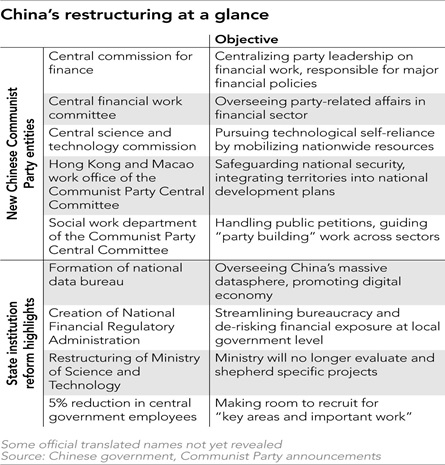
Building upon an earlier
shake-up of party and state agencies in 2018, the latest restructuring includes
a raft of new entities, such as organizations to oversee China's financial
sector; a CCP-led commission charged with ensuring technological self-reliance;
a national data bureau to promote the country's digital economy; an agency to
engage with the general public; and another agency to administer Hong Kong and
Macao.
Xi has repeatedly called for
reducing dependence on foreign tech, clearly feeling the squeeze from U.S.
restrictions on the supply of advanced computer chips to China. To counter
this, the CCP will lead a central science and technology commission.
One expert likened the
initiative to China's quest for nuclear weapons, which made it the first Asian
nation to successfully test an atomic bomb in 1964.
"The formation of the
central science and technology commission means Xi is using the same model as
Mao [Zedong] when China possessed nuclear capabilities in the 1960s," said
Deng Yuwen, former editor of the CCP Central Party
School's journal Study Times. The main idea, he said, is "mobilizing
nationwide resources to achieve breakthroughs."
Meanwhile, the existing
Science and Technology Ministry, which has been overseeing policy and managing
funding, will no longer evaluate and shepherd specific projects after the
restructuring. In addition, some of the ministry's divisions and duties will be
transferred to other government agencies.
Deng, who now lives in the
U.S., explained why this matters.
"From Xi's perspective,
if he doesn't consolidate power, it will be difficult for him to accelerate
projects that he prioritizes," Deng said. "For example, if the [task
of] tech restructuring only stays with the Science and Technology Ministry, the
ministry will have huge difficulties in getting support from other government
agencies."
The growing trove of
zettabytes is seen as another means to gain a global edge.
In recent years, Beijing has
stepped up oversight of data collected by tech companies and it has introduced
laws on data security and personal information protection. Now it believes it
is sitting on an economic gold mine.
"In today's society,
digital resources and the digital economy play a fundamental role in economic
and social development, and are of great significance for ... building new
advantages in the competition between nations," said State Councilor Xiao Jie during the
National People's Congress, adding that the country must strengthen its
management and utilization of data.
There is little doubt that
the digital economy is a bright spot for China. The sector's growth rate far
exceeds that of the gross domestic product.
In 2021, China's digital
economy reached 45.5 trillion yuan ($6.6 trillion), double the size in 2016,
according to the China Academy of Information and Communications Technology, a
government research institute.
It will be up to the new
national data bureau to capitalize on this by coordinating the sharing and
development of the country's ever-swelling stockpile of digital information.
And it is a critical job, as China looks for a new growth engine to compensate
for slower overall investment, consumption and exports.
Questions remain over how it
will work. Before the central bureau was proposed, China saw the creation of
dozens of so-called "big data bureaus" or "big data management centers" at the local government level. It is not
clear how they will be merged or managed once the new entity is formed.
Authorities did say that some staff from the top online watchdog, the
Cyberspace Administration of China, and the key economic planner, the National
Development and Reform Commission, will be shifted to the bureau.
Deng, the former Study Times
editor, said the national data bureau is more of an economic project than a
security one. "That's why the new bureau is under the National Development
and Reform Commission rather than the Cyberspace Administration," he said.
Another economic project that
has caught investors' attention is the centralization of China's financial
regulation. A new National Financial Regulatory Administration will take over
some responsibilities from the banking and insurance regulator, portending
stricter oversight. Some observers view the move as a way to streamline the
bureaucracy and reduce financial risks at the local government level.
Two new party bodies will
also keep an eye on the financial sector -- a central
financial commission and a central financial work committee, both of which will
be responsible for strengthening the roles of ideology and the party in
China's overall financial system.
But many of the changes are
clearly security-minded -- whether it is keeping Hong Kong and Macao under the
party's thumb or checking dissent on the mainland.
Beijing's top office that
oversees Hong Kong will be restructured into a new body that reports directly
to the Communist Party leadership. This marks another phase in the political
transformation the former British colony has experienced since the protests of
2019 and the introduction of a sweeping national security law in mid-2020.
The new entity, referred to
as the Hong Kong and Macao work office of the Communist Party Central
Committee, will give the CCP more direct control over the cities' affairs, as
opposed to the executive State Council. The reform announcement stressed the
committee's mission to "safeguard national security, guarantee people's
livelihoods and well-being, as well as support Hong Kong and Macao to integrate
into the national development plan."
This is where yet another
new institution, the mysterious social work department of the Communist Party's
Central Committee, may come in. The new body will be responsible for dealing
with public petitions, as well as guiding industry associations and
non-state-owned enterprises in "party building" work -- both efforts
to strengthen the ideology of party members through various forms of education.
"The financial overhaul
may help to reduce the financial risks, but whether the CCP can reach its goal
of achieving technology self-reliance via power consolidation, that's another
matter."