China’s
New Export Orders Index at 33.5 – Container Shipping Demand in Free Fall
Global economic activity continues to suffer
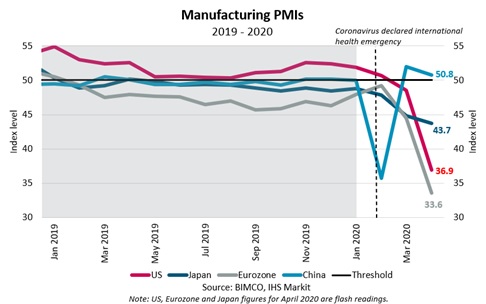
as the coronavirus runs rampant and manufacturing PMI readings for April indicate
a massive weakening of global manufacturing. While flash readings in the US and
Eurozone composites declined to 36.9 and 33.6 index points respectively, the
flash reading in Japan showed surprising resilience, declining only 1.1 points
to 43.7 index points in April. Nonetheless, the readings reveal deep
contraction which will result in choppy seas in the coming months, particularly
for container shipping.
China’s manufacturing PMIs in April
highlighted sluggish recovery from March. The PMI figure from Caixin highlighted a contraction to 49.4 index points,
while the figure from the National Bureau of Statistics China (NBS) showed an
expansion to 50.8 index points.
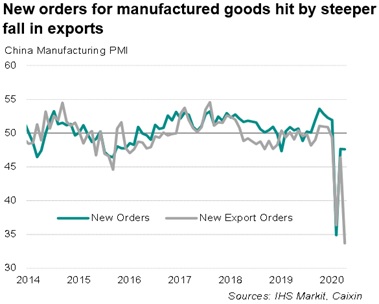
The common denominator between the two was the
New Export Orders sub index (at 33.5 points), which in both cases plummeted
amid slowing demand from the rest of the world.
US retail sales at clothing stores halved in
March
Global manufacturing activity is slowing on
the back of the constrained labour force and
faltering demand, and data from the US Census Bureau highlight how US retail
sales effectively slammed into a brick wall in March 2020. As the US entered a
state of lockdown in March, clothing and clothing accessories stores saw retail
sales drop 50% from February 2020 as well as year-on-year.
Similarly, sales in furniture stores dropped
26.8% from February, while motor vehicle and parts dealers had their sales
slashed by 25.6%, also compared with February. The products and parts sold in
these types of stores constitute a significant fraction of all seaborne containerised goods, and such dramatic drops in US retail
sales are indicative of the calamity that container carriers face.
Manufacturing PMIs slide into unparalleled
contraction
In Japan and the Eurozone, the manufacturing
PMIs have been in contraction since February 2019, while the US remained in
expansion until March 2020. With all the readings now in unprecedented
contractionary territory, and the US and Eurozone seeing the largest declines
on record, dwarfing the impact of the financial crisis, a gloomy path lies
ahead. The slowing new orders domestically, as well as for exports and
diminishing backlogs, amplifies the bleak outlook for the foreseeable future.
While PMI readings could quickly be back above
50 index points, it does not imply a return to pre-crisis conditions, but
rather, a slight improvement from last month’s activity level. It is important
to note that structural damage has already been inflicted on economies around
the world, including massive rises in unemployment which will protract any
recovery to normal conditions.
Container carriers will be stress-tested in
the coming months
Manufacturing PMI readings serve as a
bellwether for container shipping volumes for the months ahead, and recent data
suggest that 2020 will be a stress-test for container carriers, perhaps on an
unprecedented scale.
Idle container ship capacity ticked up when
Chinese lockdowns created export disruptions in February, and idle container
capacity remain around 10% of the total fleet as demand for containerised
goods in advanced economies fade. Supply chain disruptions are on retreat,
which is certainly a positive development, but with slowing consumer demand for
finished goods, seaborne container volumes are set to remain low and outright
decline in 2020.
In recent years, the container shipping
industry has been battling challenging market conditions, squeezing container
carriers’ operating margins. 2019 marked, for a change, a full year of
profitability judged by the average operating margins for main carriers
(source: Alphaliner). Yet, faced with the greatest
economic downturn since the Great Depression during the 1930s, any profits of
recent years could be wiped out in a matter of months.
[Source: Peter Sand, Chief Shipping Analyst,
BIMCO BIMCO]