Covid-19 Antibody Test-It’s Advantage Private Labs
·
With No ICMR Norm, Laboratories are Charging
Arbitrarily
As the number of asymptomatic Covid-19 cases shows a rising
curve, there is an increasing desire among people to know if they have already encountered
the virus without their own knowledge and turned ‘immune’.
Capitalising on this and in the absence of regulations, many private labs
have jumped in to offer testing to detect protective ‘antibodies’ against Covid-19
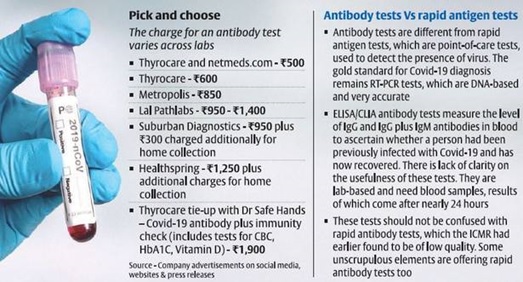
in healthy individuals at rates varying from ₹500 to ₹1,250 per test.
Two weeks ago, India’s apex health research body, the Indian
Council of Medical Research (ICMR), gave the green signal to begin antibody tests
on healthy individuals with no symptoms, to check if they had developed ‘immunity.’
Test not ‘immunity passports’
ICMR’s former head of infectious disease R Gangakhedkar, who played a prominent role in the pandemic response
until he hung up his boots, in an internal presentation, had said that antibody
tests may not be useful as ‘immunity passports’ because there is lack of clarity
on the long-term immune responses of the body to the virus SARS-CoV-2.
But, in a contradicting recommendation, on June 23, the ICMR
stated, ‘‘These tests will help in allaying the fear and
anxiety of health-care workers, office employees.’’ It vaguely mentioned that all
government and private hospitals, offices and public sector units should do the
antibody-based testing. However, it failed to mention the laboratories eligible
to perform the test.
Doctors, however, say that undergoing this test does not mean
much because antibodies develop 7-10 days after the infection has set in. “So, if
I am hiring someone and I need to get him tested on the third day instead of seventh,
the test will be negative. Again, we have very limited scientific information on
how the virus reacts even if antibodies have developed. It is a very hardcore virus.
It survives the winters and summers. So, even if you have developed antibodies,
we currently don't know if it means anything,” said Altaf
Patel, Senior Consultant, Medicine, at Mumbai-based Jaslok
Hospital.
But this has not dissuaded individuals and corporates from
getting the test done for themselves or for their staff. This offers an opportunity
to the labs, which are setting rates arbitrarily, to run the recommended Enzyme
Linked Immunosorbent Assay (ELISA) or Chemiluminescence
Immunoassay (CLIA) test. These tests measure Covid-19-specific antibodies — Immunoglobulin
G and Immunoglobulin M — which indicate that the person undergoing the test may
have been infected but has since recovered.
In the presentation, Gangakhedkar
had also said that the rate per test would be capped at ₹214, though there
has been no official notification to that effect. Pan-India lab chain Thyrocare charges ₹600 for the test, but in a tie up with
netmeds.com, offers it for ₹500. Thyrocare and other
labs use the ErbaLisa kit test supplied by India-based
MNC Transasia, which makes them at the company’s US-based
Calbiotech facility. A Transasia
official told Businessline that the kits were supplied
to labs at ₹180-220.
But Thyrocare founder A Velumani said that at ₹500/₹600, his lab was offering
the cheapest option to individuals. Thyrocare says it
has done over 13,000 antibody tests, 90 per cent of which was at the behest of employers .
Lal Pathlabs charges ₹950
for the total antibody test, and ₹1,400 for the IgG test. “The difference
is because we are sourcing different brand kits for the tests. The input costs vary,”
said a senior Lal Pathlabs official.
Suburban Diagnostics brands its antibody tests as ‘Know if
you have encountered the invisible enemy.’ It prices them at ₹950, and charges
another ₹500 for home collection of blood samples. Healthspring,
according to its press release, is offering these tests across 15 clinics in Mumbai
and Pune for ₹1,250. “It will be beneficial to those individuals who have
been exposed to the virus or if they live in or have recently travelled to a place
where Covid-19 transmission is known to occur,” claims Kaushik Sen, company’s co-founder
and CEO.
Sharing of data
The ICMR has stated that any institution that gets its employees
tested must share its data with the government. Only Thyrocare
has made its data public. Velumani said that of 13,045
samples tested, 950 were positive, which is 7.28 per cent.
“Even if we are hoping to develop ‘herd immunity, this is too low a number for that,”
he said.
The ICMR has also put the onus on the States to devise guidelines
for antibody testing, but there has been no progress. GSK Velu,
founder of Chennai-based Neuberg Diagnostics, said, “Tamil
Nadu has not approved private labs for doing antibody testing. Even across India,
there is confusion about private labs doing the test. There are no testing and pricing
guidelines from State governments, yet. There is also confusion about what should
be done, IgG only or total antibodies.”
“Private labs’ focus is on monetising
their new freedom to conduct antibody testing. This is leading to wide variations
in the rates as labs view maximising profits as a numbers
game,” said Malini Aisola, co-convenor, All India Drug Action Network.