Current World Trade Trends Drop by 1.1
percent Point
·
Agro Shipping, Electronic Components Worst Affected
·
Coronavirus will Worsen Trend
World merchandise trade growth
is likely to remain weak in early 2020, according to the WTO Goods Trade Barometer
released on 17 February. The real-time measure of trade trends now reads 95.5 —
less than the 96.6 recorded last November and well below the index’s baseline
value of 100. This below-trend performance could be reduced further by a new
global health threat.
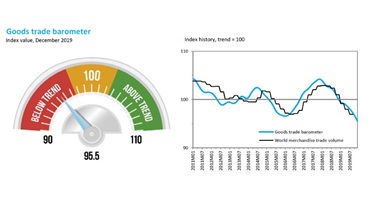
The Goods Trade Barometer provides information on the
current trajectory of world merchandise trade relative to recent trends, based
on best-available forward-looking data. It does not account for recent
developments such as the outbreak of COVID-19, the new coronavirus disease,
which may dampen trade prospects further.
WTO trade statistics show that the volume of world
merchandise trade was down 0.2% in the third quarter of 2019 compared to the
previous year. While the year-on-year growth figures for the fourth quarter may
pick up slightly, the latest barometer reading provides no indication of a
sustained recovery. Indeed, year-on-year trade growth may fall again in the
first quarter of 2020, though official statistics to confirm this will only
become available in June.
The drop in the barometer since November has been driven by
additional declines in indices for container shipping (94.8) and agricultural
raw materials (90.9), as well as the plateauing of the automotive products
index (100.0). Although indices for export orders (98.5), air freight (94.6)
and electronic components (92.8) are all below baseline, they appear to have
stabilized and would normally be expected to rise in the coming months.
However, every component of the Goods Trade Barometer will be influenced by the
economic impact of COVID-19 and the effectiveness of efforts to treat and
contain the disease.
Like its counterpart for services, the Goods Trade Barometer
aims to gauge momentum and identify turning points in global trade growth. As
such, it complements trade statistics and forecasts from the WTO and other
organizations. Readings of 100 indicate growth in line with medium-term trends;
readings greater than 100 suggest above-trend growth, while those below 100
indicate below-trend growth.