EU
Names UAE as Risky Country in Third Country Category under FATF
·
High
risk third countries and the International context
content of anti-money laundering and countering the financing of terrorism
Based
on Directive (EU) 2015/849, Article 9, the Commission is mandated to identify
high-risk third countries having strategic deficiencies in their regime on
anti-money laundering and countering the financing of terrorism.
One of the pillars of the
European Union's legislation to combat money laundering and countering the
financing of terrorism is Directive (EU) 2015/849. According to this Directive,
banks and other gatekeepers are required to apply enhanced vigilance in
business relationships and transactions involving high-risk third countries.
The types of enhanced vigilance requirements are basically extra checks and
control measures which are defined in article 18a of the Directive.
New delegated act on high-risk third
countries
On 19 December 2022, the
European Commission adopted a new Delegated Regulation in relation to third
countries which have strategic deficiencies in their AML/CFT regimes that pose
significant threats to the financial system of the Union ('high-risk third countries').
Identification of such countries is a legal requirement stemming from Article 9
of Directive (EU) 2015/849 (4th anti-money laundering Directive and aiming at
protecting the Union financial system and the proper functioning of the
internal market. The Delegated Regulation amends
Delegated Regulation (EU) 2016/1675.
The following jurisdictions are identified as having
strategic deficiencies in their AML/CFT regimes:
|
High-risk
third country |
Date
of entry into force |
|
Afghanistan |
23
September 2016 |
|
Barbados |
1
October 2020 |
|
Burkina
Faso |
13
March 2022 |
|
Cambodia |
1
October 2020 |
|
Cayman
Islands |
13
March 2022 |
|
Democratic
Republic of the Congo |
16
March 2023 |
|
Democratic
People's Republic of Korea (DPRK) |
23
September 2016 |
|
Gibraltar |
16
March 2023 |
|
Haiti |
13
March 2022 |
|
Iran |
23
September 2016 |
|
Jamaica |
1
October 2020 |
|
Jordan |
13
March 2022 |
|
Mali |
13
March 2022 |
|
Morocco |
13
March 2022 |
|
Mozambique |
16
March 2023 |
|
Myanmar |
1
October 2020 |
|
Panama |
1
October 2020 |
|
Philippines |
13
March 2022 |
|
Senegal |
13
March 2022 |
|
South
Sudan |
13
March 2022 |
|
Syria |
23
September 2016 |
|
Tanzania |
16
March 2023 |
|
Trinidad
and Tobago |
6
March 2018 |
|
Uganda |
23
September 2016 |
|
United
Arab Emirates |
16
March 2023 |
|
Vanuatu |
23
September 2016 |
|
Yemen |
23
September 2016 |
Revised EU methodology for the identification
of high-risk third countries
The Commission has also
published a revised methodology for the identification of high-risk third
countries This methodology ensures that a robust, objective and transparent
process is applied. The objective is to identify jurisdictions which have
strategic deficiencies in their national AML/CFT regimes which pose significant
threats to the financial system of the Union and hence the proper functioning
of the internal market. Once identified, the Commission adopts delegated acts
listing these jurisdictions.
This methodology was based
following the adoption of a Roadmap.
The methodology describes
the main steps, assessment criteria and follow-up.
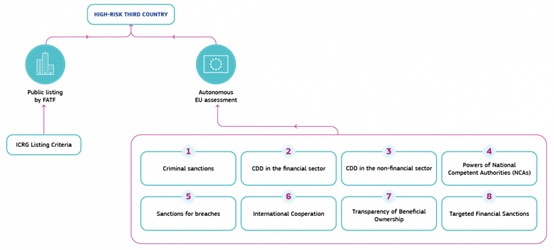
The methodology provides
that the Commission will consider FATF lists as a starting point and complement
this by an autonomous assessment of additional countries using the following
approach:
·
identify the risk profile and the level of
threat to which the country is exposed
·
assess the legal framework and its effective
application in 8 key areas – by analysing the countries measures on
1.
criminalisation of money laundering and
countering the financing of terrorism
2.
customer due diligence requirements, record
keeping and reporting of suspicious transactions in the financial sector
3.
the same requirements in the non-financial
sector
4.
the existence of dissuasive, proportionate
and effective sanctions in case of breaches
5.
the powers and procedures of competent
authorities
6.
their practice in international cooperation
7.
the availability and exchange of information
on beneficial ownership of legal persons and legal arrangements
8.
implementation of targeted financial
sanctions.
The methodology was revised
to ensure an increased engagement with third countries by
1.
consulting third countries on preliminary
findings
2.
drafting country-specific “EU benchmarks” to
address each country’s concerns (identified on a preliminary basis) in relation
to the criteria set by the Anti-Money Laundering Directive
3.
seeking third countries’ commitment to
implement specific corrective measures before a listing is considered.
4.
A deadline of 12 months would be given to
third countries taking commitments to address concerns.
A listing occurs in case
jurisdictions are not cooperative (i.e. refusing to
express a commitment) or jurisdictions fail to implement the benchmarks within
the agreed period. In case there is an overriding level of risk that needs to
be mitigated and emergency situations, the Commission reserves the possibility
to proceed immediately with identifying strategic deficiencies on the basis of
the anti-money laundering Directive.
Here is an overview of the
engagement approach with third countries based on an autonomous assessment.
Step-by-step implementation of the
methodology
The following timeline
displays the implementation of the methodology to identify high-risk third
countries.
2017 - Stage 1: Designing Phase
o
Preparation of a new methodology
o
International engagement
o
Engagement with the European Parliament and
the Member States
22 June 2018 - Adoption of
the first methodology for identifying high risk third countries
2018 - Stage 2: Initial
scoping/selection phase
o
Pre-assessment of all third countries based
on economic and socio-political criteria
o
Identification of Priority 1 (to be assessed
by end of 2018) and Priority 2 (to be assessed progressively by 2025) countries
o
Publication of results of selection phase on
13 November 2018
31 December 2018 - Stage 3:
Assessment Phase – Priority 1 countries
o
Assessment of countries that have been
identified as Priority 1 countries based on listing criteria using various
information sources
13 February 2019 - Adoption
of new EU Delegated Act on high-risk third countries (based on first methodology)
- rejected
7 May 2020
o
Adoption of new EU delegated act on high-risk
third countries
o
Publication of revised EU methodology for the
identification of high-risk third countries
31 December 2025
Stage 4: Assessment Phase –
Priority 2 countries and follow up
o
Gradual assessment of remaining countries
o
Follow-up of countries listed following stage
3
o
Monitoring of reviewed countries
Objectives of the list on
high-risk third countries
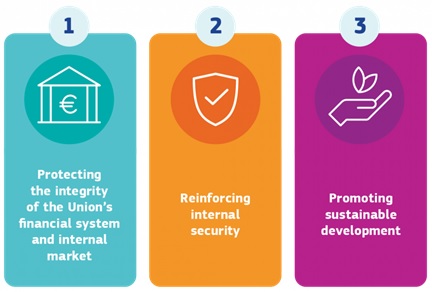
The objectives of the list
can be subdivided into three principle goals:
The listing process
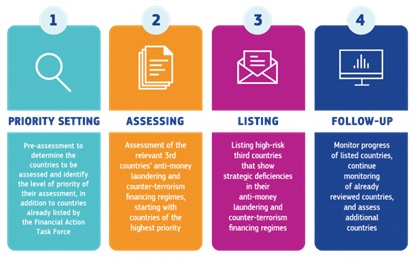
The listing process follows a staged approach that can be
divided into four parts:
Planning of assessment
The Commission carried out a
pre-assessment to determine relevant countries to be assessed and the level of
priority, in addition to those already listed by the Financial Action Task
Force. Countries are considered relevant for the EU financial system in case
they meet any of the following non-cumulative criteria:
·
a country is identified by the European
External Action Service or by Europol as having a systemic impact on the
integrity of the EU financial system
·
a country was reviewed as an international offshore financial centres by the
International Monetary Fund
·
a country is considered as economically
relevant based on the strength of the economic ties with the EU and the
magnitude of its financial sector
On this basis, the
Commission identified 132 jurisdictions so far that will be further analyzed according to its methodology over the period
2018-2025. The list of 132 countries included in the scope.
With regard to the level of
priority:
·
the Commission reviews as a matter of
priority a first group of 54 jurisdiction (Priority 1 countries). The
assessment is an ongoing exercise; hence any country will be reassessed when
new relevant information sources become available
·
the other jurisdictions (Priority 2
countries) will be assessed successively until 2025
Evolution of the EU list on
high-risk third countries
Based on Directive (EU)
2015/849 and the Commission’s power of adopting delegated acts regarding
high-risk third countries, the Commission adopted the following delegated acts:
24 February 2023
Publication of Commission
Delegated Regulation (EU) 2023/410 amending the EU list.
21 February 2022
Publication of Commission
Delegated Regulation (EU) 2022/229 amending the EU list.
7 December 2020
Publication of Delegated
Regulation (EU) 2021/37 amending the EU list.
7 May 2020
o
Revised methodology for identifying high risk
third countries
o
FATF lists as a baseline/ and increased
synergies with FATF listing process
o
additional countries based on EU own
assessment based on increased engagement
o
Enhanced consultation of Member States’
experts
Publication of Delegated
Regulation (EU) amending the EU list
27 July 2018
Publication of the Delegated
Regulation (EU) 2018/1467 amending the EU list.
22 June 2018
First methodology for
identifying high risk third countries
o
FATF lists as a baseline
o
additional countries based on EU own
assessment
13 December 2017
Publication of Delegated
Regulation (EU) 2018/212 amending the EU list.
27 October 2017
Publication of Delegated
Regulation (EU) 2018/105 amending the EU list.
14 July 2016
First EU list – based on
FATF lists (Delegated Regulation (EU) 1675/2016).