Eight Out of
Twenty Major Countries in the World are not in Lockdown
The world economy will go into recession this
year with a predicted loss of trillions of dollars of global income due to the coronavirus
pandemic, spelling serious trouble for developing countries with the likely
exception of India and China, according to a latest UN trade report.
With two-thirds of the world’s population
living in developing countries facing unprecedented economic damage from the
COVID-19 crisis, the UN is calling for a USD 2.5 trillion rescue package for
these nations.
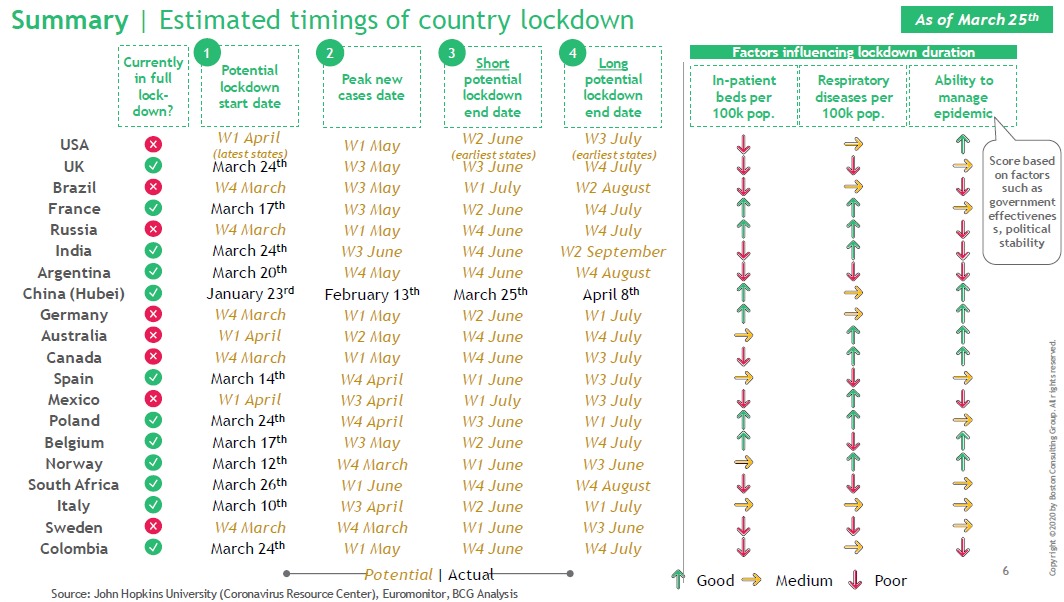
India may not lift coronavirus lockdown before September, study
says
India will begin lifting COVID-19 lockdown
restrictions only between the fourth week of June and the second week of
September, says a new study.
The “longer range” of lifting the restrictions
was a result of expected challenges in India due to health system preparedness
and record of public policy effectiveness, said the study by Boston Consulting
Group (BCG).
The government announced a lockdown on March 24,
joining other countries such as the UK, Poland, Colombia to impose curbs on
movement and business activities.
The report by BCG, an American consultancy firm,
is centred on epidemic projection on COVID-19. This
report represents estimates as of March 25, based on a predictive modelling
leveraging John Hopkins University data with full modelling constraints.
The report shines a light on country-wise
epidemic scenarios:
The report provides estimated key dates of
COVID-19 crisis on the following parameters:
- Status of the countries whether it is fully
lockdown or not?
- Potential lockdown start dates
- The peak dates for respective countries.
- Short and long potential lockdown end date.
The BCG data suggests that the India lockdown
started in line with China's timing of the lockdown.
According to the new analysis from United
Nations Conference on Trade and Development (UNCTAD), the UN trade and
development body titled ‘The COVID-19 Shock to Developing Countries: Towards a
‘whatever it takes’ programme for the two-thirds of
the world’s population being left behind’, commodity-rich exporting countries
will face a USD 2 trillion to $3 trillion drop in investments from overseas in
the next two years.
The UNCTAD said that in recent days, advanced
economies and China have put together massive government packages which,
according to the Group of 20 leading economies (G20), will extend a $5 trillion
lifeline to their economies.
“This represents an unprecedented response to
an unprecedented crisis, which will attenuate the extent of the shock
physically, economically and psychologically,” it said.
It added that while the full details of these
stimulus packages are yet to be unpacked, an initial assessment by the UNCTAD
estimates that they will translate to a $1 trillion to $2 trillion injection of
demand into the major G20 economies and a two percentage point turnaround in
global output.
“Even so, the world economy will go into
recession this year with a predicted loss of global income in trillions of dollars.
This will spell serious trouble for developing countries, with the likely
exception of China and the possible exception of India,” the UNCTAD said.
The report, however, did not give a detailed
explanation as to why and how India and China will be the exceptions as the
world faces a recession and loss in global income that will impact developing
countries.
Further, given the deteriorating global
conditions, fiscal and foreign exchange constraints are bound to tighten
further over the course of the year.
The UNCTAD estimates a $2 trillion to $3
trillion financing gap facing developing countries over the next two years.
In the face of a looming financial tsunami this
year, the UNCTAD proposes a four-pronged strategy that could begin to translate
expressions of international solidarity into concrete action.
This includes a $1 trillion liquidity injection
for those being left behind through reallocating existing special drawing
rights at the International Monetary Fund; a debt jubilee for distressed
economies under which another one trillion dollars of debts owed by developing
countries should be cancelled this year and a 500 billion dollars Marshall Plan
for a health recovery funded from some of the missing official development
assistance (ODA) long promised but not delivered by development partners.
The speed at which the economic shockwaves from
the pandemic has hit developing countries is dramatic, even in comparison to
the 2008 global financial crisis, the UNCTAD said.
“The economic fallout from the shock is ongoing
and increasingly difficult to predict, but there are clear indications that
things will get much worse for developing economies before they get better,”
UNCTAD secretary-general Mukhisa Kituyi
said.
The report shows that in two months since the virus
began spreading beyond China, developing countries have taken an enormous hit
in terms of capital outflows, growing bond spreads, currency depreciations and
lost export earnings, including from falling commodity prices and declining
tourist revenues.
Lacking the monetary, fiscal and administrative
capacity to respond to this crisis, the consequences of a combined health
pandemic and a global recession will be catastrophic for many developing
countries and halt their progress towards the Sustainable Development Goals.
Even as advanced economies are discovering the
challenges of dealing with a growing informal workforce, this remains the norm
for developing countries, amplifying their difficulties in responding to the
crisis.
“Advanced economies have promised to do
‘whatever it takes’ to stop their firms and households from taking a heavy loss
of income,” said Richard Kozul-Wright, UNCTAD’s
director of globalisation and development strategies.
He added: “But if G20 leaders are to stick to
their commitment of ‘a global response in the spirit of solidarity’, there must
be commensurate action for the six billion people living outside the core G20
economies”.
According to reports, the death toll from the
coronavirus pandemic has soared past 35,000 while the number of confirmed cases
topped 750,000 globally.