Electronics and Automotive Products Lift
Global Merchandise Trade in Q3, Services Lag Behind
The third quarter of 2020 saw a partial recovery of world trade
in manufactured goods, led by electronics, textiles and automotive products, as
production resumed and lockdown measures were eased in major economies, new WTO
statistics show. However, despite substantial improvement in recent months, merchandise
trade is still well below 2019 levels, and preliminary estimates suggest services
trade remains severely depressed.
Trade
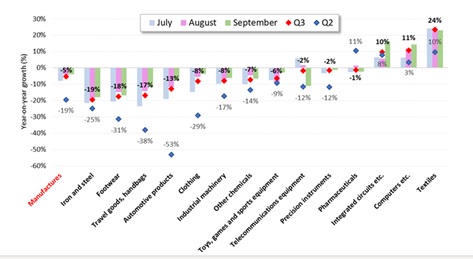
in manufactured goods was down 5% year-on-year in the quarter from July to September,
much closer to pre-pandemic trade levels than the second quarter's 19% shortfall.
Computers and electronic components saw double-digit trade growth, as did shipments
of textiles, which were boosted by demand for face masks.
Source: WTO estimates.
Trade
in automotive products, representing 11% of manufactured goods trade worldwide,
accelerated in the third quarter as manufacturers ramped up production to meet pent-up
consumer demand. Trade in automotive products was down 19% year-on-year in July,
but only 8% lower in September. For the whole of the third quarter, shipments in
the sector were down 13% compared to last year. This represents a substantial improvement
over the second quarter, when trade in automotive products was down 53% year-on-year
due to both supply disruptions and plunging demand in the early stages of the pandemic.
Clothing
trade also showed signs of resilience in the third quarter, with shipments down
just 4% year-on-year in September as imports picked up in North America and Europe.
In comparison, trade in July was down 15% compared to the same month in 2019. Trade
in toys, games, sporting equipment and travel/luxury goods also recovered over the
course of the third quarter, although they too remain below pre-pandemic levels.
The recovery in footwear trade, however, appears to have stalled.
Trade
in telecommunications equipment, which includes smart phones, improved year-on-year
in the third quarter compared to the previous quarter, but surprisingly fell by
11% in September compared to the same month in 2019, as Chinese exports declined
by 13%. This development may suggest a saturation of the market. In contrast, trade
in computers and electronic components, which had already recorded positive growth
in the second quarter, accelerated in the third quarter by 11% and 10%, respectively.
After
growing at an average rate of 10% in the first half of the year, trade in pharmaceutical
products contracted by 1% in the third quarter. This appears to indicate an end
to stockpiling, particularly in Europe, where COVID-19 cases dropped significantly
over the summer.
Trade
in personal protective equipment (PPE) — not shown in the chart — continued to grow
rapidly, rising by 63% in the third quarter compared to the year before, with trade
in face masks, largely fabric masks, up 102%. In the first nine months of 2020,
nearly 60% of face masks were supplied by China.
Total
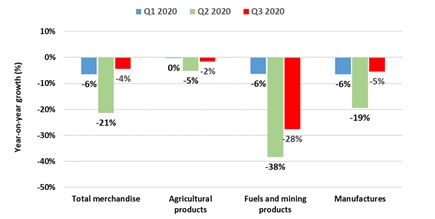
merchandise trade — which includes fuel and agricultural products as well as manufactured
products — in the period from January to September was down 11% year-on-year. Trade
in manufactured goods, for which prices are less volatile than commodities, contracted
by 10% on average in the first nine months of 2020. The value of trade in fuels
and mining products saw sharp declines in the third quarter due to falling prices,
while trade in agricultural products remained resilient due to sustained demand
for food during the pandemic.
Source:
WTO estimates.
These
figures are broadly consistent with the WTO's most recent trade forecast of 6 October,
which projected a 9.2% decline in the volume of world merchandise trade in 2020.
In particular, the forecast predicted a rebound in trade volumes in the third quarter
following a precipitous decline in the second quarter.
Trade in services
By contrast,
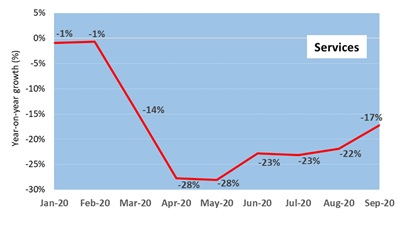
services trade remained depressed, down 17% year-on-year in September after registering
declines of 23% in July and 22% in August compared to the same months in the previous
year. These estimates are based on preliminary statistics of 39 economies representing
more than two-thirds of global services trade. Figures for the third quarter, which
will cover a larger pool of economies, are expected to be released in late January.
Although
the fall in services trade appears to have bottomed out as travel restrictions on
intra-European travel were lifted over the summer, most economies continued to record
sharp declines. In September, services exports from the United States were 27% below
pre-pandemic levels, while China's services imports were down by 18% year-on-year.
The resurgence of COVID-19 in the autumn has put recovery on hold. By contrast,
the availability of a vaccine and its manufacturing, transport and distribution
will contribute to the recovery of services trade in 2021, both directly and by
facilitating travel.
Source: WTO estimates.
The latest
statistics, which include regional breakdowns, are presented
here. More
of the short-term trade statistics, including new detail for monthly services statistics
are available in the WTO Data Portal.