For home-grown 5G, RJio bets on free
platform Open RAN
Cuts
cost, frees firm from dependence on vendors
Mukesh Ambani’s plans to build
home-grown 5G network solution is based on an open source telecom platform
called Open RAN. This network platform, similar to how open source software
became a game changer in the 1990s, attempts to build telecom radio and base
stations using non-proprietary technology. It will help bring down costs
drastically compared to buying proprietary gear from the likes of Nokia and
Ericsson.
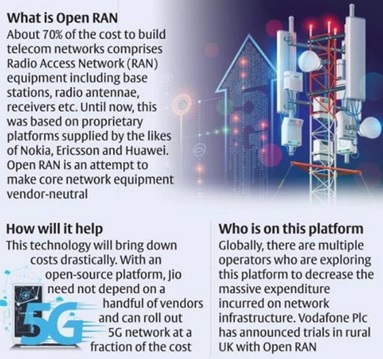
About 70 per cent of the cost to build telecom networks
comes from buying Radio Access Network (RAN) equipment, including base
stations, radio antennae, receivers. Until now, this was based on proprietary
software and hardware supplied as an end-to-end solution by the likes of Nokia,
Ericsson, and Huawei. Open RAN (O-Ran) attempts to make core network equipment
vendor-neutral with disaggregation of hardware and software functions built on
general purpose processors. This avoids vendor lock-in and minimises
payment of royalty towards Standard Essential Patents.
According to industry sources, Jio
has been quietly working on the open source platform for at least two years. “Jio has had multiple teams on this project for two years at
least. Its acquisition of Bengaluru-based Radisys in
2018 was part of this plan,” said an industry source.
With an open-source platform, Jio
need not depend on a handful of vendors and can roll out 5G network at a
fraction of the cost.
But there are concerns over integrating open source
network with all the devices and legacy proprietary networks.
‘Can take 3 years’
CS Rao, former President and CEO of Lucent India, and
Chairman, Quadgen Wireless, said, “It will take at
least 3 years for open RAN-based network solutions to become a reality. Of
course, Jio has the financial power and right global
partnerships to invest in developing a ‘Made-in-India’ RAN product, but there
are multiple issues that need to be addressed. For example, the RAN Network
Element (NE) will have to be tested for 4G and 5G air interface 3GPP standards
compatibility with multiple user equipment devices for seamless user experience
of enhanced mobile broadband and for IoT devices .”
4G integration, ‘a
challenge’
Sanchit Vir Gogia,
Founder & CEO, Greyhound Research, said, “ Integration
with the existing 4G network will be a big challenge for any operator. You
cannot run 5G in isolation even if you want to use it for IoT
or machine-to-machine communication. Because at the end of the day, you would
want to connect your car to the owner’s phone or a factory machinery to the
factory manager. All this needs integration and testing. So I expect 3-5 years
before we can have a fully workable open RAN based 5G network. It has potential
in the future but we are not there yet to make it viable.” However, given Jio has support from global partners, including Qualcomm,
it may be able to overcome these challenges.
Radio frequency issue
“A substantial part of 5G network is going to be
software, so this can be done in India by Jio. The
hardware part is what could be challenging but even this can be done using
O-RAN. One of the issues could be the lack of clarity on which radio frequency
India will operate 5G. We are thinking about 3.4 GHz now, but what if we see
higher frequencies being opened up later.
“So Jio will have to ensure
that they build antennas and radio access network that are compatible with any
new radio frequencies bands that emerge. Since O-RAN uses modular technologies,
it can be integrated with the existing backhaul and 4G access network
infrastructure,” said V Sridhar, Professor, International Institute of
Information Technology.
‘It’s doable’
TV Ramachandran, President, Broadband India Forum said,
“I believe that Jio can make this a reality. There is
lot of work being done in this space already. Many operators in Europe and the
US are also looking at this open platform. I know of start-ups in India that
are building 5G solutions using open RAN systems. A large player such as Jio, betting on Open RAN, can speed up the development
work. But at the same time, traditional vendors such as Nokia and Ericsson will
continue to be important and relevant as they have invested billions into
R&D.”