Foreign Trade Policy 2023 Announced
·
FTP 2023 is a
dynamic and open ended Policy that will accommodate
the emerging needs
·
PM Modi has
given the vision to increase exports manifold
·
FTP seeks to
take India's exports to 2 trillion dollars by 2030
·
4 pillars of
FTP 2023: Incentive to Remission, Export promotion through collaboration, Ease
of doing business and Emerging Areas
Ø Process
Re-Engineering and Automation
Ø Towns of
Export Excellence
Ø Recognition of
Exporters
Ø Promoting
export from the districts
Ø Streamlining
SCOMET Policy
Ø Facilitating
E-Commerce Exports
Ø Facilitation
under Export Promotion of Capital Goods (EPCG) Scheme
Ø Facilitation
under Advance authorization Scheme
Ø Merchanting
trade
Ø Amnesty Scheme
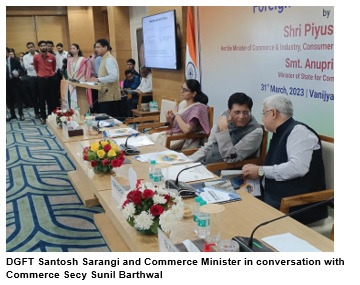 Union Minister
of Commerce and Industry, Consumer Affairs, Food and Public Distribution and
Textiles, Shri Piyush Goyal today launched the Foreign Trade Policy 2023 saying
that it is dynamic and has been kept open ended to accommodate the emerging
needs of the time. He stated that the policy had been under discussion for a
long time and has been formulated after multiple stakeholder consultations.
India's overall exports, including services and merchandise exports, has
already crossed US$ 750 Billion and is expected to cross US$ 760 Billion this
year, he said.
Union Minister
of Commerce and Industry, Consumer Affairs, Food and Public Distribution and
Textiles, Shri Piyush Goyal today launched the Foreign Trade Policy 2023 saying
that it is dynamic and has been kept open ended to accommodate the emerging
needs of the time. He stated that the policy had been under discussion for a
long time and has been formulated after multiple stakeholder consultations.
India's overall exports, including services and merchandise exports, has
already crossed US$ 750 Billion and is expected to cross US$ 760 Billion this
year, he said.
The Minister
referred to the interaction that Prime Minister, Shri Narendra Modi with the exporters
on 06th August, 2021 and encouraged them to increase exports and get more
deeply involved in the global value chain. He lauded the vision and guidance of
the Prime Minister who believed that given the size of the Indian economy and
manufacturing & service sector base, the potential for the country to grow
is manifold. He said that this vision is at the core of the policy.
The Minister
noted that the remarkable achievement in the overall export figure of crossing
US$ 760 Billion in these challenging times across the world has been the result
of enthusiasm and encouragement pumped in by the Prime Minister. He said that
this achievement is in sync with the target set in the roadmap in 2021 after
the interaction with the Prime Minister.
He stressed
that every opportunity for export must be captured and utilised effectively. He
also mentioned that in the next 5 months during India’s G20 presidency there
should be a massive concentrated outreach with the world both sector-wise and
country-wise.
The release of
the policy was also attended by Union Minister of State for Commerce &
Industry, Smt. Anupriya Patel, Commerce Secretary,
Shri Sunil Barthwal and Member Customs, Central Board
of Indirect Taxes and Customs, Shri Rajiv Talwar. Director General of Foreign
Trade, Shri Santosh Kumar Sarangi gave a detailed presentation on the policy.
The Key
Approach to the policy is based on these 4 pillars: (i)
Incentive to Remission, (ii) Export promotion through collaboration -
Exporters, States, Districts, Indian Missions, (iii) Ease of doing business,
reduction in transaction cost and e-initiatives and (iv) Emerging Areas –
E-Commerce Developing Districts as Export Hubs and streamlining SCOMET policy.
Foreign Trade
Policy (2023) is a policy document which is based on continuity of time-tested
schemes facilitating exports as well as a document which is nimble and
responsive to the requirements of trade. It is based on principles of ‘trust’
and ‘partnership’ with exporters. In the FTP 2015-20, changes were done subsequent
to the initial release even without announcement of a new FTP responding
dynamically to the emerging situations. Hereafter, the revisions of the FTP
shall be done as and when required. Incorporating feedback from Trade and
Industry would also be continuous to streamline processes and update FTP, from
time to time.
The FTP 2023
aims at process re-engineering and automation to facilitate ease of doing
business for exporters. It also focuses on emerging areas like dual use high
end technology items under SCOMET, facilitating e-commerce export,
collaborating with States and Districts for export promotion.
The new FTP is
introducing a one-time Amnesty Scheme for exporters to close the old pending
authorizations and start afresh.
The FTP 2023
encourages recognition of new towns through “Towns of Export Excellence Scheme”
and exporters through “Status Holder Scheme”. The FTP 2023 is facilitating
exports by streamlining the popular Advance Authorization and EPCG schemes, and
enabling merchanting trade from India.
Process
Re-Engineering and Automation
Greater faith
is being reposed on exporters through automated IT systems with risk management
system for various approvals in the new FTP. The policy emphasizes export
promotion and development, moving away from an incentive regime to a regime
which is facilitating, based on technology interface and principles of
collaboration. Considering the effectiveness of some of the ongoing schemes
like Advance Authorisation, EPCG etc. under FTP 2015-20, they will be continued
along with substantial process re-engineering and technology enablement for
facilitating the exporters. FTP 2023 codifies implementation mechanisms in a
paperless, online environment, building on earlier 'ease of doing business'
initiatives. Reduction in fee structures and IT-based schemes will make it
easier for MSMEs and others to access export benefits.
Duty exemption
schemes for export production will now be implemented through Regional Offices
in a rule-based IT system environment, eliminating the need for manual
interface. During the FY23-24, all processes under the Advance and EPCG
Schemes, including issue, re-validation, and EO extension, will be covered in a
phased manner. Cases identified under risk management framework will be
scrutinized manually, while majority of the applicants are expected to be
covered under the 'automatic' route initially.
Towns of
Export Excellence
Four new
towns, namely Faridabad, Mirzapur, Moradabad, and Varanasi, have been
designated as Towns of Export Excellence (TEE) in addition to the existing 39
towns. The TEEs will have priority access to export promotion funds under the
MAI scheme and will be able to avail Common Service Provider (CSP) benefits for
export fulfillment under the EPCG Scheme. This
addition is expected to boost the exports of handlooms, handicrafts, and
carpets.
Recognition of
Exporters
Exporter firms
recognized with 'status' based on export performance will now be partners in
capacity-building initiatives on a best-endeavor
basis. Similar to the 'each one teach one' initiative,
2-star and above status holders would be encouraged to provide trade-related
training based on a model curriculum to interested individuals. This will help
India build a skilled manpower pool capable of servicing a $5 Trillion economy
before 2030. Status recognition norms have been re-calibrated to enable more
exporting firms to achieve 4 and 5-star ratings, leading to better branding opportunities
in export markets.
Promoting
export from the districts
The FTP aims
at building partnerships with State governments and taking forward the
Districts as Export Hubs (DEH) initiative to promote exports at the district
level and accelerate the development of grassroots trade ecosystem. Efforts to
identify export worthy products & services and resolve concerns at the
district level will be madethrough an institutional
mechanism – State Export Promotion Committee and District Export Promotion
Committee at the State and District level, respectively.District specific export action plans to
be prepared for each district outlining the district specific strategy to
promote export of identified products and services.
Streamlining
SCOMET Policy
India is
placing more emphasis on the "export control" regime as its
integration with export control regime countries strengthens. There is a wider
outreach and understanding of SCOMET (Special Chemicals, Organisms, Materials,
Equipment and Technologies) among stakeholders, and the policy regime is being
made more robust to implement international treaties and agreements entered
into by India.A robust export control system in India
would provide access of dual-use High end goods and technologies to Indian
exporters while facilitating exports of controlled items/technologies under
SCOMET from India.
Facilitating
E-Commerce Exports
E-commerce
exports are a promising category that requires distinct policy interventions
from traditional offline trade. Various estimates suggest e-commerce export
potential in the range of $200 to $300 billion by 2030. FTP 2023 outlines the
intent and roadmap for establishing e-commerce hubs and related elements such
as payment reconciliation, book-keeping, returns policy, and export entitlements.
As a starting point, the consignment wise cap on E-Commerce exports through
courier has been raised from ₹5Lakh to ₹10 Lakh in the FTP 2023.
Depending on the feedback of exporters, this cap will be further revised or
eventually removed.Integration
of Courier and Postal exports with ICEGATE will enable exporters to claim
benefits under FTP. The comprehensive e-commerce policy addressing the
export/import ecosystem would be elaborated soon, based on the recommendations
of the working committee on e-commerce exports and inter-ministerial deliberations.Extensive outreach
and training activities will be taken up to build capacity of artisans,
weavers, garment manufacturers, gems and jewellery designers to onboard them on
E-Commerce platforms and facilitate higher exports.
Facilitation
under Export Promotion of Capital Goods (EPCG) Scheme
The EPCG
Scheme, which allows import of capital goods at zero Customs duty for export
production, is being further rationalized. Some key changes being added are:
·
Prime Minister Mega Integrated Textile Region and
Apparel Parks (PM MITRA) scheme has been added as an additional scheme eligible
to claim benefits under CSP(Common Service Provider)
Scheme of Export Promotion capital Goods Scheme(EPCG).
·
Dairy sector to be exempted from maintaining
Average Export Obligation – to support dairy sector to upgrade the technology.
·
Battery Electric Vehicles (BEV) of all types,
Vertical Farming equipment, Wastewater Treatment and Recycling, Rainwater
harvesting system and Rainwater Filters, and Green Hydrogen are added to Green
Technology products – will now be eligible for reduced Export Obligation
requirement under EPCG Scheme
Facilitation
under Advance authorization Scheme
Advance
authorisation Scheme accessed by DTA units provides duty-free import of raw
materials for manufacturing export items and is placed at a similar footing to
EOU and SEZ Scheme. However, the DTA unit has the flexibility to work both for
domestic as well as export production. Based on interactions with industry and
Export Promotion councils, certain facilitation provisions have been added in
the present FTP such as
·
Special Advance Authorisation Scheme extended to
export of Apparel and Clothing sector under para 4.07 of HBP on self-declaration
basis to facilitate prompt execution of export orders – Norms would be fixed
within fixed timeframe.
·
Benefits of Self-Ratification Scheme for fixation
of Input-Output Norms extended to 2 star and above status holders in addition
to Authorised Economic Operators at present.
Merchanting
trade
To develop
India into a merchanting trade hub, the FTP 2023 has introduced provisions for
merchanting trade. Merchanting trade of restricted and prohibited items under
export policy would now be possible. Merchanting trade involves shipment of
goods from one foreign country to another foreign country without touching
Indian ports, involving an Indian intermediary. This will be subject to
compliance with RBI guidelines, andwon’t be
applicable for goods/items classified in the CITES and SCOMET list. In course
of time, this will allow Indian entrepreneurs to convert certain places like
GIFT city etc. into major merchanting hubs as seen in places like Dubai,
Singapore and Hong Kong.
Amnesty Scheme
Finally, the
government is strongly committed to reducing litigation and fostering
trust-based relationships to help alleviate the issues faced by exporters. In
line with "Vivaad se Vishwaas" initiative, which sought to settle tax
disputes amicably, the governmentis introducing a special
one-time Amnesty Scheme under the FTP 2023to address default on Export
Obligations. This scheme is intended to provide relief to exporters who have
been unable to meet their obligations under EPCG and Advance Authorizations,
and who are burdened by high duty and interest costs associated with pending cases.All pending cases of the default in meeting Export
Obligation (EO) of authorizations mentioned can be regularized on payment of
all customs duties that were exempted in proportion to unfulfilled Export Obligation.The interest payable is capped at 100% of these
exempted duties under this scheme. However, no interest is payable on the
portion of Additional Customs Duty and Special Additional Customs Duty and this
is likely to provide relief to exporters as interest burden will come down substantially.It is hoped that
this amnesty will give these exporters a fresh start and an opportunity to come
into compliance.