GDP Contraction
less Sharp at 7.5% in Q2, but Economy in Recession
Agriculture sector in rescue act, again; CEA cautiously
optimistic on full year growth
The
contraction in the Gross Domestic Production slowed to 7.5 per cent in the
July-September period even as the economy technically slipped into recession
with two consecutive quarters of contraction in the current fiscal.
The
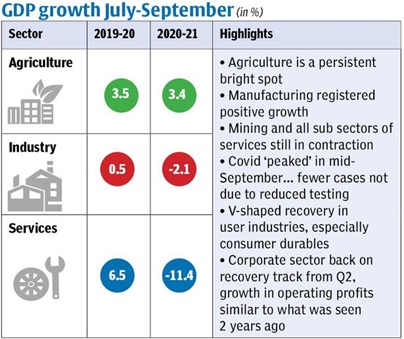
GDP contraction of 7.5 per cent in July-September compares with a growth of 4.4
per cent in the same quarter last year. But the economy made a significant
climb back from the 23.9 per cent contraction during the first, April-June,
quarter of this fiscal.
It
was once again agriculture sector to the rescue, clocking a growth of 3.4 per
cent at constant prices in the quarter, according to data released by the
National Statistical Office (NSO). Manufacturing grew a feeble 0.6 per cent in
the quarter, but recovered from a 39.3 per cent contraction in Q1.
The
Chief Economic Advisor to the government, Krishnamurthy Subramanian, while
terming the recovery as very encouraging sounded ‘cautiously optimistic’ about
expectations of better growth in the remaining two quarters. “It is period of
uncertainty. Actual numbers (for the second quarter) are much better than
expectation. It is very difficult to predict a number (for the whole year),” he
said while cautioning about a fresh wave of Covid-19 as winter sets in.
‘Recovery process started’
Former
RBI Governor C Rangarajan said the numbers broadly
indicate that the economy is picking up. “Therefore, for a year as a whole I
expect the contraction to be around 8 per cent. This is under the assumption
that the second half of the fiscal will be as good as last year or slightly
better. This is possible as agriculture will do better and manufacturing too
can be better as the recovery process has started,” he said.
The
tight control on expenditure, with revenue spend, excluding interest payments,
declining 14.2 per cent and capital expenditure dipping 37.7 per cent as
against growth of 9.7 per cent and 40.1 per cent respectively during the first
quarter, also helped.
On
the government consumption expenditure contracting 22 per cent during the
quarter as against a growth of 16.4 per cent during the first, Sunil Kumar
Sinha, Principal Economist with Ind-Ra, said:
“Perhaps with the growth dwindling and revenue receipts not coming forth it was
not possible for the government to sustain the expenditure. Government
consumption expenditure will remain under pressure due to weak GDP growth.”