GST E-invoicing: Gradual Roll-Out will Ease
the Pain
The Goods and Services Tax regime, which was launched in July
2017, seemed to be settling down when the Covid-19 pandemic dealt a blow to the
economy, bringing businesses to a standstill in April and May.
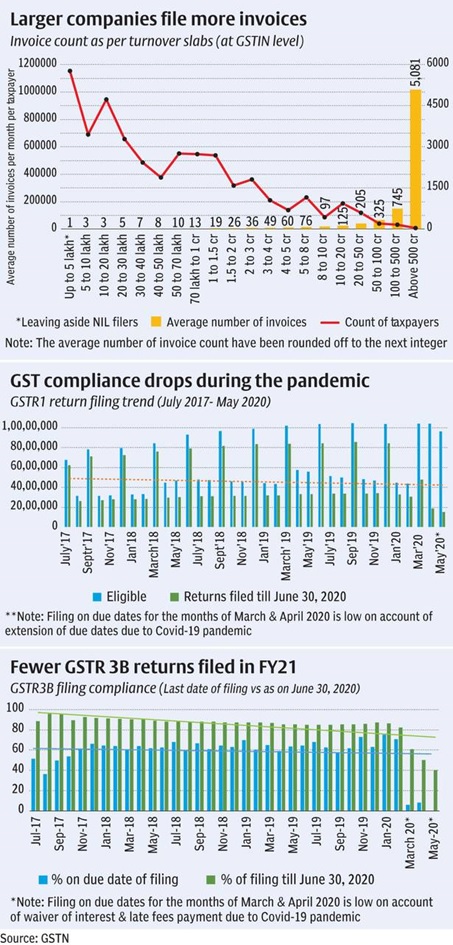
GST compliance also dipped in April and May, as seen in the
adjacent graph, less than 10 per cent of GSTR 3B returns for March, April and May
were filed until June.
Of the GSTR1 returns due for March, only around 50 lakh returns
were filed up to June, compared with over 80 lakh returns filed at the end of every
quarter.
It is quite clear that GST compliance has taken a knock during
the lockdown as the movement restriction along with funds crunch made payment of
tax difficult. The leeway given to businesses in tax filing also contributed to
the lowered compliance.
Amidst all this businesses are questioning the need for the
introduction of e-invoicing regime from October 1. E-invoicing involves reporting
details about GST invoices, credit notes, debit notes for all B2B supplies and exports
on a special government notified portal. This upload is besides the regular invoices
created on their own accounting/billing/ERP systems.
That said, smaller businesses are unlikely to be hurt since
only taxpayers with aggregate turnover exceeding ₹500 crore in a financial
year have to generate e-invoices. There are almost 11 lakh entities with annual
turnover under ₹5 lakh, that generate an average
of just one invoice per day. At the other end of the spectrum are a handful of companies
with turnover exceeding ₹500 crore, that generate over 5,000 invoices every
day; these larger companies are the most affected as of now.
E-invoicing could, however, be introduced to all businesses,
in a phased manner.
Not all are ready
So, are businesses ready for the e-invoicing regime? “Some
of the taxpayers are ready; however, there are a few taxpayers who are still struggling
due to lack of access to IT team and resources for implementing e-invoicing,” says
Pritam Mahure, a Pune-based
tax consultant.
He also points out that many countries had given around three
years’ time for implementation of e-invoicing after the final format/schema was
made available in public domain. In India, the final schema was made available on
July 30 and thus taxpayers have got just less than 2 months for preparation during
pandemic time.
“While the government has given time to businesses to prepare
for the impending e-invoicing regime, the Covid pandemic
has affected the readiness of businesses for the same,” concurs Tanushree Roy, Director, Nangia Andersen India. “Given the various annual deadlines
(GST Audit and Annual return FY 2018-19 and last date for availing credits/ raising
of invoices/ debit/ credit notes for FY 2019-20) falling in September/ October 2020,
it appears a tough time ahead for the businesses. However most appear to be in implementation
mode/ stage.”
Additional work
The tax payer has to generate QR code/ IRN for every invoice
from hereon. This will increase the workload on businesses, says Mahure. He also points out that those businesses who are not
yet ready with their software updates for the transition may prefer to not make
any supplies for few days, in order to be compliant with the new rules.
“E-invoicing is expected to create additional work load for
businesses at least initially,” says Roy. “Till date, invoices were being raised
by the businesses internally. Now given that raising of invoices would depend on
generation of IRN through government portal, any glitches may result into delay
in raising of invoices. Also the lack of trained staff engaged in such activity
may also create initial impediments, thereby creating additional work load for businesses.
This would particularly be a concern for businesses generating numerous invoices
daily.”
Beneficial in the long
run
E-invoicing could eventually help in improving GST compliance
as well as in checking evasion. This was the primary intention of the government
in introducing the e-invoicing mechanism and linking the same with the e-way bill
mechanisms. However, as e-invoicing is being made applicable to businesses having
turnover exceeding ₹500 crore, matching/ verification of invoices raised by
vendors not covered by e-invoicing provisions would have to be carried out in the
present manner. So, a hybrid mechanism of matching/ reconciliation is likely to
continue till e-invoicing is made applicable to all businesses.