G-20 Trade Restrictions Increase as Trade Flows Slow Down, says WTO
Report
In
the last six months, most G-20 members have put in place new trade restrictions
or measures that have the potential to restrict trade, according to the latest
WTO report on G-20 trade measures published on 18 December 2013. A total of 116
new trade restrictive measures were identified since the last WTO report, up
from 109 measures recorded for the previous seven-month period.
Summary
of WTO Report on G-20 Trade Measures
(Mid-May 2013 to mid-November 2013)
Trade restrictive measures increase as
trade flows slow down
World
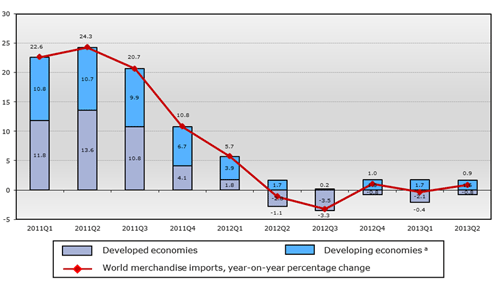
trade growth in 2013 is slower than expected
Global
economic growth remains slow and uneven, not only in most developed economies
but also in major emerging markets. The shortfall in activity has weighed
heavily on world trade flows. Trade growth this year is expected to register
only a slight increase over 2012, and although prospects are improving the
forecast for next year is still below the historical trend. The volume of world
merchandise trade is expected to grow by 2.5% in 2013 and 4.5% in 2014.
Contributions to year-on-year
growth in world merchandise imports, 2011Q1 - 2013Q2
(percentage change in US$ values)
The
number of new trade restrictions has increased
In
the last six months, most G-20 members have put in place new trade restrictions
or measures that have the potential to restrict trade. The trend is towards
more restriction. 116 new trade restrictive measures were identified since the
last WTO report, up from 109 measures recorded for the previous seven-month
period. These were mainly new trade remedy actions, in particular the
initiation of anti-dumping investigations, tariff increases and more stringent
customs procedures. New measures affect around 1.1% of G-20 merchandise
imports, equivalent to 0.9% of world merchandise imports.
The
trade restrictive or distorting effects of behind-the-border measures, such as
subsidies, public procurement activity and goods and services regulations, are
more difficult to measure. These are more varied than border measures, their
effects on trade are usually more indirect, and they are harder to monitor,
particularly those applied at sub-federal levels and where implementation
involves administrative discretion. All of these measures can affect trade, but
for the purposes of this Report the key question is whether they are being used
deliberately to restrict or distort access to domestic markets. In the case of
new TBT and SPS regulations, where data is more available, 2 to 3% of the thousands
that are notified each year to the WTO are taken up by Members for closer
scrutiny on the grounds that they raise specific trade concerns, and that
proportion has not significantly changed over the past six years.
Better
transparency and more evidence are needed to evaluate properly the trade impact
of behind-the-border measures.
Trade
restrictive measures
|
Type of measure |
Mid-Oct 10 to Apr 11 (6 months) |
May to mid-Oct 11 (6 months) |
Mid-Oct 11 to mid-May12 (7 months) |
Mid-May to mid-Oct 12 (5 months) |
Mid-Oct 12 to mid-May13 (7 months) |
Mid-May to mid-Nov 13 (6 months) |
|
Trade remedy |
53 |
44 |
66 |
46 |
67 |
70 |
|
Import |
52 |
36 |
39 |
20 |
29 |
36 |
|
Export |
11 |
19 |
11 |
4 |
7 |
8 |
|
Other |
6 |
9 |
8 |
1 |
6 |
2 |
|
Total |
122 |
108 |
124 |
71 |
109 |
116 |
|
Average per month |
20.3 |
18.0 |
17.7 |
14.2 |
15.6 |
19.3 |
Fewer
trade liberalising or facilitating measures were taken than in the past
Some
G-20 members also took measures that facilitate trade, although fewer than in
the period covered by the last report. Around 33% of the total recorded
measures can be considered as trade facilitating, compared with 40% at the time
of the previous trade monitoring report. Facilitating measures are mainly in
the form of termination of trade remedy actions and tariff reductions. These
measures cover around 0.8% of G-20 merchandise imports and 0.6% of world
imports.
Trade
restrictions continue to accumulate
The
accumulation of trade restrictions continues. This is a result of more new
measures being taken during the most recent period. This time the rate of
removal of restrictions put in place since the outbreak of the global crisis is
slightly higher than in the previous period. Around 20% of the total number of
trade-restrictive measures taken since October 2008 has so far been eliminated;
this compares with 19% at the time of the previous report in June 2013.
All
import-restrictive measures adopted since October 2008, excluding those that
have been reported as terminated up to mid-November 2013, are estimated to
cover around 3.9% of world merchandised imports, and around 5% of G-20 imports.
G-20
economies should show leadership in reinvigorating the multilateral trading
system
Strong
leadership by the G-20 economies is crucial for the world, in particular to
move forward on the positive momentum generated by the adoption of the Bali
package. The success in the WTO's 9th Ministerial Conference should not be
the end of the road, but the beginning of the process towards conclusion of the
Doha Round. The multilateral trading system must be reinforced and strengthened
to help global trade liberalization continue and so that trade rules are
updated to reflect the issues of the 21st century.
The
multilateral trading system remains the best defence against protectionism and
the strongest force for economic growth, sustainable recovery and development.
The system has proved its usefulness as an insurance policy against
protectionist tendencies. Protectionist pressures are bound to remain in a
context of slow uneven economic recovery and persistent high levels of
unemployment. In this period, it is all the more important to put the spotlight
on trade as a source of growth, employment creation and development.
[The members of the G20 are: Argentina,
Australia, Brazil, Canada, China, France, Germany, India, Indonesia, Italy,
Japan, Republic of Korea, Mexico, Russia, Saudi Arabia, South Africa, Turkey,
United Kingdom, United States, European Union.]