Global Imports of Seaborne Wheat maintain Upward Trend
·
India
not in the Picture
·
Prices also eased as
maritime exports from Ukraine resumed following agreement on the Black Sea
Grain Initiative, which was signed in July 2022 under the auspices of the
United Nations and Türkiye.
By Emmanuelle Ganne (WTO), Alexander Karavaytsev (International Grains Council — IGC), Mun How
Mong (WTO), Cédric Pene (WTO)
Wheat
is among the world’s most common food staples. Its availability is therefore
crucial for food security in many parts of the globe. While around one-quarter
of the world’s wheat supply is obtained through international trade — 80 per
cent of it seaborne trade — this share is much higher for some net
food-importing developing economies. This highlights how important it is for
international trade channels to function well.
A new dashboard to log wheat maritime trade and food security
The WTO
and the International Grains Council (IGC) have jointly developed a new dashboard
to allow users to monitor short-term trends in maritime wheat flows. This
information is particularly important at a time when concerns about food
security and risks of supply chain disruptions are so high on the agenda.
Data on global seaborne wheat shipments
The
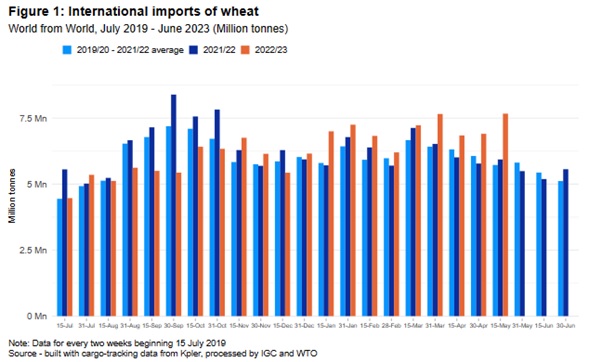
latest data reveals that seaborne shipments of wheat continued at a strong pace
in the second half of May 2023, with arrivals at monitored ports estimated at
around 7.7 million tonnes. This is 40 per cent higher than the same period last
year and one-third higher than the three-year average.
Around
6.5 million tonnes of wheat were dispatched over the last 14 days. Taking into
account volumes of wheat in transit as of 4 June (4.2 million tonnes), Russia,
with close to 3 million tonnes, was the world’s largest wheat exporter,
followed by Australia, with over 2 million tonnes, Canada (1.4m), the United
States (0.8m), Ukraine (0.5m) and France (0.4m). China, Indonesia, Algeria,
Egypt and Spain are the key destinations in order of volume for these exports
(as of 4 June).
After a
relatively slow start to the July 2022 – June 2023 season due partly to
disruptions caused by the outbreak of the war in Ukraine, global maritime trade
flows accelerated in late 2022 as global prices retreated as a result of
improving global wheat availability and stiff competition for export business.
Prices also eased as maritime exports from Ukraine resumed following agreement
on the Black Sea Grain Initiative, which was signed in July 2022 under the
auspices of the United Nations and Türkiye.
Cumulative
2022-23 global seaborne imports of wheat were around 140 million tonnes by the
end of 2023, marginally higher than the volume during the same period the
previous year, and 5 per cent higher than the average volume over the past
three seasons.
However,
parts of Africa, Southern and South-eastern Asia as well as the Caribbean and
South America have seen a decline in imports while imports to Western and
Eastern Asia, Northern Africa, Europe and Oceania have increased.
Contrasts in deliveries to Africa and Asia
In
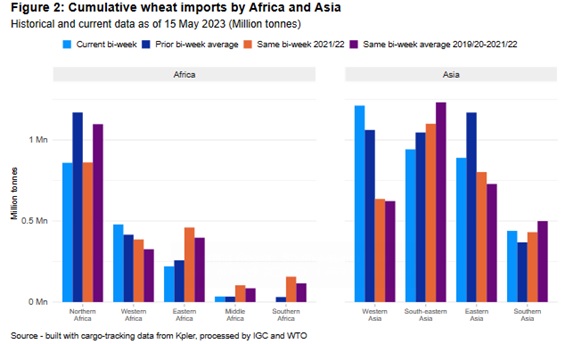
Northern Africa, disappointing harvests in some countries reduced domestic
wheat availability, underpinning imports across the region in May. Deliveries
in the second half of the month were estimated at 1.9 million tonnes — almost
double the import levels during the same period one year ago. For the marketing
year (July-June), the cumulative total through May stands at around 29 million
tonnes, up by 9 per cent year-on-year, with smaller year-on-year imports by
Egypt outweighed by larger arrivals in other countries in the region, notably
Algeria, Morocco and Tunisia.
Wheat
imports by Western Asia have also been exceptionally strong, with cumulative
deliveries through the end of May 42 per cent above the average level over the
same period and one-quarter higher than last season. This trend is expected to
continue in the coming weeks. Of the 8.6 million tonnes of wheat in transit to
monitored ports around the world as of the end of May, with a significant
portion originating from Russia, the bulk was destined for Western Asia (1.7
million tonnes) and Northern Africa (1.6 million tonnes).
In
contrast, wheat deliveries to Western, Eastern and Central Africa are lagging
well behind those for last season and the average pace of exports. In Eastern
Africa, the bulk of the year-on-year decline stems from lower deliveries to
Djibouti, the major portion of which is assumed to be transhipped to Ethiopia,
where import needs this season are likely capped by a good local crop.
Accumulated deliveries to Madagascar, Réunion and Kenya are also lower than
last season but those to Somalia and Tanzania are up slightly. In Western
Africa, reduced imports by Nigeria, Ghana, Liberia and Togo outweigh larger
deliveries to Côte d’Ivoire and Guinea.
Deliveries
to Southern Asia have been generally slow this season, in part owing to smaller
deliveries to Iran, where long delays at discharge were also reported in recent
months. Cumulative arrivals in the region lagged last season by one-quarter as
of the end of May.
Delivery times to some regions have increased
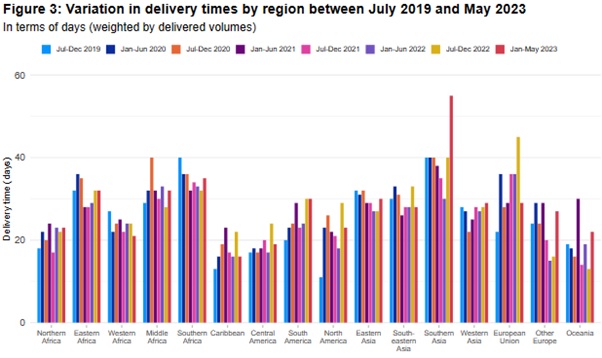
In the
period from July 2022 to May 2023, calculated delivery times (from dispatch to
unloading) took markedly longer to reach monitored regions than they did during
the previous season (July-June), with regions such as Eastern Africa, Central
America, South America, Eastern Asia, Other Europe and Southern Asia especially
affected. For Southern Asia, delivery times in the July 2022 — May 2023 period
averaged 46 days, up from 33 days during the prior season — a relatively steep
increase stemming partly from longer delivery times to Iran.
South-Eastern
Asia and Central Africa have some of the longest average delivery times.
The
wheat maritime trade and food security dashboard provides aggregated estimates
for seaborne wheat shipments based on private vessel tracking, compiled by Kpler, a commodities market data and analytics solutions
company. Data are updated twice a month, in the middle and at the end of each
month.
In
addition, two live dashboards, which are updated every three hours, enable
users to visualize the short-term evolution of trade in grains and oilseeds,
including wheat, as well as corn, barley and soybeans over the previous 14
days. These live dashboards will be discussed in a future blog post.