Govt
Notifies Steel Scrapping Policy, Mandates Discounts on Junking Old Cars
·
OEMs, dealers to aid the collection of
old vehicles, recyclable spares through the take-back scheme, or by setting up
scrapping centres or through tie-ups with such
facilities
The Centre has notified a scrap
recycling policy to promote circular economy in the steel sector and utilise scrap emanating from vehicles and white goods that
have reached their end of life.
Under the policy, the ministry of road
transport and highways and the department of heavy industry would work towards
“extended producer responsibility” by requiring vehicle manufacturers to incentivise scrapping of unfit vehicles in exchange for
price discounts for purchase of new vehicles. "This too shall provide for
the required feed to the scrapping centres. MoRTH may formulate an Automobile Fitness Certification
Policy to prevent plying of unfit and polluting vehicles. This would facilitate
establishment of fitness centres in the private
sector by providing supporting policy framework," said the new policy
announced by the Union ministry of steel on Friday, 8 November 2019.
The OEMs and/or its dealers would
facilitate collection of old vehicles/ELVs (end of life vehicles)/ recyclable
spare parts of old automobiles either through a take back scheme or by setting
up scrapping centres of their own or through tie-ups
with such facilities, thereby acting as an aggregator for the collection of
vehicles.
Unfit vehicles, according to the
voluntary decision of the owners, would be considered as the feed material for
the steel scrapping centres.
Under the policy, scrap processing
units would be set up which could use the new corporate rate structure notified
on September 20, offering domestic company incorporated on or after October 1,
2019 and making fresh investment in manufacturing, an option to pay income-tax
at the rate of 15 per cent.
Further, the policy said the department
of revenue might examine the proposal regarding the exemptions under section 35
AD of Income Tax Act to scrap processing units.
The policy requires vehicle
manufacturers to shoulder responsibilities to use an increased quantity of
recycled material in vehicles and other products, (provided they do not give
rise to safety or environmental hazards), thereby creating a market for
recycled products, and the percentage use of such recycled materials in
vehicles should be periodically audited to ensure compliance.
Additionally, vehicle and white good
manufacturers would be required to provide dismantling information for each
type of new product within six to two months of the launch and should assist/
guide the recycling centers to expand the technological know
how for segregation and recycling.
The policy would involve a formal and
scientific collection, dismantling and processing activities for end of life
products that are sources of recyclable (ferrous, non- ferrous and other
non-metallic) scraps.
Under the policy, high quality ferrous
scrap for quality steel production would be produced.
To address the issue of collecting such
end of life products for increasing scrap generation in India and also to
structure the informal recycling sector based on environmental and scientific
fronts, a hub and the spoke model has been promulgated.
The collection /dismantling center
and/or scrap processing center must issue a certificate of destruction (COD) or
proof of scrappage to the owner. Records of the same must be maintained and it
should be available for scrutiny by the authority concerned.
The collection and/or dismantling
center should either setup by or be associated with a scrap processing center.
They should handover the depolluted/dismantled ELVs, white goods and other
scraps without any legal liabilities or encumbrances to the authorized scrap
processing center.
These centres
would be set up near highways, industrial corridors, railway sidings and in the
close proximity to the Sagarmala project which would
help in development of multimodal logistics parks.
The increased production of vehicles
and increased use of consumer durable white goods in the last two decades and
their rapid obsolescence shall generate large quantities of end of life
products. This shall result in generation of continuous flow of large ferrous
scrap for recycling in steel production.
It would be put in place a mechanism
for treating waste streams and residues produced from dismantling and shredding
facilities in compliance to Hazardous & Other Wastes (Management &
Transboundary Movement) Rules, 2016 issued by the ministry of environment.
An inter-ministerial coordination
committee has been set up with steel secretary as convener and secretaries of
ministry of road transport and highways, department of heavy industry, ministry
of environment, forest & climate change, department of revenue and ministry
of labour & employment as members. The mandate of
the committee is to look into policy changes required for creating an organized
steel scrapping ecosystem.
A government statement said the
availability of scrap was a major issue in India and the deficit was 7 million tonne in 2017. This was imported at the cost of more than Rs 24,500 crore in 2017-18. The gap between demand and
supply is can be reduced in the future and the country may be self-sufficient
by 2030. This is mainly because with the increase in consumption of steel in
the recent past and ELVs, the generation of scrap is likely to be increased
considerably. This scrap has to be channelized so that the same can be utilized
for steel production in an environmentally friendly manner.
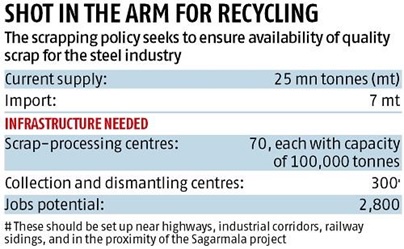
The scrapping policy seeks to ensure
availability of quality scrap for the steel industry. The current supply of
scrap is 25 MT from the domestic unorganized scrap industry and 7 MT from
import of scrap. There is potential to harness this 7 MT of scrap that is
currently being imported from the domestic market itself. This shall require
adequate collection centres, dismantling centres shall work in a hub-spoke model and feed to the
scrap processing centres. To produce 7 MT more of
scrap, the country shall require 70 scrap processing centres
each with the capacity of 100,000 tonnes; this is
without disturbing the existing dismantling centres.
The 70 scrap processing centres shall require about
300 collections and dismantling centres on the
presumption that 4 collecting and dismantling centres
cater to scrap processing centre.
A 4+1 hub and spoke model is envisaged,
where four collection and dismantling centres cater
to one scrap processing centre. There would be 70
units producing a total of 7 MT of scrap the potential for employment
generation would be of 2,800 persons.