India comes in the Way
of Concluding RCEP in Bangkok Meet
· Final Signing Postponed to Feb 2020
· India does want Negotiation from 2010 Tariff Rates
when Peak Tariff was 10%, after this we raised duties to 20% on some 4000 plus
Tariff Lines
· Transition Period for India should start with
Current base Year and not 2010 as Demanded by China
·
US
Downgrades Summit, Trump does not come Personally but Deputes Commerce Secy Ross to Substitute
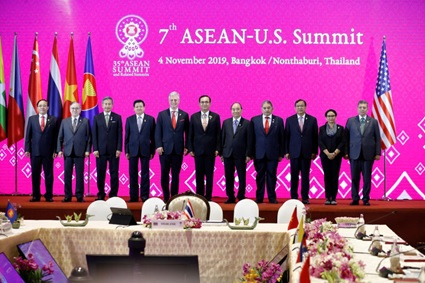
Prime Minister Prayut
Chan-o-cha, ASEAN foreign ministers and US National Security Advisor Robert C.
O’Brien attend the 7th ASEAN-United States Summit in Bangkok on 4th
November 2019.
Asian countries held conclusive talks on what could
be the world's biggest trade pact and there will be an announcement of success
at a summit in Bangkok, despite doubts raised by India.
But questions still hung over India's participation
in the China-backed 16-nation Regional Comprehensive Economic Partnership
(RCEP), which has been given new impetus by the US-China trade war.
Despite a message of support from US President
Donald Trump to the Association of Southeast Asian Nations (Asean),
regional countries noted that Washington had downgraded its delegation
for the annual Asian meetings.
Southeast Asian countries hoped to announce at
least provisional agreement on the 16-nation trade bloc that would account for
a third of global gross domestic product and nearly half the world's
population.
But last-minute demands raised by India meant negotiations among ministers went late into
the night. The bloc includes the 10 Asean members
plus China, South Korea, Japan, India, Australia and New Zealand.
"The negotiation last night was
conclusive," Commerce Minister Jurin Laksanawisit told Reuters.
"There will be an announcement together on the
success of the RCEP agreement by the leaders later today. India is part of this
as well and will jointly make the announcement. The signing will be next
year."
But an Indian official with close knowledge of
talks said not everything had been resolved and discussions were still on,
adding that it was "all being decided politically".
China Denies
Full Recognition to India in RCEP, Titles Grouping as RECP 15
China's foreign ministry referred in a statement to
"RCEP-15 member states" concluding most negotiations - implying that
only 15 countries had agreed. Australia's trade minister Simon Birmingham also
cast doubt on whether India was on board.
New impetus to complete the deal has come from the
trade war, which has knocked regional growth, but India fears a potential flood
of Chinese imports and officials with knowledge of the negotiations said India
had raised late demands.
One advantage for Southeast Asian countries of
including relative heavyweight India in the trade pact would be less domination
by China.
US Downgrades
Event
Diplomatic and security calculations in Southeast Asia
have shifted under the Trump administration.
And the US decision to send a lower level
delegation to the summits this year has raised regional concerns that it can no
longer be relied on as a counterweight to China's increasing regional might.
Because of the downgrade in the US delegation, only
three of the 10 regional leaders joined the usual US-ASEAN meeting.
US Commerce Secretary Wilbur Ross told a business
meeting on the sidelines of the summit that the administration of US President
Donald Trump was "extremely engaged and fully committed" to the
region.
White House national security adviser Robert
O'Brien brought a personal message from Trump offering to host a meeting of
Southeast Asian leaders in the United States.
He also condemned Chinese "intimidation"
in the South China Sea, where several regional states reject China's sweeping
maritime claims and complain that Beijing is illegally stopping them from
exploiting their energy resources and fishing grounds.
But diplomats and analysts said the message from
Washington was clear.
"Doubts have been raised in a more serious way
about the Trump administration engaging and this may also play into the hands
of other superpowers in pushing their own agendas," said Panitan Wattanayagorn, a former
Thai national security adviser.