Retro Tax Flare-Up: India Loses Cairn Case
FinMin says all options against
$1.2-b arbitration award to be considered
In the second such adverse verdict against the government
in three months, an arbitration tribunal in The Hague found India guilty of breaching
its obligations to Scottish oil and gas explorer Cairn Energy under the UK-India
Bilateral Investment Treaty and has awarded to Cairn damages of $1.2billion plus
interest and costs.
“The tribunal ruled unanimously that India had breached its
obligations to Cairn under the UK-India Bilateral Investment Treaty and has awarded
Cairn damages of $1.2 billion plus interest and costs, which now becomes payable,”
Cairn Energy said in a statement on Wednesday
Responding to the ruling, the Finance Ministry said that it
will study the award: “The government will be studying all aspects carefully in
consultation with its counsels. After such consultations, the government will consider
all options and take a decision on the further course of action, including legal
remedies before appropriate fora,” a statement issued by the Finance Ministry said.
In September 24 this year, the Permanent Court of Arbitration
at the Hague had ruled that the Indian government’s ₹22,100-crore retrospective
tax demand against telecom major Vodafone was in “breach of the guarantee of fair
and equitable treatment” under the bilateral investment protection pact between
India and the Netherlands. Incidentally, the last date for appealing against the
verdict in Vodafone case expired on December 24.
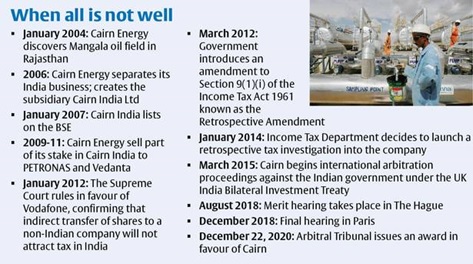
Cairn commenced international arbitration proceedings against
the Government of India under the UK India Bilateral Investment Treaty in March
2015. The arbitration intended to determine if India breached its obligations under
the Treaty to protect Cairn’s investments in India by retrospectively applying a
newly enacted capital gains tax law to an internal corporate reorganisation undertaken in 2006.
What Cairn wants
According to Cairn, it is seeking full restitution for losses
resulting from: the expropriation of its investments in India in 2014, continued
attempts to enforce retrospective tax measures and the failure to treat the company
and its investments fairly and equitably.
According to Cairn, it has legal advice confirming that the
maximum amount that could ultimately be recovered by the department is limited to
the value of Cairn UK Holdings Ltd’s assets, principally
the ordinary and preference shares, almost all of which have already been sold and/or
redeemed, plus the seized dividends and tax refunds from 2009 and 2011.
What experts say
Rakesh Nangia, Chairman at Nangia Andersen India, said the Indian Government may end up
paying approximately ₹8,000 crore. “It shall be interesting to understand
the difference between ‘tax dispute’ and ‘tax related investment dispute’, which
is the arbitration court’s ground while stating that Cairn’s tax issue is not a
tax dispute but an investment dispute, and hence gets covered by the Treaty,” he
said.
Tarun Gulati, a senior lawyer in Supreme Court, said: “I hope that
the government will course-correct. I hope that Indian courts also come to the rescue
of domestic investors by holding governments to their word. It is unfortunate that
in India, the doctrine of promissory estoppel has been severely diluted and governments
are getting away with withdrawing benefits which are promised to investors.”