International Centre for Automotive
Technology Organises Webinar on Ethanol Economy to
Deliberate on Ethanol Blended Fuels
·
Target of Achieving 20%
Ethanol-Blending with Petrol by Five Years to 2025 to Cut Dependence on Costly
Oil Imports
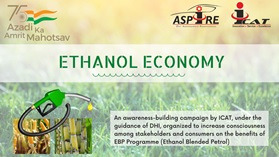 International Centre for Automotive Technology (ICAT) organized
a knowledge-sharing two-day ‘Ethanol Economy’ webinar last week through its
technology platform of ASPIRE to celebrate AzadiKaAmritMahotsav.
Prime Minister Narendra Modi, released the “Report of the Expert Committee on
Road Map for ethanol blending in India 2020-2025 on the occasion of World
environment day, 5th June 2021 on 24 August 2021.
Experts from India and global who have been
working on developing vehicles and infrastructure to support Ethanol Economy
shared their experiences in the webinar highlighting opportunities and
challenges which one might face while adopting
and developing technologies for Ethanol Blended Fuels. Ideas, new
proposals and new suggestions to enable a smooth adoption of EBP fuels in India
were also discussed. Prime Minister announced the target of achieving 20%
ethanol-blending with petrol by five years to 2025 as it looks to cut
dependence on costly oil imports. Blending petrol with ethanol will cut down
the dependency on imports. Government of India is expecting investments of up
to INR 41,000 Cr to help India achieve its ethanol blending target of 10
percent by 2022 and 20 percent by 2025.
Dinesh Tyagi,
Director, ICAT and Member Secretary, Governing Board, ASPIRE inaugurated the
webinar. In his address, he emphasised the need of
embracing Ethanol Economy in view of energy independence and sustainability for
India.
Dr. SSV Ramakumar,
Director R&D, IOCL who is also one of the co-authors of Ethanol Economy
Policy document prepared under Niti Aayog presented the current scenario of ethanol blending in
the country which is to the tune of 8.5% and which is slated to increase 10%
ethanol by end of FY 2021-22 by concerted efforts of Oil Marketing Companies
and Various state Governments. He mentioned that current capacity of 300 Cr litres ethanol increase to 400 Cr litres
for 10% blend. By 2025, it is estimated that 1000 Cr litres
of ethanol will be required for the country.
Dr Reiji Mathai, Director, Automotive Research Association of
India (ARAI) stated that by 2023 some places in India will be selling 20%
blended ethanol, and by 2025 it will be available all across India. He
mentioned that vehicle manufacturers will be addressing the challenges of
ethanol blended fuels and he mentioned options of availability of E20 reference
fuels locally in India is being explored with various refineries in India.
Mr C V Raman, Chief Technical Officer, Maruti
Suzuki India, and President, ASPIRE Governing Board stated that ethanol blended
fuels has the potential to replace 18% gasoline consumption. E20 fuels will
also lead to 16% reduction in harmful greenhouse gases. However, he expressed
his concerned about customer acceptability and impact of compatibility with ethanol fuels with on-road
vehicles which are not developed to run on 20% ethanol blended fuel which might
would result in increased fuel consumption and higher maintenance costs of
vehicles. He also emphasised on the need to recognise ethanol as a carbon neutral fuel and mentioned
that RON 95 fuels should be the standard for all ethanol blended fuels from E20
to E85/E100.
Mr Vikram Kasbekar,
ED & CTO, Hero MotoCorp further added that automotive industry as a whole
has contributed largely for the development of the Indian economy and has
enhanced the overall manufacturing capability in India. He expressed his
concern on E20 fuel impact on carburetted two-as
large number of such two wheelers are running across length and breadth of the
country. He suggested E10 to be the base
fuel for a certain period of time to compensate customers for the loss of fuel
economy. He stated that clarity in energy road map is imperative for the
industry.
The second session on ‘Technological
Challenges’ was related to ethanol blended fuels. Speakers included Prof Avinash K Agarwal, Engine Research Laboratory, IIT Kanpur; Dr S S Thipse,
Deputy Director Powertrain, ARAI; Dr Devendra Singh, Principal Scientist, IIP; Dr Devendra Deshmukh,
Asst Professor, IIT Indore; and Mr
Dinesh Kumar, VP (Air Purification, R&D), Sud Chemie India, Vadodara. The session discussed the aspects
of manufacturing challenges of developing vehicles for ethanol blended fuels.
Material compatibility, energy efficiency, fuel economy and matching
after-treatment technologies which are key challenges in developing vehicles
for Ethanol blended fuels also were also discussed.
The panel discussion on ‘Challenges for Auto
Industries of Ethanol Blended Fuel (EBF) Policy’ was moderated by Mr Deepangshu Dev Sarmah, Editor, Mobility Outlook.
The panellists
included Dr. Anjan Ray, Director, IIP; Mr. Harjeet Singh, Executive Adviser, Hero MotoCorp; Mr.Anoop Bhat, Executive VP –Engineering, MSIL; Mr. PK
Banerjee, Executive Director, SIAM; Mr Dinesh Kumar,
VP (Air Purification R&D) , Sud Chemie; Mr. K U Ravindra, General
Manager, Bosch (ACMA); and Dr. R.K Malhotra, Director General, FIPI. All the panellist acknowledge the benefits of ethanol blended
petrol in reducing harmful emissions, the reduction in import costs and
advantages to farmers in producing raw materials.
The panel discussed that awareness building is
a crucial aspect for the success of EBP in India, and all stakeholders must
work on spreading as much knowledge about EBP as possible. Other challenges
include vehicle performance compatibility for ethanol blended petrol, reduced
fuel efficiency, pricing, storage, engine reliability issues, inconsistency in
character of ethanol blended petrol from various bio sources, requirement of
consistency in policy across all aspects, etc. The session covered a holistic
scenario of EBP in the country, the challenges and the possible solutions, like
planning a long term strategy, stable pricing, consistent policies and align
all developments, may be undertaken by the ministries and industry to succeed
with ethanol blended fuels.
ICAT is under National Automative
Board (NAB) which is the autonomous body under the aegis of Ministry of Heavy
Industries.