MSME Turnover
Limit Enhanced; Support Price for Paddy Hiked
Last date to avail 3%
additional subsidy on short-term farm loans extended to Aug 31
Even
as the nation entered Lockdown 5.0 amid a deepening economic crisis, the Centre
on Monday, 1 June 2020 made two key announcements in a bid to salvage the
situation.
One,
the Union Cabinet announced a modification in the definition of micro, small
and medium enterprises (MSMEs) to bring more entities under its ambit, besides
approving a ₹50,000-crore funding mechanism
for the sector. Two, the Cabinet Committee on Economic Affairs (CCEA) raised
the minimum support price (MSP) for 14 kharif crops,
including paddy.
MSME
Minister Nitin Gadkari said the investment and
turnover limit for medium enterprises have been increased to ₹50 crore and ₹250
crore, respectively. Last month, it was proposed to hike these limits to ₹20 crore and ₹100
crore from the earlier definition of ₹10
crore and ₹5 crore, respectively.
Under
the new system, a micro unit will be one that has an investment of up to ₹1 crore and a turnover of up to ₹5 crore, against the current limit of ₹25 lakh and ₹10
lakh, respectively. Similarly, for small units, the investment and turnover
limits have been raised to ₹25 crore and ₹50 crore, respectively, from ₹5
crore and ₹2 crore. No classification will be
made in terms of ‘manufacturing’ and ‘services’.
“Earning
from exports will not be considered for the calculation of the new limits,” Gadkari said, adding that the changes will come into effect
from July 1, post promulgation of ordinances.
About
6.5 crore MSME units contribute nearly 29 per cent of the GDP and 48 per cent
of the nation’s exports, apart from providing jobs to nearly 11 crore people.
Two funds for MSMEs
Gadkari
also announced the setting of two funds for MSMEs — a distress fund and a fund
of funds (FoF). The distress fund, with a corpus of ₹20,000 crore, will offer loans of up to ₹75 lakh each to MSME units in distress. It can
help two lakh units.
The FoF, with a corpus of ₹10,000
crore, will be operated through a mother fund and a few daughter funds. The
fund structure will help leverage ₹50,000
crore at the daughter funds level. It will provide support to MSMEs to get
listed on stock exchanges.
“MSMEs
with good potential and export record and GST compliance will get support from
this fund,” Gadkari said. Once a unit gets listed,
the FoF will offload its equity stake in it and move
to invest in other entities.
Paddy MSP up by ₹53/quintal
Meanwhile,
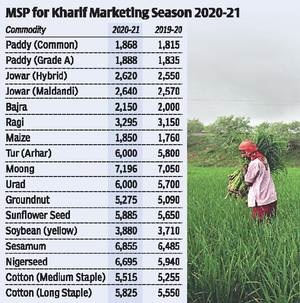
the CCEA decided to raise the MSP of paddy by ₹53
per quintal to ₹1,868 per quintal for the
2020-21 crop year. The rates for oilseeds, pulses and cereals have also been
hiked. This is expected to help farmers take a call on which kharif crop to grow as sowing picks up with the arrival of
the South-West Monsoon.
Agriculture
Minister Narendra Singh Tomar said the principle
behind the decision is that farmers should get at least 50 per cent over costs.
The MSPs were decided based on the recommendation of the Commission for Agricultural
Costs and Prices.
The
MSP of Grade A variety of paddy has been increased to ₹1,888
per quintal from ₹1,835 last year. The
support price of cotton (medium staple) has been increased by ₹260 per quintal to ₹5,515
(₹5,255 per quintal).
Tomar
further said the last date for availing 3 per cent additional subsidy on
short-term farm loans of up to ₹3 lakh has
been extended to August 31 from May 31.