Matrix for 50 Agricultural Products with
Good Export Potential Created
·
As Part of the PM GatiShakti National Master
Plan, APEDA Collaborates with various Ministries to Ensure Seamless Logistics
·
Government Focuses on Boosting Agri
Exports from Purvanchal, Himalayan Region, North Eastern
States, J&K and Ladakh
India’s agri exports
crossed USD 50 billion for the year 2021-22, notwithstanding logistical challenges
posed by COVID-19 pandemic in the form of high freight rates, container shortages,
etc. Agricultural and Processed Food Products Export Development Authority (APEDA),
which works under the Ministry of Commerce and Industry, has scripted a new history
by exporting agricultural and processed food products to the tune of USD 25.6 billion,
which is 51 per cent of the India’s total agriculture exports of USD 50 billion.
Besides, the APEDA has also surpassed its own export
target of USD 23.7 billion for the financial year 2021-22 by registering shipment
of USD 25.6 billion.
As per the provisional figures released by DGCI&S,
the agricultural exports have grown by 19.92 per cent during 2021-22 to touch USD
50.21 billion. The growth rate is remarkable as it is over and above the growth
of 17.66 per cent at USD 41.87 billion achieved in 2020-21 and has been achieved
in spite of unprecedented logistical challenges in the form of high freight rates,
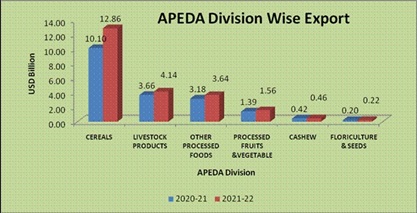
container shortages, etc. The export of APEDA schedule products export may be seen
from the Graph-1. It depicts the comparative
export of APEDA products for the current year, 2021-22 and previous year 2020-21. Cereal sector in APEDA exports contributes more
than 52 per cent share in 2021-22. Livestock
products and other processed foods contributes 17 and 15 per cent in APEDA export
respectively in 2021-22.
Graph-1
The historic achievement over past two years will
go a long way in realising the Prime Minister Narendra
Modi’s vision of enhancing farmers’ income.
Compared to total agricultural export, APEDA’s
exports registered 16 per cent growth when it touched USD 25.6 billion in 2021-22 from USD
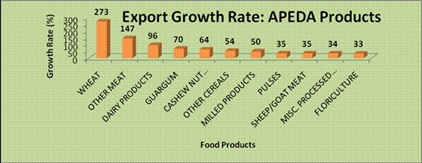
22.03 billion in 2020-21. The highest growth
rate recorded by APEDA products (more than 30 per cent) in 2021-22 corresponding
to previous year may be seen from Graph-2.
According to the DGCI&S data, export of rice
was the top forex earner at USD 9654 million during 2021-22, growing 9.35 per cent
from previous year when it touched USD 8829 million.
The export
of wheat touched an all-time high at USD 2118 million in 2021-22, growing 273
per cent from 2020-21 when it touched USD 567 million, while other cereals registered
a growth of 53 per cent by fetching USD 1083 million in 2021-22 in compare to the
previous financial year when it touched USD 705 million.
Export of pulses
reported a growth of 34 per cent touching USD 358 million in 2021-22 from USD
265 million in 2020-21.
Dairy products grew over by 96 per cent standing at USD 634 million in 2021-22 from USD 323 million in 2020-21,
while buffalo meat registered a growth of just 4 per cent as export of bovine meat
increased from USD 3171 million in 2020-21 to USD 3303 million in 2021-22.
Export of poultry
products rose to USD 71 million in 2021-22 from USD 58 million in the previous
year and sheep/goat meat export is up by 34 per cent at USD 60 million in 2021-22
from USD 44 million in the previous year.
Fruits and vegetables exports were up by 12 per cent to touch USD 1676 million in 2021-22 against USD 1492 million in
2020-21, while processed fruits and vegetables exports were up by 7 per cent to
reach USD 1202 million in 2021-22 against USD 1120 million in the previous year.
Exports of other processed food items grew by 34 per cent during 2021-22 to touch
USD 1164 million against USD 866 million in 2020-21. The cashew exports also grew
by 7 per cent to USD 452 million in 2021-22 from USD 420 million in the previous
year. Floriculture products reported a rise of 33 per cent when it touched USD 103
million in 2021-22 from USD 77 million in 2020-21.
APEDA's major exporting destination as per 2021-22
data are Bangladesh, UAE, Vietnam, USA, Nepal,
Malaysia, Saudi Arabia, Indonesia, Iran and Egypt.
The significant rise in agri-exports
is seen as a testimony of the government’s commitment to enhance farmers’ income
through giving thrust on boosting exports of agricultural and processed food products.
The rise in export of agricultural and processed food products has been largely
due to the various initiatives taken by Centre through APEDA such as organizing
B2B exhibitions in different countries, exploring new potential markets through
product specific and general marketing campaigns by active involvement of Indian
Embassies.
The government organized more than 300 outreach
programmes in collaboration with state governments for
enhancing the exports of agricultural produce.
“We have also created products matrix for 50 agricultural
products which have good scope for expanding our exports portfolios,” said Dr M Angamuthu, Chairman, APEDA.
Centre has also taken several initiatives to promote
geographical indications (GI) registered with agricultural and processed food products
in India by organizing virtual Buyer Seller Meets on agricultural and food products
with the major importing countries across the world.
In order to ensure seamless quality certification
of products to be exported, government has recognized 220 labs across India to provide
services of testing to a wide range of products to exporters.
Centre, through APEDA also assists in upgradation
and strengthening of recognized laboratories for export testing and residue monitoring
plans. APEDA also provides assistance under the financial assistance schemes of
infrastructure development, quality improvement and market development for boosting
export of agricultural products.
The participation of exporters in the International
Trade Fairs was organized, which provides a platform to the exporters to market
their food products in the global marketplace. National events like AAHAR, Organic
World Congress, BioFach India
etc. were organized to promote agri-exports.
Government, through the aegis of APEDA also initiates
registration of pack-houses for horticulture products for meeting the quality requirements
of the international market. Registration of export units for peanut shelling, grading
and processing units, for instance, is to ensure quality adherence for the EU and
non-EU countries.
APEDA also carries out registration of meat processing
plants and abattoirs for ensuring compliance with global food safety and quality
requirements. Another key initiative includes development and implementation of
traceability systems which ensure the food safety and quality compliances of the
importing countries.
For boosting exports, APEDA compiles and disseminates
various international trade analytical information, market access information amongst
exporters and address trade enquiries.
As part of the PM Gati Shakti - National Master Plan, APEDA is collaborating with
various ministries including railways and roadways for enhancing connectivity through
faster transportation of agricultural products, as they are perishable in nature
so it requires immediate and fast delivery to its destination from the production
points.
“The government has been focussing
on boosting exports from Purvanchal, Himalayan, NER states,
J&K and Ladakh,” Dr Angamuthu, said.
In line with the government’s Digital India policy,
APEDA has implemented several new digital technology-based initiatives which have
played a key role in enabling agricultural exports worth of $ 25 billion under the
its basket in 2021-22.
APEDA has adopted multiple world class technology
and software in IT division such as Blockchain technology
implemented in hortinet traceability, Farmer Connect Portal,
Geographical Indications (GI) Promotion Portal, Mobile App, iTrack
System, TraceNet, Organic Promotional Portal, Agriexchange App, and Cloud Migration etc.
Given that demand of natural products is growing
and consumers demand greater quantities of foods, cosmetics and medicines that contain
natural ingredients, the Centre is in process to formulate a strategy for promotion
of export of natural farming products in consultation with Ministry of Agriculture
to develop the standards for production along with certification system.
A Farmer Connect Portal has also been set up on
APEDA’s website for providing a platform for Farmer Producers Organisations (FPOs) or Farmer Producer Companies (FPCs), Cooperatives
and women entrepreneurs to interact with exporters. Around 3,295 FPOs and FPCs and
3,315 exporters have been registered in the portal so far. More than 24 lakh organic farmers registered with
APEDA. India is the leading producers of organic products in the world.
Table: Agricultural and processed food products
exports comparison
|
Products |
2021-22
(USD million) |
2020-21
(USD million) |
|
Rice |
9654 |
8829 |
|
Dairy Products |
634 |
323 |
|
Pulses |
358 |
265 |
|
Other Cereals |
1083 |
705 |
|
Cashew |
452 |
420 |
|
Wheat |
2118 |
567 |
|
Fruits & Vegetables |
1789 |
1617 |
|
Processed Products |
1202 |
1120 |
|
Floriculture products |
103 |
77 |
|
Sheep/goat meat |
60 |
34 |
|
Buffalo meat |
3303 |
3171 |
|
Poultry |
71 |
58 |
|
Miscellaneous processed items |
4753 |
4844 |
|
Total |
25580 |
22030 |
Source: DGCIS, based on Trade
Alert for March 2022 and subject to change