Merchandise Trade Posts Strong Gains in
First Quarter despite Growing Regional Disparities
·
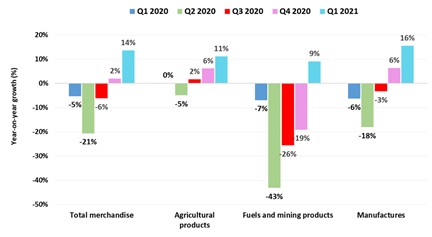
Manufactured goods trade was up 16% in the
first quarter after having fallen 18% in the second quarter of 2020 at the
height of the pandemic. Trade in agricultural products was up 11% in the latest
quarter while shipments of fuels and mining products rose 9%.
Global
merchandise trade continued to bounce back in the first quarter of 2021 from its
collapse earlier in the pandemic, but the pace of recovery has diverged strongly
across countries and regions. The volume of merchandise exports and imports in the
first quarter rose to new heights in Asia, reverted to pre-pandemic levels in Europe
and North America, and lagged in poorer, less industrialized regions such as Africa
and the Middle East.

Note:
South America includes Central America and the Caribbean. The CIS refers to the
Commonwealth of Independent States, including certain associate and former member
states.
Source: WTO and UNCTAD.
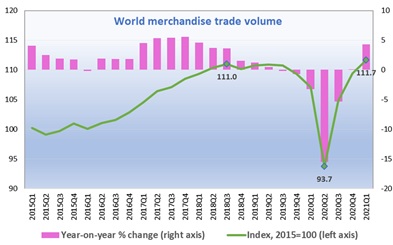
The volume
of world merchandise trade grew 2.1% quarter-on-quarter in Q1, which is equivalent
to an annual rate of 8.7%. Year-on-year growth picked up to 4.3% in the same period.
A bigger increase is expected in the second quarter due to the steep decline in
the same quarter a year ago. The current
pace of recovery is broadly consistent with the WTO's most recent forecast of 31
March 2021, which predicted global merchandise trade growth of 8.0% in 2021 and
4.0% in 2022. Inequitable access to COVID-19
vaccines continues to pose the greatest threat to the economic outlook since a failure
to protect all people regardless of income leaves populations vulnerable to further
waves of infection. The next forecast update will be released in October.
Most
regions have seen merchandise exports and imports recover to varying degrees since
trade bottomed out in the second quarter of last year. The major exception is the
Commonwealth of Independent States (CIS) including certain former and associate
members, exports of which have continued to decline. In the first quarter of 2021, merchandise export
volumes were up in Asia (+21.0% year-on-year) and Europe (+1.9%). They were down
slightly in South and Central America (‑0.1%) and North America (‑2.2%),
and down more substantially in Africa (‑4.6%), the Middle East (‑8.4%)
and the CIS (‑13.9%).
By comparison,
merchandise import volumes were up year-on-year in all regions except Africa (‑0.9%)
and the Middle East (‑2.7%). Overall, it appears that the trade recovery to
date has been strongest in Asia and weakest in regions that export natural resources
disproportionately.
Merchandise trade values
Merchandise
trade in nominal US dollar terms also rebounded strongly in the first quarter, up
14% year-on-year, due to a combination of increased quantities and higher prices. The sharp decline and subsequent rebound since
the start of 2020 mostly reflects trends in manufactured goods trade, while other
product categories made smaller contributions. Prices of primary commodities fell
during the first wave of the pandemic but have since risen steadily, contributing
to the upswings in fuels, mining products and agricultural products trade. In May
2021, prices were up 194% year-on-year for fuels, 54% for metals, 45% for food and
26% for agricultural raw materials according to IMF primary commodity price statistics.
Source:
WTO estimates.
WTO estimates
for the first quarter of 2021 show strong year-on-year growth in all main product
categories of merchandise trade. Manufactured goods trade was up 16% in the first
quarter after having fallen 18% in the second quarter of 2020 at the height of the
pandemic. Trade in agricultural products was up 11% in the latest quarter while
shipments of fuels and mining products rose 9%.
Source:
WTO estimates.
Sub-sectors
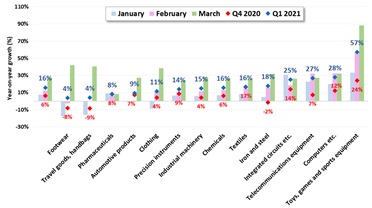
of manufactured goods showed positive year-on-year export growth in the first quarter
(see chart above). Computers, telecommunications
equipment, and integrated circuits all recorded robust year-on-year trade growth
of between 25% and 28% in the latest quarter.
In contrast, personal items such as footwear, handbags and clothing saw more
modest increases of between 4% and 11% (see above). Growth in exports of pharmaceuticals
moderated to 8% in the first quarter after having spiked last year.
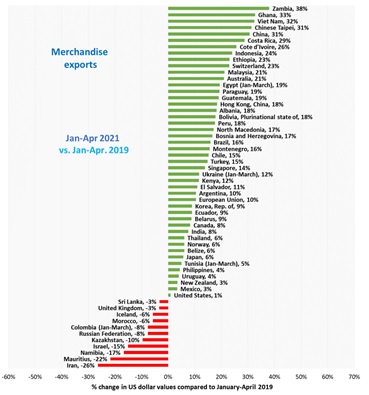
Despite
the strong recovery of merchandise trade values in the first quarter of 2021, exports
of many economies remain below their pre-pandemic peaks. This is illustrated by
the following chart showing growth in the cumulative US dollar value of exports
from January to April 2021 compared to the same period in 2019 for selected economies. Exports of the United States only increased by
1% over this period while those of the European Union rose 10%. Exports of the Russian Federation remained below
their level of two years ago (-8%) while those of China were up sharply (+31%). Some countries such as Zambia (+38%) benefitted
from improved terms of trade over this period as metals prices rose nearly 50% since
2019, whereas others such as Namibia (-17%) did not.
Source:
National data, Eurostat, and Trade Data Monitor (TDM).
The latest
trade statistics are presented here. More
of the short-term trade statistics are available in the WTO Data Portal. As
the data are subject to frequent revisions, the statistics cited above are estimates
as of time of publication.