Nairobi Ministerial of WTO Ends, US has its Way
India Isolated again, Signs on Dotted Line
Arun and Asim Goyal Report Direct from Nairobi
Nairobi, 19 Nov: The Tenth Ministerial Conference (MC10) ended in Nairobi, Kenya, on Saturday
19 Nov at the Kenyatta Conference Centre, refurbished with Rs.
80 crs from US and EU donors. Dancers pirouetted to
the beat of African music at the start of the event but few remained by the
extended session on Saturday. The mood turned despondent as ministerial
achieved little beyond the IT Agreement between the super powers.
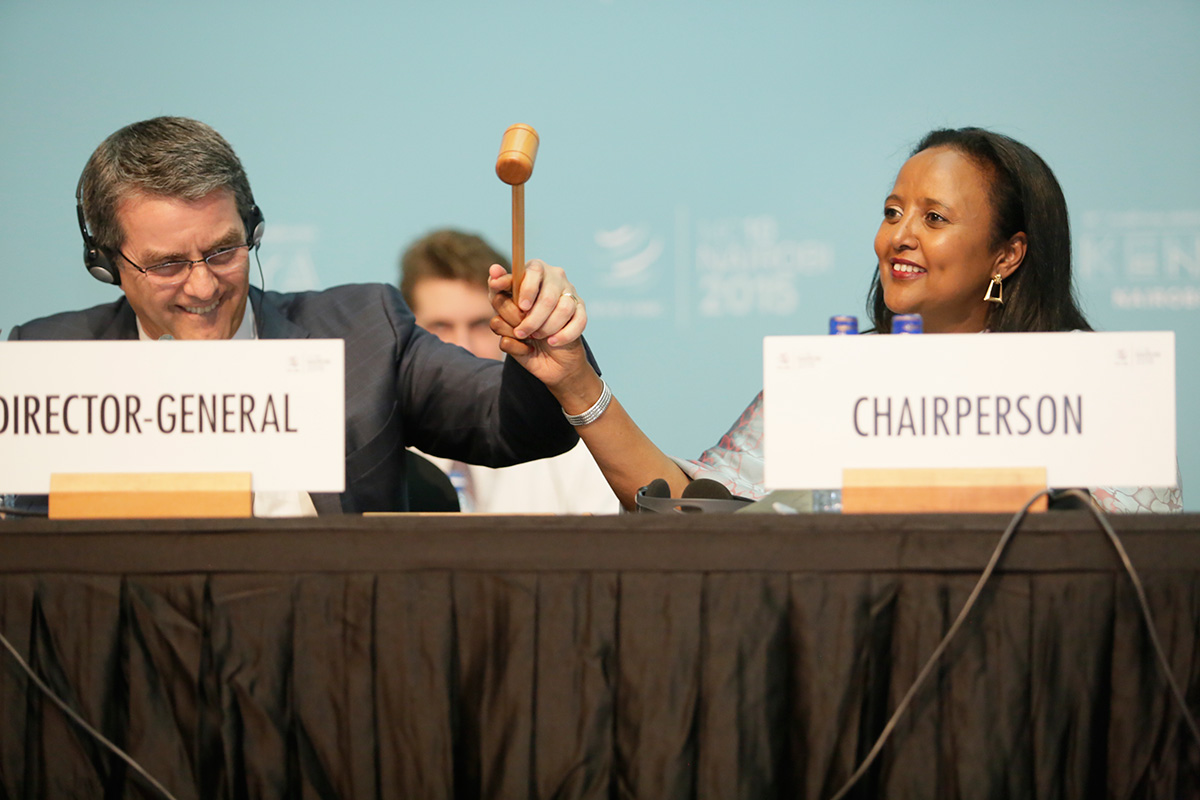
Conference Chairman Amina Mohamed and WTO DG Azevêdo "Its done"
Nairobi Ministerial Declaration (NMD) saw a
concluded ITA-II between 52 of the 162 members. (The remaining 110 get free
rides at zero duty for their exports accounting for only 10% of world IT
trade).
New negotiating approach from developing and least
developed economies was visible with tacit support to New Issues advocated by
Developed world.
The accession of Liberia and Afghanistan and
expressions of interest from Somalia and Iran shows the enlargement of the WTO
footprint.
“Members must decide – the world must decide –
about the future of this organisation,” said WTO Director-General Roberto Azevêdo during the closing moments of the ministerial. (It
seems that the Developed Countries and trade super powers see WTO as a means of
maintaining rule based trade through dispute settlement. The market openings
will be in the realm of RTAs).
“The world must decide what path this organisation
must take. Inaction itself is a decision and I believe the price of inaction is
too high,” Azevêdo added, noting that the year ahead
leaves them with a “very serious task.”
The agreement disciplining agricultural export
competition is lauded as “historic”, “an achievement that eluded the trade
system for 60 years” since the GATT imposed similar curbs on export subsidies
for industrial goods.
|
“We recognize that many Members reaffirm the Doha
Development Agenda, and the Declarations and Decisions adopted at Doha and at
the Ministerial Conferences held since then, and reaffirm their full
commitment to conclude the DDA on that basis. Other Members do not reaffirm
the Doha mandates, as they believe new approaches are necessary to achieve
meaningful outcomes in multilateral negotiations. Members have different
views on how to address the negotiations,” the declaration reads. The
way ahead could mean revival of the Singapore issues of Investment
Competition Policy, Currency, Energy and Tech Trade. The US will go full out
on zero for zero deals in other sectors on the lines of the ITA I and ITA II
and Government procurement agreements. |
The declaration specifically refers to agriculture
- domestic support, market access, and export competition - as well as the
other two core issues of industrial market access and services as issues where
members aim to advance work.
Mike Froman: Time to
be honest, we are at the end of the line on Doha
The US has for the first time publicly called for
the Doha Round of global trade negotiations to be abandoned, arguing that after almost
a decade and a half of fruitless discussions, it was time to try new
approaches. This point was recognised upfront in the final Ministerial
Declaration.
Writing in the Financial Times ahead of the World
Trade Organisation’s biennial ministerial meeting in Nairobi this week, USTR
Mike Froman said that 14 years after it was launched
the Doha Round “simply has not delivered”.
“It is time for the world to free itself of the
strictures of Doha.”
The belief of most people in the global business
community is that it died a painful and final death in 2008 amid a stalemate
over agriculture between developed and developing nations. The first blow to
Doha was in Cancun Ministerial in year 2003 followed by the July 2004 package
at Geneva when the so-called Singapore issues like investment and competition
policy were dropped. The issues of agriculture subsidies by India almost killed
the Bali ministerial meet in 2013. The Trade facilitation agreement which was
part of the Doha agenda was concluded in an ‘early harvest’ programme in this
meeting.
Frustrated at the lack of progress on the Market
Access agenda, the US and others have turned their focus in recent years to new
regional negotiations such as the recently concluded TransPacific
Partnership, which included the US, Japan and 10 other economies.
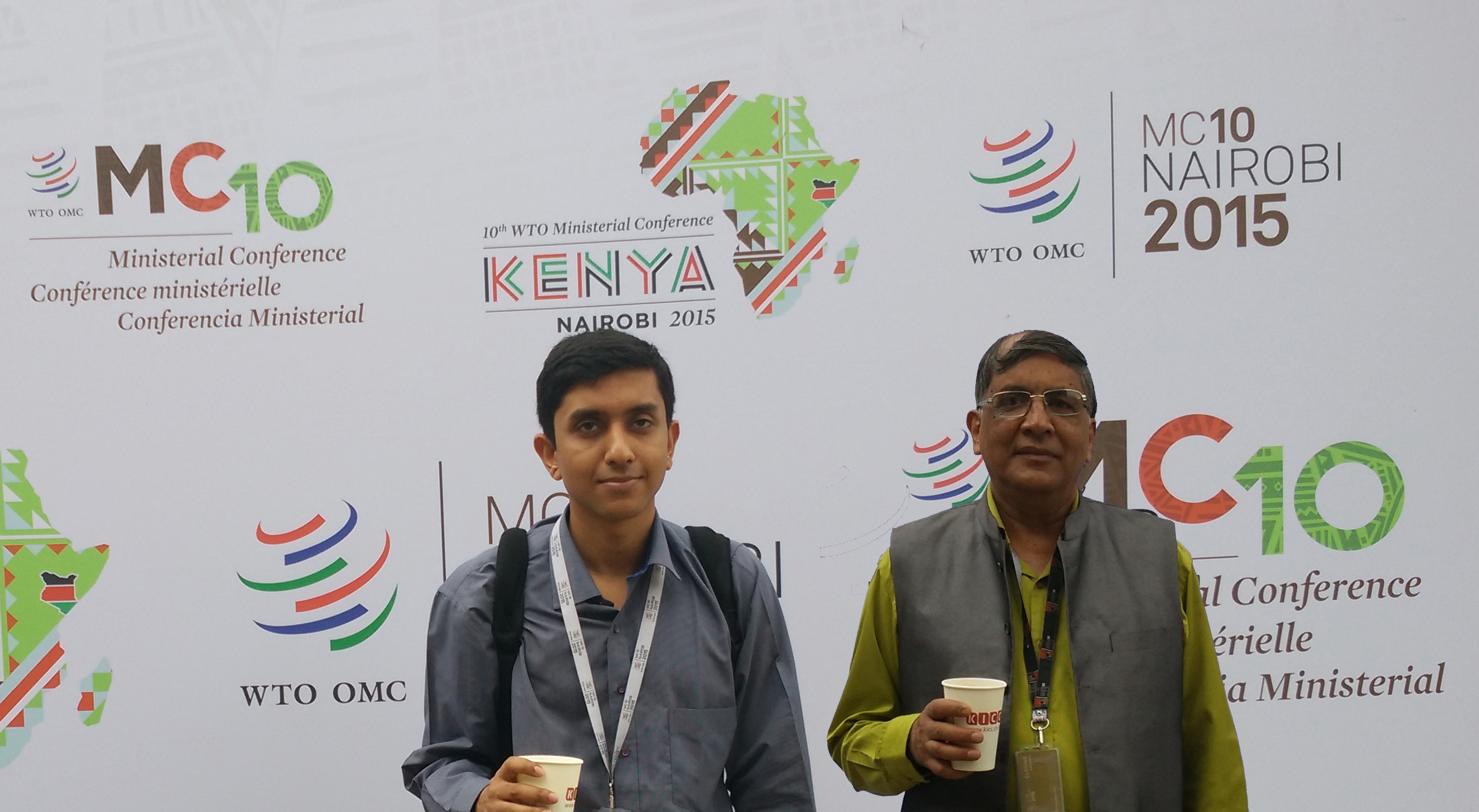
WTS Reporters
Japan, EU and Australia tilt to the US position
In the lead up to this week’s gathering, other big
advanced economies such the EU and Japan have sided with the US in its push for
a new approach to negotiations after the Nairobi meeting and a shift to more
focused discussions on specific sectors rather than a monolithic global
agreement.
EU Commissioners Cecilia Malmström
and Phil Hogan – responsible for trade and agriculture, respectively – joined
the fray in a joint public statement, saying that they were “concerned by the deep
persisting differences” between governments on the postNairobi
WTO agenda. While the organisation should “keep working on” the outstanding
Doha issues, it should also start to address other issues that are important
for today’s global trade, the Commissioners argued.
Amina Tilts against India
On 18 December, the Kenya Minister and Conference
Head openly declared at a press conference that India and Africa covering 53
Developing and LDC members differed Agriculture subsidies. She said that it is
time to bury artificial groups, self-interest is more important.
China Looms
Doha rules of engagement as outdated, particularly
with regard to China. Beijing, US officials argue, now has the biggest farm
subsidy program in the world. And yet under Doha it is considered a developing
economy and may not cut subsidies in the event of a deal even
Developing Countries
The US stance seemed directly at odds with the
position taken by India and numerous other developing countries, many of which
have argued that the long running talks need to be concluded before moving on
to new issues.
A joint ministerial statement from the African
Group, China, Ecuador, India, and Venezuela called for a redoubling of efforts
to “proceed towards the full, successful, and multilateral conclusion of the
negotiations,” referring to the Doha mandate. (It is ironical that these very
countries were vehemently opposed to Doha and wanted the unfinished tasks of
the Uruguay Round process to be completed before taking on Doha. Now that the
finishing line is changed to the TPP type frame, Doha has changed form from
“enemy” to “friend”).
Although not referring specifically to the position
taken by Froman, the group highlighted the various
benefits they say would come from a successful, “comprehensive” conclusion of
the Round with “economically meaningful and balanced outcomes.”
Separate statements from both the least developed
country (LDC) and small, vulnerable economies (SVE) trade ministers issued
going into the conference also called for a successful conclusion to the Doha
Round trade talks.
An achievement of great significance, the ITA-II
involves products currently valued at US$1.3 trillion annually and responds to
the continued evolution of the global digital economy. For many, this model of
Most-Favoured Nation (MFN)-based, represented by the ITA-II may become an
increasingly more common alternative to multilateral trade agreements under the
WTO. The big players do a deal between themselves while the smaller ones accede
to the done deal without negotiating on their concerns. The smallest ones come
in as “free riders”, that is they export to the signatories at zero duty but
charge duty on imports.
E-commerce
WTO members also extended their moratorium
prohibiting customs duties on electronic transmissions until the next
ministerial conference in 2017, along with renewing a related work programme.
The organisation’s General Council is mandated to report in December 2016 and
July 2017 on related issues arising in WTO bodies where the work programme is
being implemented.
Regional Trade Agreements
The continued proliferation of regional trade
agreements (RTAs) has been another area of both interest and concern for WTO
members, with the ministerial declaration including language reaffirming “the
need to ensure that [RTAs] remain complementary to, not a substitute for, the
multilateral trading system.”
The language draws from a proposal made by Brazil
on the subject in the context of the WTO’s rules negotiations. The decision
puts in place a more active process to report by the next ministerial due in
2017.
Agriculture: Four New Decisions
The Nairobi package includes new ministerial
decisions covering a special safeguard mechanism for developing countries; a
decision on export subsidies and other “export competition” elements; a
decision on cotton; public stockholding for food security purposes.
The decisions, which are legally binding, represent
the “most significant outcome on agriculture” seen in the WTO’s 20-year
history, Azevêdo told members.
Special Safeguard Mechanism – Dedicated Mechanisms
The G-33 group assembling a set of developing
countries, that includes China, India, and Indonesia as well as many smaller
economies, had argued in favour of a special safeguard mechanism that will
allow developing countries to raise tariffs temporarily to respond to sudden
import surges and price depressions. Countries such as Australia, Brazil, and
the US wanted a cut in tariffs to go with SSM.
The new decision states that developing countries
will “have the right to have recourse” to a special safeguard mechanism “as
envisaged under paragraph 7 of the Hong Kong Ministerial Declaration.
It also says that WTO members will pursue
negotiations on a special safeguard mechanism for developing country members in
dedicated negotiating sessions of the WTO agriculture committee.
Export Competition – Financing, State Enterprises,
Food Aid EU Discontinues Subsidies
This decision groups together export subsidies with
other types of export support instruments that can distort competition: export
credits, export credit guarantees and other types of export financing;
exporting state trading enterprises; and food aid.
When the Doha talks were launched, the EU insisted
that these other types of arrangements also be disciplined in parallel to
efforts to phase out and ultimately eliminate export subsidies. The EU
subsidised exports at very high levels – reaching €10 billion in 2000 - and
since almost totally curbed.
Historically, the US has been the main provider of
export credits and food aid, while Canada, New Zealand and Australia have
operated exporting state trading enterprises, some of which have since been
privatised.
While the EU has discontinued export subsidies for
most products, Switzerland, Norway, and Canada still notify support to the WTO,
and some developing countries such as India or Turkey also provide this type of
support but have not formally notified it to the trade body.
Although the Hong Kong ministerial declaration has
said that developing countries should be allowed to provide Article 9.4 export
subsidies – related mostly to marketing and internal transportation - for five
years after export subsidies are eliminated, the legal authority for doing so
under the Agreement on Agriculture has already expired.
Export Subsidies – End by 2018
Under the decision, developed countries will
immediately eliminate their remaining agricultural export subsidies. These
types of payments have long been seen as particularly trade-distorting, and
already prohibited for manufactured goods. At the Hong Kong ministerial
conference in 2005, members agreed that these payments would be eliminated by
2013, although the wider stalemate on the Doha agenda meant that this deadline
was missed.
A footnote provides an exception until 2020 for
developed countries that provide these subsidies on “processed products, dairy
products, and swine meat,” to accommodate countries such as Switzerland and
Canada that still use this type of support. The exception nonetheless would
require the countries concerned not to export these products to least developed
countries.
Developing countries must also eliminate their
export subsidies by the end of 2018. Again, a footnote provides an exception
until 2022 for some countries which have notified their support to the WTO.
An extended 2023 deadline is also provided for
developing countries to use export subsidies for transport and marketing, which
were originally covered under article 9.4 of the Agreement on Agriculture. The
arrangement is in keeping with other WTO clauses providing “special and
differential treatment” to developing countries - often in the form of longer
implementation periods for commitments. Least developed countries and net food
importing developing countries will be allowed to do so until 2030.
Special arrangements are made for export subsidies
on cotton. Developed countries would have to immediately implement their export
subsidy commitments for this product, and developing countries would have until
January 2017 to do so. More ambitious disciplines on cotton have long been a
special demand of West African cotton-producing countries in the C-4 - Benin,
Burkina Faso, Chad, and Mali.
Export Credits, Export Credit Guarantees, or
Insurance Programmes–18 Months Limit
The decision says that maximum credit repayment
periods for developed countries would be eighteen months. The EU, Brazil, and
other members had proposed nine month repayment periods under certain
conditions. Although current US legislation allows repayment periods of up to
24 months, actual practice is believed to be 18 months.
Developing countries would initially also be
allowed to extend credit for longer periods of up to 36 months, although this
would be gradually reduced to 18 months over the course of a four-year
implementation period.
Exporting State Trading Enterprises
The decision states that WTO members must ensure
that exporting state trading enterprises do not operate in a manner that
circumvents any other disciplines. This could be interpreted as meaning that
these enterprises must not be allowed to operate in a way that effectively
subsidises exports once the relevant deadlines in the export subsidy section of
the text have expired.
A “best endeavours” clause would also commit
members to making their best efforts to ensure that any export monopoly powers
exerted by these bodies do not distort trade, the text says.
Food Aid
New language on food aid would commit WTO members
to refrain from providing in-kind food aid where this might cause an adverse
effect on local or regional production of the same or substitute products. The
decision would also require them to ensure that international food aid does not
unduly impact established, functioning commercial markets of agricultural
commodities.
The decision would also establish new commitments
affecting the extent to which countries would be allowed to “monetise” food aid
- meaning for donors to sell in-kind food in recipient countries so as to raise
funds for development projects.
The text would require WTO members to monetise international
food aid “only where there is a demonstrable need” for transport purposes, or
where monetisation is used to redress food deficit requirements or
“insufficient agricultural production situations” which give rise to hunger and
malnutrition in least developed and net food-importing countries. Other
requirements are also included in the decision - such as for a market analysis
to take place before monetisation occurs.
Public Stockholding – Not in Doha Process
On public stockholding, the G-33 group of
developing countries has argued that current farm subsidy rules unfairly
constrain their ability to purchase food at administered prices as part of
their public programmes for food security purposes. The 2013 Bali ministerial
saw WTO members agree not to challenge these schemes under the trade body’s
dispute settlement process, and members agreed a year later that this
arrangement would apply until a permanent solution is reached.
The G-33 have argued that price inflation over the
last two decades have eroded the degree of flexibility they have to provide
farm subsidies, even if purchases are made at administered prices that are
below the level of international market prices.
The new text says that WTO members note the Bali
decision, and also reaffirm a November 2014 decision extending the arrangement
until a permanent solution is reached.
Today’s agreement also says that negotiations will
be held on the subject in dedicated negotiating sessions of the WTO’s
agriculture committee - but that these will be distinct from Doha negotiations.
Cotton – Developing Countries including China to
provide Market Access
African countries have long sought stricter
disciplines on cotton, and in particular in the area of domestic support.
The new agreement says that developed countries
shall grant “to the extent provided for in their respective preferential trade
arrangements” duty free and quota free market access for least developed
country cotton exports, from 1 January 2016 onwards.
Developing countries “declaring themselves in a
position to do so” would undertake the same commitment - and a footnote
clarifies that this would include China, both for general market access
commitments and also in their preferential trade agreements. In the past,
the US has often argued that China ought to undertake market access commitments
as part of a broader sectoral agreement in this area.
The most recent proposal from the C-4 group would also have included separate
market access commitments for developing countries, including China.
An annexed product list would also specify which
other cotton-related products would benefit from similar market access
treatment.
Substantive advances for LDC issues– 75% Foreign
Material Allowed
LDCs had repeatedly voiced concerns that these
preferential rules of origin are often too restrictive and impose onerous
compliance burdens, making it difficult for them to take full advantage of
existing preferential margins.
The decision adopted in Nairobi now sets a
timeframe for preference-granting members to undertake the commitments
contained in the decision by 31 December 2016.
Regarding the value addition threshold, the
document allows for the use of materials not originating from an LDC to make up
to 75 percent of the final value of a product for it to qualify for
preferential treatment. Some observers consider, however, that 75 percent
non-originating material is in fact still prohibitive, given modern
manufacturing methods based on global value chains which require in some cases
only very little domestic content.
Services Waiver
Discussions on the services waiver for LDCs – which
had proved difficult on certain technical aspects early in the morning
yesterday – eventually led to a compromise on the draft text proposed by
Rwandan Minister of Trade and Industry François Kanimba,
who was facilitating those talks.
The draft text adopted in Nairobi provides for an
extension of the existing services waiver until 31 December 2030.
The text also contains provisions related to the
provision of technical assistance and initiation of a process to review the
operation of notified preferences.
Special and differential treatment
Discussions on special and differential treatment
(S&DT) continued to prove divisive on Friday, before ultimately collapsing.
The proponents met yesterday morning to “essentially restate their positions
and even backslide,” said one developed country trade delegate.
Various consultations took place on the subject,
however issues related to balance of payments, sanitary and phytosanitary
measures, technical barriers to trade, safeguards, LDC-specific issues and also
tariff negotiations have been cited as being particularly problematic.
The revised text presented by the facilitator in
this issue, WTO Deputy-Director General Yonov
Frederick Agah, was rejected by the G-90 and LDCs as
it did not reflect any consensus, said one source close to the process.
Instead, on Saturday morning, the G-90 submitted a draft decision which
included text on future work on the issue, instructing the Committee on Trade
and Development in Special Session (CTD SS) to continue to negotiate on the
basis of specific proposals tabled by the G-90 last November with a view to
achieving agreement on all proposals by 31 July 2016.
An outcome on S&DT could not be secured as members
had “opposing interests,” explained Azevêdo.
“S&DT is an area that is horizontal, crossing
across all WTO agreements. These are also difficult negotiations, as it is
about the flexibilities in the agreement,” he said.
No Transparency on Anti-dumping
The first draft decision would have instructed the
WTO Committee on Anti-Dumping Practices, through its Working Group on
Implementation, to study and make recommendations to report to the General
Council on a specific list of topics. This would be done in order to ensure
“maximum possible” predictability and objectivity in implementing the relevant
provisions in the Anti-Dumping (AD) Agreement. The Committee on Subsidies and
Countervailing Measures would also have been instructed to study these outcomes
to determine their relevance and report conclusions to the General Council.
Some industry voices have cautioned that the
proliferating use of trade remedies could threaten expansion or foreign
investment in growing and salient industries, pointing to areas such as clean
energy technologies. Other experts in Nairobi, however, considered that the
steps proposed chair’s text would not have been a high-ambition outcome.
The document was panned by several nations,
including Russia among others, who had also circulated its own revised draft
decision on transparency issues in anti-dumping and countervailing measures on
Friday morning. Moscow reportedly expressed disappointment that the chair’s
text did not explicitly include a reference to the Agreement on Subsidies and
Countervailing Measures (SCM) in the instructions paragraph on implementation
recommendations, as featured in its proposal.
Fisheries Subsidy to Stay
The second draft decision on fisheries subsidies
would have decided to work towards completing negotiations within specific
timeframe – potentially two years, though this was bracketed – for prohibitions
on subsidies linked to illegal, unreported, or unregulated (IUU) fishing and
those provided to any vessel or fishing activity “negatively affecting fish stocks
that are in an overfished condition.”
This language was reportedly resisted in the final
stretch on Friday by the 28-nation EU. The chair’s document would also have had
members commit to a best endeavour standstill on introducing new fisheries
subsidies contributing to overcapacity and overfishing in so far as these
undermine the development livelihood and food security prospects of developing
countries – a move rejected by China, given its estimated sizeable domestic
support in this area.
The draft decision also included additional
fisheries subsidy programmes notifications commitments under the SCM Agreement
with guidance on format outlined in an annex, taking into account each members’
resources and technical capacity. China and India reportedly struck out against
the supplementary notifications on Friday afternoon, reiterating concerns these
did not constitute a development outcome, due to the potential additional
burden it could imposed on poorer countries.
Academy of Business Studies News Service