Pascal Lamy
Calls upon India to Team Up with US to Revive Doha
- A Report
by Arun Goyal, Editor -
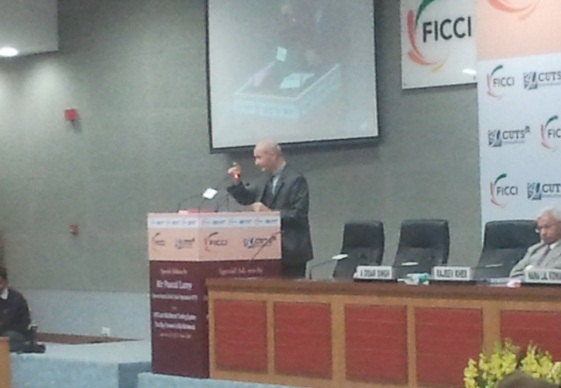 The WTO DG Pascal Lamy
addressed a packed house at FICCI on the 29th of January in the run up to the
December Bali Ministerial. The Commerce Ministry was represented by Rajiv Kher who put forward the traditional protectionist concerns
of India. The meeting was organised jointly by CUTS and FICCI.
The WTO DG Pascal Lamy
addressed a packed house at FICCI on the 29th of January in the run up to the
December Bali Ministerial. The Commerce Ministry was represented by Rajiv Kher who put forward the traditional protectionist concerns
of India. The meeting was organised jointly by CUTS and FICCI.
Lamy said that an understanding of trade today is a
must to inform the political concerns of national governments. Today more than
50 percent export depends on imports. 40 percent of imports are made up of parts and components.
Bilateral and regional trade agreements favour the strong countries. India can
afford to meet the loss due to the weakening of multilateral trade vis-a-vis regional and bilateral
trade but the small countries cannot stand up in the new milieu. They have to
globalise to survive.
Indian bound tariff is 50 percent but applied tariff is 15 percent.
This gap is under attack in the Doha market access negotiations. If India
accepts the US demand to bring the 50 down to 25, Doha will revive. India,
Brazil and China are different from the LDCs and must pull their weight in Doha
negotiations.
Regulatory convergence
Lamy also said that regulatory affairs convergence in
global trade administration is of even greater importance than tariffs to bring
order in movement of goods and services.
Banking
convergence although not the subject matter of WTO will, in a similar way, lead
the world out of the current financial crisis in both fiscal and monetary affairs.
Expansion of global supply
chain is yet another subject in today’s trade. Goods and services cross many
borders in several directions during production and trade before entering the
consumers’ door.
Value addition in world
trade is redefining the traditional meaning of exports and imports. Services
trade is double at 40 percent in value terms.
In the high range countries
of China, Japan and EU, 30 percent of GDP is trade.
India and Brazil are at 15 percent. US is only 10 percent.
Trade facilitation
Border costs are three to
four times the tariffs. Land locked countries are starved by border costs.
Father of trade facilitation
was Kautilya. India and US
should agree to push negotiations forward.
Trade facilitation, Agri rules and LDC support are three will be the low
hanging fruit which can be harvested at Bali for a mini Doha.
Microsoft complained in the
question answer session on Indian practices of customs valuation. It said
deviations from WTO rules should be checked. WTO must align theory with practice
and there must be a fair set up.