RBI Delivers
without a Policy Rate Cut
The slew of liquidity and financial market measures promises
pre-Diwali cheer
As
widely expected, the Monetary Policy Committee maintained status quo on the key
policy rate, with inflation rate holding above the RBI’s comfort level. But the
MPC brought pre-Diwali cheer by giving a ‘whatever it takes’ assurance to
revive growth, as it looked at the “current inflation hump as transient”.
The
5:1 vote of the six-member MPC in favour of a
continued accommodative stance “at least during the current financial year and
into the next financial year”, also offered markets an extended comfort on
rates and liquidity.
Key overhangs
The
policy had to address three key overhangs weighing on markets. One, the RBI’s
seemingly hardline stance on inflation, which has now eased with the current
narrative opening up scope for further rate cuts. Two, concerns over the RBI
reversing its liquidity stance to abate inflation worries. Three, the huge
oversupply of Central and State government bonds slated to hit the market
towards the end of the fiscal, exerting upward pressure on long-term bond
yields. The slew of liquidity and financial market measures announced by the
RBI considerably ease these concerns.
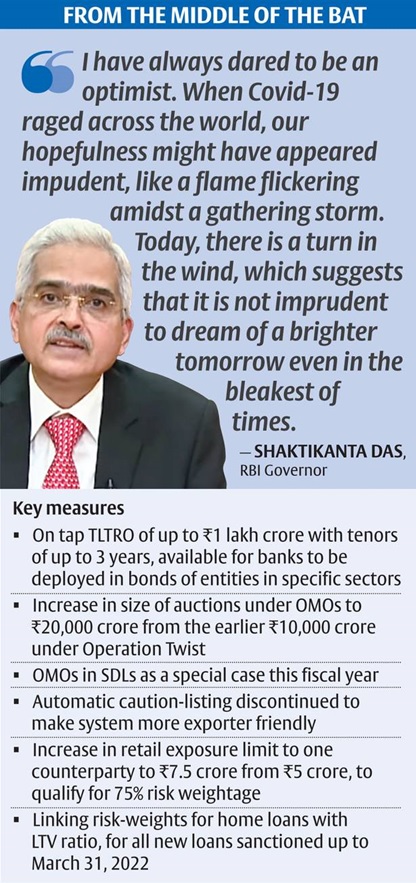
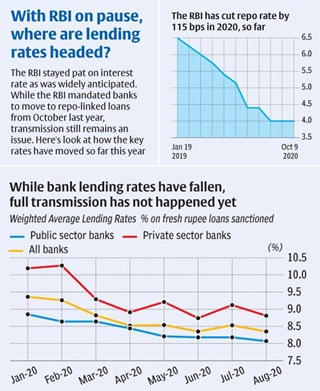
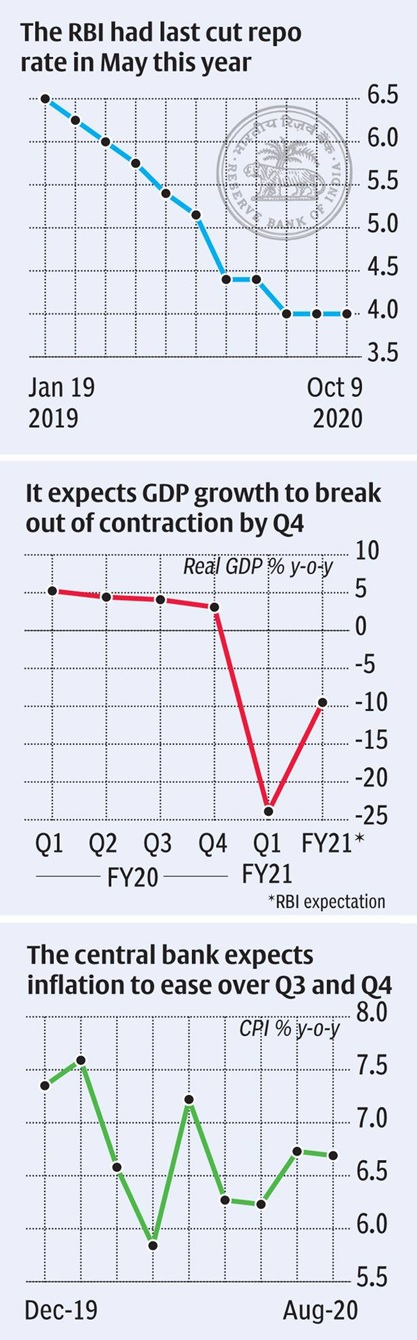
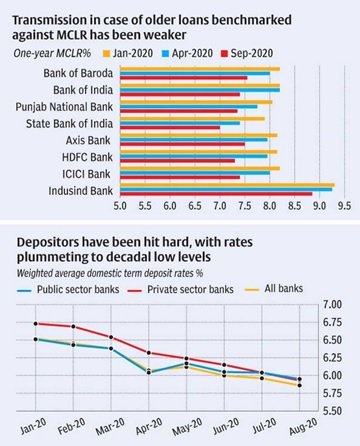
“The augmented borrowing programme for 2020-21 has been
necessitated due to the exigencies imposed by the pandemic in the form of the
fiscal stimulus and the loss of tax revenue. While this has imposed pressures
on the market in the form of expanded supply of paper, the RBI stands ready to
conduct market operations as required through a variety of instruments to
assuage these pressures, dispel any illiquidity in financial markets and
maintain orderly market conditions,” said RBI Governor Shaktikanta
Das.
SBI
Group’s Chief Economic Advisor Soumya Kanti Ghosh said: “Recourse to non-conventional policy
tools has been the most innovative tool that the RBI has been using to manage
financial stability in a most durable manner in the current challenging
circumstances. Accordingly, the adjustment in risk weights, OMO in SDL,
extension of co-origination model and enhanced HTM limits are measures that are
bold and pragmatic.”
While
conservatives will fret over both inflation and financial stability risks, Abheek Barua, Chief Economist,
HDFC Bank, believes that the RBI has not gone overboard in its effort to
support growth. “The Indian economy’s revival efforts are hobbled by the lack
of adequate fiscal support. If the monetary policy does have to do the heavy
lifting, it cannot do it within the confines of a conventional ‘take-no-risks’
framework,” he said.
“The
RBI,” said Ananth Narayan, Professor at SPJIMR, “has
managed the borrowing programme very well so far. The
big measures announced yesterday send a strong signal that the RBI will ensure
that yields are kept under check. Including T-bills, over ₹13-lakh
crore of central borrowing is already done. Hence, the real concern was with
SDLs, where only ₹3-lakh crore of borrowings
has been completed so far. The OMOs of SDLs is a welcome move that will address
the issue of oversupply of these bonds in the second half of the fiscal.”
Liquidity support
Radhika
Rao, Economist, DBS Group Research, believes that the liquidity support for
bond markets — Centre as well as State bonds – will be timely, helping to keep
a lid on risk-free yields and, by extension, borrowing costs.