RBI Tightens Export Credit Refinance, FIEO Protests
[RBI
Press Release dated 3rd June 2014]
Monetary
and Liquidity Measures
On
the basis of an assessment of the current and evolving macroeconomic situation,
it has been decided to:
· keep
the policy repo rate under the liquidity adjustment facility (LAF) unchanged at
8.0 per cent;
· keep
the cash reserve ratio (CRR) of scheduled banks unchanged at 4.0 per cent of
net demand and time liabilities (NDTL);
· reduce
the statutory liquidity ratio (SLR) of scheduled commercial banks by 50 basis
points from 23.0 per cent to 22.5 per cent of their NDTL with effect from the
fortnight beginning June 14, 2014;
· reduce
the liquidity provided under the export credit refinance (ECR) facility from 50
per cent of eligible export credit outstanding to 32 per cent with immediate
effect;
· introduce
a special term repo facility of 0.25 per cent of NDTL to compensate fully for
the reduction in access to liquidity under the ECR with immediate effect; and
· continue
to provide liquidity under 7-day and 14-day term repos of up to 0.75 per cent
of NDTL of the banking system.
Consequently,
the reverse repo rate under the LAF will remain unchanged at 7.0 per cent, and
the marginal standing facility (MSF) rate and the Bank Rate at 9.0 per cent.
|
Reduction in Export Credit Re-finance Limit will Affect
Availability and Push Cost of Credit, says FIEO President Commenting on the Bi-monthly Monitory Policy
statement of the Reserve Bank of India issued 3 June, Mr M Rafeeque Ahmed, President, Federation of Indian Export
Organisations (FIEO) said that reduction in the Export Credit Re-Finance
(ECR) from 50% to 32% will affect both the availability and cost of credit
which will be detrimental to competitiveness of Indian exports at a time when
Global economy is gathering momentum with Global trade forecasted to grow by
4.7% in 2014. Elaborating further Mr Rafeeque
said that banks would be reluctant to lend to the export sector, with the
reduction in ECR, which is already facing liquidity crunch, as share of
exports credit in net bank credit has come down drastically from close to 9%
to3.5% in last ten years. The cost of credit is also likely to go up between 0.5% to 1% and it is not clear to what extent the
special term Repo facility to 0.25% of net demand and time liquidity of the
bank will offset this loss said Mr Ahmed. FIEO Chief said that FIEO is
pushing to bring exports under priority sector lending and this move has
definitely upset us. [Source: FIEO Press Release dated 3 June 2014] |
Assessment
2. Since the
first bi-monthly monetary policy statement of April 2014, global activity is
evolving at different speeds. A broad-based strengthening of growth is gaining
traction in the US and the UK, after a moderation in the first quarter of 2014
due to adverse weather conditions. However, in the euro area, recovery is
struggling to gather momentum. The pick-up in sales in Japan in anticipation of
the consumption tax hike has been followed by a sharp fall in consumer spending.
Growth in coming quarters will depend on all three “arrows” being put in play.
Structural constraints continue to impede growth prospects in emerging market
economies (EMEs), with concerns about the slowdown in China as its economy
rebalances. Financial markets across the world still remain vulnerable to news
about the impending normalisation of interest rates in some developed
economies, even as some valuations appear frothy.
3. Lead
indicators point to continuing sluggishness in domestic economic activity in
the first quarter of 2014-15. The outlook for agriculture is clouded by the
meteorological department’s forecasts of a delay in the onset of the south-west
monsoon with a 60 per cent chance of the occurrence of El Nino. The ongoing contraction in the production of consumer durables
and capital goods, coupled with moderation in corporate sales and non-oil
non-gold imports, is indicative of continuing weakness in both consumption and
investment demand. The decisive election result, together with improved
sentiment should, however, create a conducive
environment for comprehensive policy actions and a revival in aggregate demand
as well as a gradual recovery of growth during the course of the year.
4. Retail
inflation measured by the consumer price index (CPI) increased for the second
consecutive month in April, pushed up by a sharp spike in food inflation,
especially in the prices of fruits, vegetables, sugar, pulses and milk. CPI
inflation excluding food and fuel has moderated gradually since September 2013
although it is still elevated.
5. For the year
2013-14 as a whole, India’s current account deficit (CAD) narrowed sharply to
1.7 per cent of GDP, primarily on account of a decline in gold imports,
although other non-oil imports also contracted with the weakening of domestic
demand, and there was some pick-up in exports. In April 2014, the trade deficit
narrowed sharply due to resumption of export growth after two consecutive
months of decline, and the ongoing shrinking of
import demand. Robust inflows of portfolio investment, supported by foreign
direct investment and external commercial borrowings, kept external financing
conditions comfortable and helped add to reserves.
6. With the
unwinding of year-end window dressing, the corresponding decline in the size of
excess CRR holding of banks as well as the sharp decline in Government cash
balances with the Reserve Bank as a result of Government expenditure, liquidity
conditions improved significantly in April and May 2014. The average daily
access to liquidity from the LAF and term repos during this period has been
close to 1.0 per cent of NDTL. The Reserve Bank will continue to monitor
liquidity conditions and will actively manage liquidity to ensure adequate flow
of credit to the productive sectors.
Policy Stance and Rationale
7. In March and
April, CPI headline inflation has risen on the back of a sharp increase in food
prices. Some of this price pressure will continue into May, but it is largely
seasonal. Moreover, CPI inflation excluding food and fuel has been edging down.
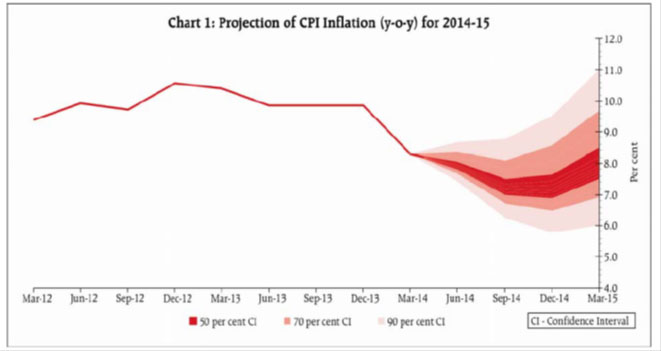
The risks to the central forecast of 8 per cent CPI inflation by January 2015
remain broadly balanced. Upside risks in the form of a sub-normal/delayed
monsoon on account of possible El Nino effects, geo-political tensions
and their impact on fuel prices, and uncertainties surrounding the setting of
administered prices appear at this stage to be balanced by the possibility of
stronger Government action on food supply and better fiscal consolidation as
well as the pass through of recent exchange rate appreciation. Accordingly, at
this juncture, it is appropriate to leave the policy rate unchanged, and to
allow the disinflationary effects of rate increases undertaken during September
2013-January 2014 to mitigate inflationary pressures in the economy.
8. The Reserve Bank remains committed to keeping
the economy on a disinflationary course, taking CPI inflation to 8 per cent by
January 2015 and 6 per cent by January 2016. If the economy stays on this
course, further policy tightening will not be warranted. On the other hand, if
disinflation, adjusting for base effects, is faster than currently anticipated,
it will provide headroom for an easing of the policy stance.
9. Contingent
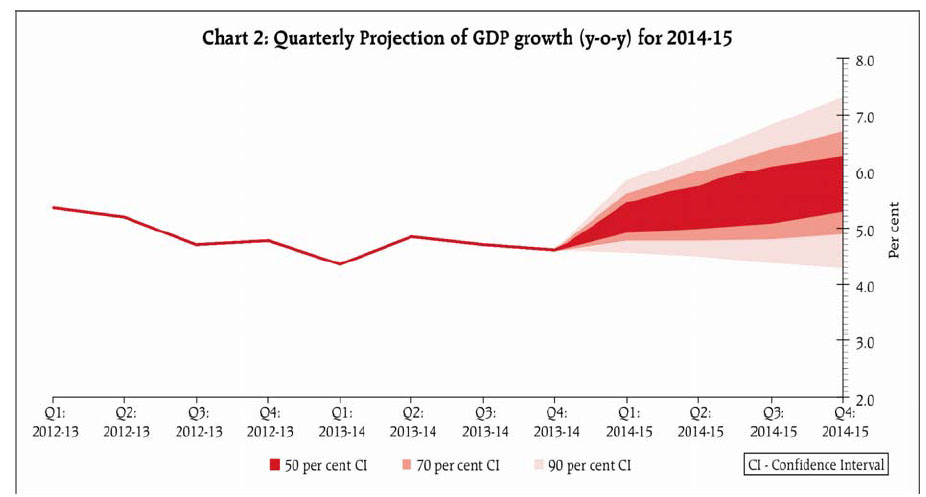
upon the desired inflation outcome, the April projection of real GDP growth
from 4.7 per cent in 2013-14 to a range of 5 to 6 per cent in 2014-15 is retained
with risks evenly balanced around the central estimate of 5.5 per cent (Chart
2). The outlook for the agricultural sector is contingent upon the timely
arrival and spread of the monsoon. Easing of domestic supply bottlenecks and
progress in the implementation of stalled projects should brighten the outlook
for both manufacturing and services. The resumption of export growth is a
positive development and as world trade gathers momentum, the prospects for
exports should improve further.
10. In pursuance
of the Dr. Urjit R. Patel
Committee’s recommendation to move away from sector-specific refinance towards
a more generalised provision of system liquidity without preferential access to
any particular sector or entity, the Reserve Bank has decided to limit access
to export credit refinance while compensating fully with a commensurate expansion
of the market’s access to liquidity through a special term repo facility from
the Reserve Bank (equivalent to 0.25 per cent of NDTL). This should improve
access to liquidity from the Reserve Bank for the system as a whole without the
procedural formalities relating to documentary evidence, authorisation and
verification associated with the ECR. This should also improve the transmission
of policy impulses across the interest rate spectrum and engender efficiency in
cash/treasury management.
11. As the
economy recovers, investment demand and the need for credit will pick up. To
the extent that this contributes eventually to supply, it is important that
banks have the room to finance it. A reduction in the required SLR will give
banks more freedom to expand credit to the non-Government sector. However, the
Reserve Bank is also cognisant of the significant on-going financing needs of
the Government. Therefore, the SLR is reduced by 0.50 per cent of NDTL, with
any further change dependent on the likely path of fiscal consolidation
12. With a view
to improving the depth and liquidity in the domestic foreign exchange market,
it has been decided to allow foreign portfolio investors to participate in the
domestic exchange traded currency derivatives market to the extent of their
underlying exposures plus an additional US$ 10 million. Furthermore, it has
also been decided to allow domestic entities similar access to the exchange
traded currency derivatives market. Detailed operating guidelines will be
issued separately.
13. As a
prudential measure, the eligibility limit for foreign exchange remittances
under the Liberalised Remittance Scheme (LRS) had been reduced to US$ 75,000
last year. In view of the recent stability in the foreign exchange market, it
has been decided to enhance the eligible limit to US$ 125,000 without end use
restrictions except for prohibited foreign exchange transactions such as margin
trading, lottery and the like. Operating guidelines will be issued separately.
14. At present,
only Indian residents are allowed to take Indian currency notes up to `10,000 out of the country.
Non-residents visiting India are not permitted to take out any Indian currency
notes while leaving the country. With a view to facilitating travel
requirements of non-residents visiting India, it has been decided to allow all
residents and non-residents except citizens of Pakistan and Bangladesh to take
out Indian currency notes up to `25,000
while leaving the country. Operating guidelines in this regard are being issued
separately.
15. The third
bi-monthly monetary policy statement is scheduled on Tuesday, August 5, 2014.