RBI Trims Repo Rate by 35 bps
·
Unveils
a Measures to Boost Consumer Credit
With
an eye on addressing economic growth concerns and kick-starting private
investments, the Reserve Bank of India on Wednesday announced an unconventional
35-basis-point cut in the repo rate.
This
is a shift away from the convention of effecting rate changes in multiples of
25 basis points (bps). The central bank also unveiled a host of measures to
boost consumer credit and enhance credit flow to non-banking finance companies.
While
emphasising that there is nothing sacrosanct about
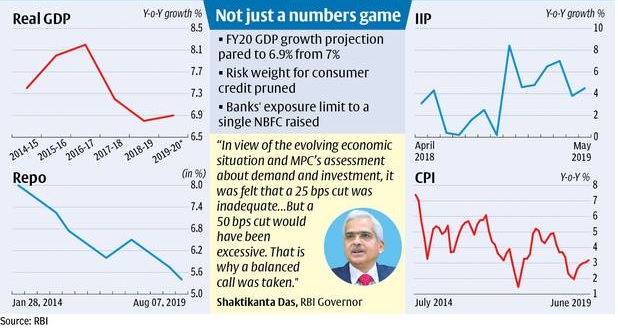
rate action being only in multiples of 25 bps, RBI Governor Shaktikanta
Das said: “In view of the evolving economic situation and MPC’s assessment
about demand and investment, it was felt that a 25 bps cut was inadequate. But
a 50 bps cut would have been excessive. That is why a balanced call was taken.
So, keeping in mind the requirement of the economy, the MPC has taken the
decision unanimously to reduce the policy repo rate.”
While
all six members of the Monetary Policy Committee (MPC) voted unanimously to
reduce the policy repo rate, four voted for a 35 bps cut and two for 25 bps.
All the members voted to maintain the accommodative stance of the monetary
policy.
Following
the rate cut, the repo rate is now at 5.40 per cent against 5.75 per cent
earlier.
Benign inflation
outlook
From
February 2019 till date, the RBI has cumulatively cut
the repo rate by 110 bps. The benign inflation outlook provides headroom for
policy action, the RBI said in a statement.
Referring
to banks reducing interest rates on fresh rupee loans by only 29 bps during the
February to June 2019 period when the repo rate was cut by 75 bps, Das observed
that the banking system is flush with liquidity. Hence, the rate cuts effected
by the RBI and the liquidity which it has injected together have now initiated
the cycle of rate cuts vis-a-vis fresh loans from banks.
To
give a leg up to consumer credit, including personal loans but excluding credit
card receivables, the RBI cut the risk weight on the segment from 125 per cent
to 100 per cent. What this means is that lenders will need to set aside
relatively less capital to make such loans. To help NBFCs overcome liquidity
issues, the central bank has decided to raise the limit of a bank’s exposure to
a single NBFC to 20 per cent of the Tier-I capital against 15 per cent now.
The
RBI has allowed, subject to certain conditions, their lending to the latter
(other than microfinance institutions) for onward-lending to agriculture, micro
and small enterprises and housing, to be classified as priority sector lending.
This move is aimed at encouraging banks to lend to the NBFCs.
GDP and inflation
The
MPC has revised downwards the projection of real GDP growth to 6.9 per cent for
2019-20 against 7 per cent quoted in its June resolution.
Das
said the downward adjustment in the GDP growth projection was warranted by
various high-frequency indicators pointing to weakening of both domestic and
external demand conditions.
The
MPC has retained its inflation projection at 3.1 per cent for Q2
(July-September) 2019-20 and has revised the projection for H2 2019-20
(April-September) to 3.5-3.7 per cent, with risks evenly balanced, from 3.4-3.7
per cent projected in June.