Report Shows Trade Restrictions by WTO Members
at Historically High Levels
The Director-General’s annual overview of trade-related
developments discussed on 12 December at a meeting of the Trade Policy Review Body
shows that trade restrictions by WTO members continue at historically high levels.
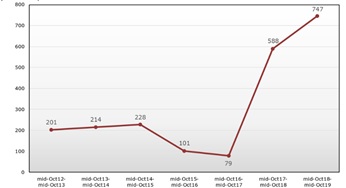
Between mid-October 2018 and mid-October 2019, the trade coverage of import-restrictive
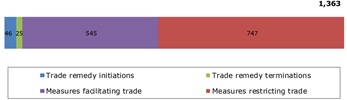
measures implemented by members was estimated at USD 747 billion. This is the highest
trade coverage recorded since October 2012 and represents an increase of 27% compared
to the figure recorded in the previous annual overview (USD 588 billion). The report
notes that new trade restrictions and increasing trade tensions added to the uncertainty
surrounding international trade and the world economy.
In presenting the report to members, Director-General
Roberto Azevêdo said:
"The report's findings should be of serious concern for WTO members
and the broader international community. Historically high levels of trade-restrictive
measures are hurting growth, job creation and purchasing power around the world.
Strong collective leadership from the membership would make an important contribution
to increasing certainty, encouraging investment and bolstering trade and economic
growth. Without such action, however, unfavourable trends
could become worse."
The report shows that 102 new trade-restrictive measures were put in
place by members during the review period, including tariff increases, quantitative
restrictions, stricter customs procedures, and imposition of import taxes and export
duties. The main sectors targeted by the new import restrictions were mineral and
fuel oils (17.7%), machinery and mechanical appliances (13%), electrical machinery
and parts thereof (11.7%) and precious metals (6%).
Such trade measures are adding up over time. WTO Secretariat estimates
suggest that the accumulated stockpile of import restrictions introduced since 2009,
and still in force, currently affects 7.5% of world imports. At the end of 2018,
USD 1.5 trillion out of a total USD 19.5 trillion of world imports were estimated
to be affected by import restrictions put in place by WTO members over the last
decade. As of mid-October 2019, this trade
coverage was estimated at USD 1.7 trillion, suggesting that the stockpile of import
restrictions has continued to grow.
During the same review period, WTO members also implemented 120 new
measures aimed at facilitating trade, including reducing or eliminating tariffs,
export duties and import taxes. The trade coverage of the import-facilitating measures
implemented during the review period was estimated at USD 545 billion, the second
highest figure for this type of measures since October 2012.
In addition, liberalization associated with the 2015 expansion of the
WTO's Information Technology Agreement (ITA) continues to feature as an important
contributor to trade facilitation. The trade coverage of the import-facilitating
measures implemented during the review period associated with the ITA amounted to
USD 705 billion, according to preliminary WTO estimates.
Overall, the monthly average of initiations of trade remedy actions
by WTO members remained stable compared to 2018. However, the second half of the
review period saw this figure accelerate, in particular as a result of new anti-dumping
investigations, which continue to be the most frequent trade remedy action.
The report also provides evidence of the continuous increase in trade
issues and concerns raised in a wider range of WTO bodies during the review period.
About 230 trade concerns were raised in some 28 formal meetings of WTO bodies other
than the Committee on Sanitary and Phytosanitary Measures
and the Technical Barriers to Trade Committee, showing an increase of 8% per meeting
compared to the previous annual overview. WTO members are increasingly using multiple
platforms within the WTO committee structure to address various aspects of their
trade concerns and for exploring solutions to trade frictions non-litigiously.
Key findings
·
This Report covers new trade and trade-related
measures implemented by WTO members between 16 October 2018 and 15 October 2019.
During the review period, new trade restrictions and increasing trade tensions added
to the uncertainty surrounding international trade and the world economy.
·
World trade growth stalled during
the review period and, on 1 October 2019, the WTO downgraded its forecast for world
trade growth in 2019 to 1.2%; down from the previous estimate of 2.6% from last
April. Risks to the forecast are predominantly on the downside and include a further
ratcheting-up of trade-restrictive measures and a sharper slowing of GDP growth
in one or more major economies.
·
WTO members implemented 102 new trade-restrictive
measures during the review period. The trade coverage for the import-restrictive
measures was estimated at USD 746.9 billion. This is the highest recorded since
October 2012 and represents an increase of 27% compared to that in the previous
annual overview (USD 588.3 billion). The trade coverage of import-restrictive measures
recorded in the last two annual overviews has soared.
·
The stockpile of import restrictions
implemented since 2009, and still in force, suggests that 7.5% of world imports
are affected by import restrictions implemented since 2009. At the end of 2018,
USD 1.5 trillion out of a total USD 19.5 trillion of world imports were estimated
to be affected by import restrictions put in place by WTO members over the last
decade. The trade coverage of import-restrictive measures implemented since 2009
and still in force by mid-October 2019 is estimated at USD 1.7 trillion, suggesting
that the stockpile of import restrictions has continued to grow.
·
WTO members also implemented 120 new
measures aimed at facilitating trade. The trade coverage of the import-facilitating
measures introduced by WTO members during the review period was estimated at USD
544.7 billion. This is the second highest trade coverage reported for this type
of measures since October 2012.
·
Overall, for the review period, the
monthly average of initiations of trade remedy actions by WTO members remained stable
compared to 2018. However, the second half of the review period saw this figure
accelerate, in particular as a result of new anti-dumping investigations. The trade
coverage of trade remedy initiations during the review period was estimated at USD
46.2 billion, and that of terminations at USD 24.8 billion. Both figures are significantly
higher than the trade coverage recorded for these measures in the previous report.
Trade coverage of new import-restrictive measures
in each reporting period (not cumulative)
(USD billion)
Note: These figures are estimates and represent the trade coverage
of the measures (i.e. annual imports of the products concerned from economies affected
by the measures) introduced during each reporting period, and not the impact of
the trade measures.
Source: WTO Secretariat.
Trade coverage of new import-facilitating measures
in each reporting period(not cumulative)
(USD billion)

Note: These figures are estimates and represent the trade coverage
of the measures (i.e. annual imports of the products concerned from economies affected
by the measures) introduced during each reporting period, and not the impact of
the trade measures. Liberalization associated with the 2015 Expansion of the WTO's
ITA is not included in the figures.
Source: WTO Secretariat.
Cumulative trade coverage of import-restrictive
measures in force since 2009
(USD billion and % of world merchandise imports)

Note: The cumulative trade coverage estimated by the Secretariat is
based on information available in the TMDB on import measures recorded since 2009
and considered to have a trade-restrictive effect. The estimates include import
measures for which HS codes were available. The figures do not include trade remedy
measures. The import values were sourced from the UNSD Comtrade
database.
Source: WTO Secretariat.
WTO trade remedies initiations and terminations
(average per month)

Note: Values are rounded.
Source: WTO Secretariat.
Trade measures, mid-October 2018 to mid-October
2019
(by number)

Source: WTO Secretariat.
Trade coverage of trade measures, mid-October
2018 to mid-October 2019
(USD billion)
Note: 2018 figures. ITA expansion measures are not included.
Source: WTO Secretariat.