Revenue
Dept Goes Slow on Several Anti-Dumping Case
What’s common between Thai radial tyres for buses and lorries and Chinese caustic soda? They
are among a whole host of items on which the revenue department has not imposed
antidumping duty, despite the directorate general of trade remedies (DGTR)
recommending action.
The list of such items is only growing by
the day, with industry estimates suggesting that there are 25-30% of the products
on which the DGTR’s recommendation has been rejected during the last 18-20
months. DGTR is the agency housed in the commerce department, In contrast,
during the earlier months, revenue department’s strike rate in acting on DGTR’s
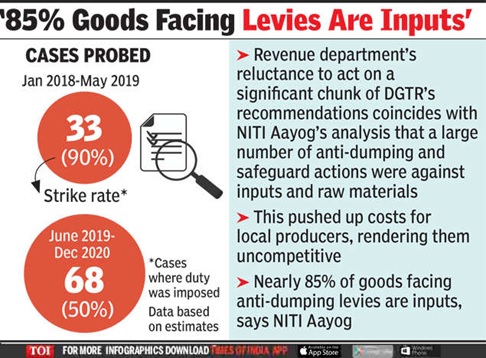
recommendations was as high as 90%. Between January 2018 and May 2019, there
were 33 investigations by the agency and the number nearly doubled during the
next 18 months.
The revenue department’s reluctance to act
on a significant chunk of the recommendations is seen as a change of stance and
coincides with NITI Aayog’s analysis that a large
number of anti-dumping and safeguard actions were against inputs and raw
materials, which pushed up costs for local producers, rendering them
uncompetitive. Nearly 85% of the goods facing antidumping levies are inputs,
NITI Aayog had assessed.
While globally too
inputs face the highest number of action, a section in NITI Aayog
and revenue department viewed these actions as protectionist, although they are
trade defence measures provided by the World Trade
Organization (WTO). Since it got the powers under the WTO regime, India is the
world’s biggest user of the anti-dumping weapon.
Even now industry believes that the revenue
department’s decision against imposing the recommended levies, meant to protect
domestic industry against cheap imports, is resulting in imports of around Rs 20,000 crore annually and hurting them. A bulk of these
shipments are coming from China and causing job losses, industry
representatives said.
For instance, of the 68 cases investigated
by DGTR between June 2019 and December 2020, over half involved imports from
China, government sources confirmed. To impose anti-dumping duty, DGTR has to
establish injury to the domestic industry due to exports of goods at a price
lower than the domestic market. In most cases India’s actions have been aimed
at Chinese goods.