Semiconductors: Your Car is a Computer on Wheels
A modern car is one of the most complex, software-driven gadgets
in the world. No wonder, a chip the size of a thumbnail can make it run or stop
it.
[ABS News Service/14.03.2022]
Commenting on February 2022 sales data released on Friday, Rajesh
Menon, the director general of the Society of Indian Automobile Manufacturers (SIAM),
said, “Sales in February 2022 declined compared to February 2021—across passenger
vehicles, two-wheelers and three-wheelers. Supply-side challenges like semiconductor
shortage … impacted sales.”
Semiconductor (chip) shortage
By now, it’s fairly common knowledge how the chip shortage started:
—During the first lockdown in 2020 and the shift to work from
home and study from home, people bought laptops and mobile devices in unprecedented
numbers;
—Sales of gaming devices shot up (urban kids were at home, not
on playgrounds);
—Car sales picked up after the 2020 lockdown and pent-up demand
meant orders piled up.
Cars, mobile devices, laptops and gaming consoles … all need
chips to work, and chip industry couldn’t supply to this demand.
Then, some black swan events impacted chip production—winter
storm shutting down chip plants in Texas in early 2021, fire at Renesas Electronics’ chip plant in Japan in mid-2021, and surge
of Covid-19 cases in Malaysia in late 2021.
Automotive analysts FE talked to said that the chip shortage
may continue for the rest of CY22, though it might start to ease a bit. While India
has sanctioned Rs 76,000 crore under the PLI (production-linked
incentive) scheme to encourage manufacturing of chips, it will take time to fructify.
But where are chips in cars?
Have you ever wondered how at the touch of a button the car window
opens and closes, how if another vehicle comes closer your car’s sensors start beeping,
how a slight push to the accelerator pedal can enhance the power delivery of the
engine in a fraction of a second?
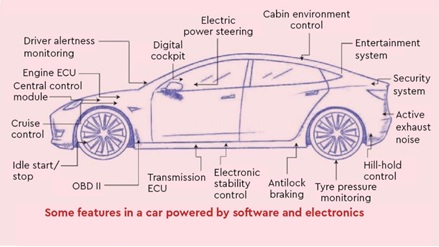
There is something working deep inside a car—software codes that
make these physical acts possible. That software runs on a microprocessor.
Then there is the microcontroller, which includes the microprocessor
and some peripherals. This microcontroller controls automatic functions needed to
run a car—from sending the right amount of fuel to the engine to controlling brakes,
and from controlling the human-machine interface (HMI) display to operating automatic
seats, windows, mirrors, and so on.
“An entry-level car might have 15-20 such microcontrollers, and
a connected car could have more than 100 such microcontrollers,” Anup Sable, CTO, KPIT Technologies, told FE. Essentially, software
codes are written for operating a particular function of a car, and the microcontroller
makes that code interact with the physical control.
The usage of such devices in vehicles is increasing. CV Raman,
chief technology officer, Maruti Suzuki India Ltd, said
that contemporary petrol/diesel cars use semiconductors in almost all functional
areas, such as powertrain, body control, steering system, braking systems, airbag
system, infotainment and vehicle telematics system, and so on.
This usage, Raman added, is only going to go up with the mass
arrival of electric cars. “Electric cars, in addition to the above, use various
controllers for managing the electric powertrain. The key components of the e-powertrain—including
the battery, motor, inverter and the charging system—require additional electronics
and semiconductors. Further, some auxiliary systems, such as the compressor, vacuum
pump and regenerative braking systems, need to be converted from mechanical to electric
type to suit electric car requirements, leading to additional usage of semiconductors,”
he said.
In a typical contemporary car, the share of electronic components
by value may range from 10-15%, “but in electric cars this may be about 1.5 times
that in conventional petrol/diesel cars,” Raman said.
The usage of chips is also increasing due to the rising popularity
of connected cars in India. These cars have an inbuilt eSIM,
and offer features such as voice-based navigation, voice-assisted phone calls, in-car
air quality monitoring, remote engine start, and are also capable of over-the-air
software updates. A lot of companies—from Kia to Hyundai to MG to Tata, and others—today
sell connected cars in India.
It’s not just advanced cars, even the seemingly ‘simpler’ vehicles
such as entry-level motorcycles or tractors need semiconductors. “Almost all vehicles
that have some or the other automatic function need these devices,” Sable said.
So the next time you observe your car responding to your voice
or the AC maintaining the cabin temperature or the anti-lock braking system helping
avoid an accident, do remember that software running on a tiny chip the size of
a thumbnail is helping the car do that.