Services Trade Drops 30% in Q2 as COVID-19 Ravages
International Travel
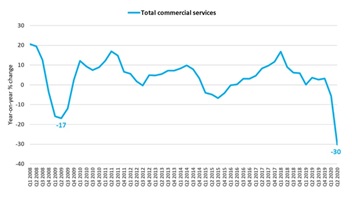
Global trade in services in the second quarter of 2020 plunged
by a record 30% year-on-year, with the travel sector particularly hard hit by COVID-19
and associated restrictions. Declines in services trade were recorded across all
regions and most services sectors except for computer services, which was buoyed
by a shift towards remote working and a rising demand for digitalization.
Source: WTO-UNCTAD-ITC
estimates.
The latest contraction in services trade is the steepest since
the financial crisis, when global commercial services trade plummeted by 17% in
the second quarter of 2009. Services exports in the second quarter of 2020 were
down 32% in North America,
29% in Asia and 26% in Europe on a year-on-year basis. Preliminary
estimates suggest even sharper declines for Latin America and the Caribbean (-46%)
and a drop of 60-65% for least-developed countries.
Source: WTO-UNCTAD-ITC
estimates.
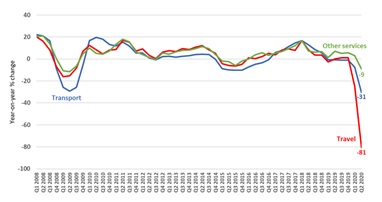
Tourism was particularly hard hit, with international travellers' expenditure down 81% and transport down 31%. These
two sectors make up 43% of services trade. The drop in transport matches declines
recorded during the financial crisis (-29%), but the underlying reasons are different.
Unlike in 2009, the decrease in transport services trade is driven predominantly
by restrictions to passenger transport and a fall in global demand for international
travel, not by sharp declines in freight shipping.
Source: WTO estimates
based on WTO-UNCTAD-ITC data.
Other services were affected unevenly
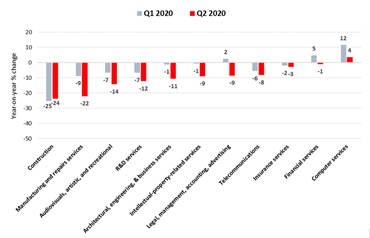
by the pandemic. Sectors requiring physical proximity fell steeply such as construction
(-25%) and audio-visual, artistic and recreational services (-14%). Architectural
and engineering services, closely linked with construction, and other business services
were also down 11%. Contract manufacturing services also collapsed (-22%), with
factory production halting in many countries. Uncertainty about the economic context
also had an impact on research and development (R&D) services, with exports
from this sector declining 8% in the United States and 11% in the European Union.
Financial services were only marginally affected, emphasizing
the very different nature of this crisis from the financial crisis, when exports
dropped by 20% in the first quarter of 2009. Recent growth in this sector is even
understated due to the dollar appreciation. For example, intra-EU trade in financial
services rose by 2% in euro terms, while it stagnated in dollar terms.
Computer services, the fastest growing services sector in the
last decade, was the only one to record an increase in exports, which was up 4%
due to the rising demand for digitalization. This trend has been further accelerated
by the pandemic.