Stay Safe from Mucormycosis
- a Fungal Complication being Detected in COVID-19 Patients
·
Control Diabetes, Use Steroids Judiciously, Keep Good Hygiene, Don’t
Self-Medicate
[MoH&FW
Press Release/14.05.2021]
Even as we try our best to protect ourselves from and cope
with COVID-19, there is another threat being posed by a fungus, which we must know
and act upon. Mucormycosis, a fungal infection, is being
reported in a few COVID-19 patients during or post recovery. As per a statement
given by the Health Minister of Maharashtra two days ago, more than 2000 people had already been affected by this fungal infection in the state; 10 people had even succumbed to it. Some patients even lost their
eyesight.
What causes Mucormycosis?
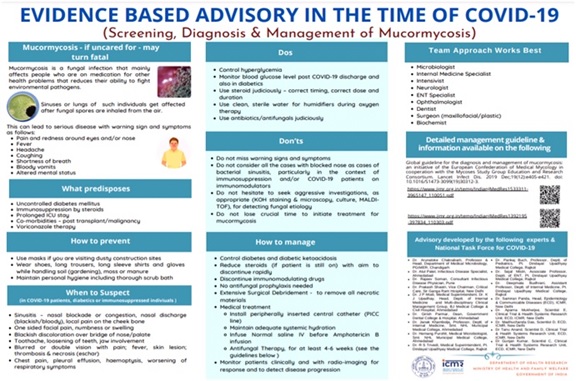
Mucormycosis or black fungus is a complication caused by fungal infection. People catch mucormycosis by coming in
contact with the fungal spores in the environment. It can also develop on the skin
after the fungus enters the skin through a cut, scrape, burn, or other type of skin
trauma.
The disease is being detected among patients who are
recovering or have recovered from COVID-19. Moreover, anyone who is diabetic and
whose immune system is not functioning well needs to be on the guard against this.
According to an advisory issued by the Indian Council of Medical
Research, the following conditions in COVID-19 patients increase the risk of mucormycosis infection:
1.
Uncontrolled diabetes
2.
Weakening of immune system due to use of steroids
3.
Prolonged ICU/hospital stay
4.
Co-morbidities / post organ transplant /
cancer
5.
Voriconazole therapy (used to treat serious fungal infections)
How it is related with COVID-19
The disease is caused by a set of micro-organisms known as
mucormycetes, which are present naturally in the
environment, seen mostly in soil and in decaying organic matter like leaves, compost
and piles.
In normal course, our body’s immune system successfully fights
such fungal infections. However, we know that COVID-19 affects our immune system.
Moreover, the treatment of COVID-19 patients involves intake of drugs like dexamethasone,
which suppress our immune system response. Due to these factors, COVID-19 patients
face a renewed risk of failing the battle against attacks mounted by organisms such
as mucormycetes.
In addition, COVID patients undergoing oxygen therapy in ICU,
where humidifier is used, are prone to fungal infection because of exposure to moisture.
But this does not mean that every COVID patient will get infected
by Mucormycosis. The disease is uncommon in those not
having diabetes but can be fatal if not treated promptly. Chances of recovery depend
upon early diagnosis and treatment.
What are the common symptoms?
Mucormycosis begins to manifest as skin infection in the air pockets located
behind our forehead, nose, cheekbones, and in between the eyes and teeth. It then
spreads to eyes, lungs and can even spread to the brain. It leads to blackening
or discoloration over the nose, blurred or double vision, chest pain, breathing
difficulties and coughing of blood.
The Indian Council of Medical Research has advised that not
all cases of blocked nose should be considered as cases of bacterial sinusitis,
particularly during/after the treatment of Covid-19 patients. One must seek medical
help for detecting fungal infection.
How is it treated?
While the infection may just begin with a skin infection, it
can spread to other parts of the body. Treatment involves surgically removing all
dead and infected tissue. In some patients, this may result in loss of upper jaw or sometimes even the eye. Cure may also involve a 4-6 weeks course of intravenous anti-fungal therapy. Since it affects
various parts of the body, treatment requires a team of microbiologists, internal
medicine specialists, intensivist neurologists, ENT specialists, ophthalmologists,
dentists, surgeons and others.
Controlling diabetes is one of the foremost prevention methods
suggested by ICMR. Hence, COVID-19 patients who are diabetic need to take utmost
care.
Self-medication and over-dosage of steroids can result in fatal
events and hence doctor’s prescription should be strictly followed. Speaking about the adverse effects of inappropriate use of steroids,
Member (Health), NITI Aayog, Dr. V.K. Paul says: “Steroids
should never be administered at an early stage of COVID-19. It should be taken only
after sixth day of infection. Patients should stick to appropriate doses of the
drugs and take the drug for specific number of days as advised by the doctors. Rational
use of medicines should be ensured to avoid adverse side effects of the drug.”
“Other than steroids, use of COVID-19 drugs such as Tocilizumob, Itolizumab also suppresses
the immune system. And when these drugs are not used appropriately, it increases
the risk, as our immune system fails to fight the fungal infection.” Dr. Paul adds.
ICMR in its guidelines has also advised COVID-19 patients to
discontinue immunomodulating drugs, a substance that stimulates
or suppresses immune system. The National COVID-19 Task Force has revised the dosage
of Tocilizumab to prevent any such adverse effects. Maintaining proper hygiene can also help keep the fungal infection
away.
For patients on oxygen therapy, it should be ensured that the
water in the humidifier is clean and is refilled regularly. Attention should be
paid to ensure there is no leakage of water (to avoid wet surfaces where the fungus
can breed). Patients should maintain proper hygiene by keeping their hands as well
as body clean.
Be on guard after COVID Recovery as well
After recovering from COVID-19, one should closely monitor
and should not miss any warning signs and symptoms mentioned above, as
the fungal infection is found to emerge even weeks or months after recovery. One
should make judicial use of steroids as per doctor’s advice to avoid risk of infection.
Early detection of the disease can ease the treatment of the fungal infection.