Steel Ministry Releases 5-Point
Plan for Steel Role in $5tn Economy
[Ministry
of Steel Press Release dated 24.12.2019]
Steel:
Crucial in India’s ascent to $5 Trillion economy
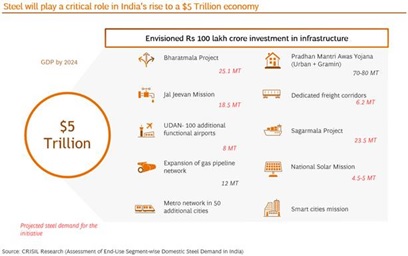
The Government's vision to achieve a $5 trillion economy by 2024
entails investments worth INR 100 lakh crore in infrastructure sectors, including
several steel intensive sectors like Housing for All, 100% electrification, piped
water for all etc. Steel has several inherent advantages of durability, faster completion
time, reduced environmental impact, and creation of a circular economy. Steel will
have a crucial role to play in India’s rise to a $5 trillion economy.
5-year Vision of the Ministry of Steel
Keeping in mind the importance and relevance of steel in building
a $5 trillion economy, the Ministry of Steel has defined its Vision in order to
shape and drive the Indian steel sector. To ensure the Vision incorporates India’s
growth imperatives and addresses the aspirations of all stakeholders of the Indian
steel ecosystem, the Ministry thoroughly studied relevant policy documents and held
many stakeholder consultations such as:
·
National Steel Policy (NSP) 2017:
Finalized by the Ministry of Steel and notified on 8th May 2017, the NSP laid down
key imperatives to ensure that the Indian steel sector is prepared to service the
growing requirements of modern India and to promote a healthy sustainable growth
for the sector.
·
Publications from various high-level bodies
such as NITI Aayog’s publications E.g. ‘Need for a New
Steel Policy – 2016’, ‘Strategy Paper on Resource Efficiency in Steel Sector through
Recycling of Scrap & Slag’ etc.
·
90+ stakeholder consultations from across
breadth of the steel value chain including - raw material providers; primary, secondary
and end user industries; logistics and other enabling industries
·
“Chintan Shivir” - an idea generation event involving 900+
representatives from across the Steel sector
·
Consultations and discussions with relevant
Central ministries and State governments
Derived from the detailed studies and consultations to further
develop the Indian steel sector and to ensure a robust and globally competitive
domestic steel industry as a critical pillar in India’s ascent to a $5 trillion
economy in a rapid environmentally sustainable manner, the Ministry of Steel has
laid out a comprehensive vision:
“Meet
the anticipated demand of 160 million tons of steel for becoming a $5 trillion economy,
through a competitive, efficient, environment friendly steel industry, adhering
to global safety and quality standards.”

Roadmap
towards achievement of the 5-year vision
The 5-year vision for the Ministry of Steel defines key imperatives
for the sector across 5 broad areas. In order to achieve the stated elements of
the Vision, the Ministry translated each of these 5 elements into 11 key initiatives
to action:

1.
Increase steel usage intensity to boost
Demand Generation – Make in Steel
2.
Improve Trade Balance for the steel sector
3.
Enable supply through best-in-class Greenfield
capacity addition
4.
Set-up value addition focused Steel Clusters
5.
Increase raw material production (by leveraging
Digitization in Mining)
6.
Promote domestic manufacturing and procurement
of Capital Goods for steel
7.
Promote a shift to an environmentally friendly
steel sector
8.
Promote R&D for the Indian steel sector
9.
Promote safety and workforce welfare for
the Indian steel sector
10. Facilitate
development of skilled manpower
11. Ensure
sufficient infrastructure and logistics capacity for the steel sector
In
order to ensure focus and drive tangible outcomes, The Ministry has prioritized
5 out of these initiatives due to their potential impact on ease of doing business/living,
employment generation as well as their criticality to economic growth.

High
Impact 100-day initiatives
From
across these initiatives, 4 key elements had been prioritized by the Ministry of
Steel under the 100 days agenda of the Government. A brief summary of progress on
these initiatives is as follows:

a.
Framework policy on creation of steel clusters
-
Aimed at encouraging the MSMEs in the steel sector, this would boost production
of value-added products, drive import substitution and help create additional employment
in the steel sector.A draft policy for the same has been
prepared and uploaded online for stakeholder consultation. A cabinet note is being
prepared and the policy shall be notified post cabinet approval.
b.
Steel scrap policy -
To ensure adequate availability of scrap for steel manufacturers which will reduce
imports and improve competitiveness of Indian steel sector. Steel Scrap policy has
been notified on 7th November 2019 with roles and responsibilities for
players (aggregators, processing centres) & government
bodies (E.g. MoEFCC, CPCB) defined.
c.
Safety guidelines for Iron and Steel sector
- Ministry
of Steel had constituted a working group to develop the Model guidelines of safety
practices for iron and steel sector. This shall ensure that safe practices are adopted
in all manufacturing units, large and small, of iron & steel. It shall ensure
a healthy working environment and guard against possible hazards and risks at the
workplace.25 safety guidelines have been finalized and uploaded on the Ministry
of Steel website for adoption by the iron and steel sector.
d.
Steel Import Monitoring System (SIMS) -
An institutional mechanism in conjunction with DGFT has been envisioned for steel
import monitoring. This would be a completely online system for advance registration
for intended imports of steel. This information would be useful to the Indian domestic
steel industry in responding to market conditions in a dynamic manner.SIMS platform has been launched on 16th September 2019
and implementation has already started at the port of entry from 1st November 2019.
In
addition to these 4 initiatives, the Ministry of Steel has also worked on 6 other
key initiatives. These initiatives include:
a.
Raw Material Securitization -
To ensure short-term and long-term raw material security for the steel sector, the
Ministry of Steel has worked closely with the Ministry of Mines to initiate several
key actions.
Five proposals for amendments in the relevant mining rules have
been sent to the Ministry of Mines. Some of the major proposals include:
·
Rule 3 of Mineral (Mining of Govt. Companies
Rule) 2015 – Word “may” would be replaced with “shall” to remove uncertainty
·
Reduction in royalty proposed from 15% to
5% to dispose low grade fines to incentivize pelletization
and beneficiation
·
Liquidation of 70 MT iron ore fines (including
slime) at SAIL
·
Increasing the size of mining lease areas
c.
Digitization of mines in steel CPSEs -
To improve the operational and cost efficiencies as well as to increase the transparency
in the mining sector, digitization is being driven across the Steel CPSEs.Detailed roadmap has been put in place to kick-start the
digitization journey for the iron ore mining sector in the country for improvements
in utilization, productivity and safety. The project will involve 2 phases with
involvement from key Central Public Sector Enterprises. Identification and institutionalization
of digital lighthouse project by NMDC to identify and streamline operating modalities
has been initiated.
d.
Noamundi
block initiative - Social indicators of the Noamundi Block in the West Singhbhum
(Chaibasa) District, Jharkhand are not reflective of richness
of area in terms of natural resources (iron ore). Large organizations like SAIL,
Tata Steel etc. have significant experience that can be leveraged for social transformation
in the region. Core team has been set up under the leadership of Deputy Commissioner,
West Singhbhum with representatives from SAIL, Tata Steel
and Ministry of Steel. This program focuses on collaboration and convergence of
efforts, resources, technology and thereby enabling people to participate in economy
and governance.
e.
Outreach to workforce of Steel CPSEs -
People are the key drivers of success for most organizations. This is even more
prominent in an employment intensive sector like steel. Therefore, they need to
be the focus of the organization and their issues need to be taken care of.For this, multiple actions have been initiated at the steel
CPSEs. At SAIL, pension scheme is being implemented and process for Wage Revision,
2017 of Non-executives and 3rd PRC for executives will be implemented.
f.
Synergising
steel CPSEs’ hospitals with Ayushman Bharat -
Ayushman Bharat Yojana was launched
in 2018 as the national health protection scheme by providing coverage of 5 lakh
rupees per family per year for secondary and tertiary care hospitalization. SAIL
maintains 3000+ beds in its hospitals for employees, families and others.These SAIL hospitals will be linked with the Ayushman Bharat Yojana to leverage
existing synergies. Process of empanelment of these hospitals with Ayuhsman Bharat Yojana will be completed.
g.
Promotion of Steel Usage -
In order to leverage the several benefits afforded by steel and to transition to
an environmentally sustainable steel sector, it is crucial to promote steel usage
in the country.Multiple initiatives have already been
initiated for enhancing the domestic steel demand. These include:
·
Draft note of Committee of Secretaries (CoS) sent for inter-ministerial consultation. Under this note,
multiple proposals for addition/modifications of steel based construction codes
and necessary clauses in tender documents have been included to improve steel usage.
Additionally, initiatives to increase steel usage in road and bridge construction
have also been included.
·
Collaborative branding campaign of ‘Ispati Irada’ launched
with logo, portal and communication by national level brand ambassador P.V. Sindhu.
·
Letters sent to various Central Ministries/
Departments to improve usage of steel in Government projects.
·
Requests sent to State Governments for increasing
usage of steel intensive/composite structures in building and bridge construction
projects and for putting up steel crash barriers.
Interactions held with INSDAG, SAIL-CET, MECON, HSCL, ISA, architects,
builders, and contractors for increased steel usage in commercial and residential
construction.
A brief on Indian Steel Sector is given below:
BRIEF ON INDIAN STEEL SECTOR
The steel industry has been a core pillar of industrial development
in India. From a capacity of ~1MT at the time of independence, India’s crude steel
capacity has risen to ~142 MT at present and India has become the world’s second
largest producer of steel (~111 MT crude steel production in 2018). A vibrant domestic
steel industry is important for a developing economy as it is a critical input across
major sectors such as construction, infrastructure, automotive, capital goods, defence, rail etc. Steel has also been proven to be a driver
for prompt environmentally sustainable economic development due to its recyclable
nature and faster associated completion times. The steel sector is also pivotal
for a nation due to driving employment generation and economic growth. It has a
multiplicative effect on the economy stemming from both direct and associated effects
on the supply chain and consumption industries.
The Ministry of Steel, Govt. of India is responsible for planning
and development of iron and steel industry, development of essential inputs such
as iron ore, limestone, dolomite, manganese ore, chromites,
ferro-alloys, sponge iron etc. and other related functions.
1.
Steel industry at a glance
The steel industry in India is well established and has shown
a steady growth. The demand for finished steel has consistently grown at 6.4% over
the past 5 years reaching ~99 MTPA in 2018-19. In accordance with the rising demand,
the crude steel capacity in the country has also increased to 142 MTPA.
1.1 India’s crude steel capacity and production:-
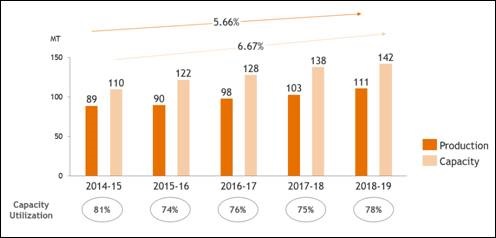
Domestic crude steel capacity and production has shown a sustained
rise since 2014-15. Crude steel production grew at a compound annual growth rate
(CAGR) of 5.6% during the last five years ending 2018-19 along with robust capacity
expansion from ~110 Million Tonnes (MT) in 2014-15 to
~142 MT in 2018-19, showcasing a strong 6.6% CAGR.
India’s
crude steel capacity and production (2014-19) (Source: JPC)
·
Crude steel capacity in country stood at
142.236 million tonnes in 2018-19 while production of
crude steel reached at 110.921 million tonnes.
Capacity
and Production of Crude Steel
|
(in million tonnes) |
|||
|
Year |
Working
Capacity |
Production |
%
Utilisation |
|
2015-16 |
121.971 |
89.791 |
74% |
|
2016-17 |
128.277 |
97.936 |
76% |
|
2017-18 |
137.975 |
103.131 |
75% |
|
2018-19 |
142.236 |
110.921 |
78% |
Source:
JPC

1.2
India’s position in global crude steel production
This consistent growth in production has ensured that India remains
a dominant player in the global steel industry. India was the 2nd largest
crude steel producer (75.69 MT) with a 6.1% share in total world production and
a 4.4% growth in production over same period of 2018.
|
Country |
2016 |
2017 |
2018 |
Jan-Oct
2019 |
|
China |
807.610 |
870.855 |
923.836 |
828.330 |
|
India |
95.480 |
101.455 |
109.272 |
93.304 |
|
Japan |
104.780 |
104.662 |
104.319 |
83.791 |
|
United
States |
78.480 |
81.612 |
86.607 |
73.539 |
|
South
Korea |
68.580 |
71.030 |
72.464 |
60.121 |
|
Russia |
70.450 |
71.491 |
71.246 |
59.341 |
|
Germany |
42.080 |
43.297 |
42.435 |
34.017 |
|
Turkey |
33.160 |
37.524 |
37.312 |
27.973 |
|
Brazil |
31.280 |
34.365 |
35.407 |
27.216 |
|
Italy |
23.370 |
24.068 |
24.532 |
19.845 |
|
Others |
271.680 |
289.441 |
281.607 |
233.406 |
|
Total |
1626.950 |
1729.800 |
1789.035 |
1540.882 |
Source:
WSA, Statistical Year Book 2019
· The
country is 3rd largest consumers of finished steel in world in 2018 and
expected to be 2nd largest consumers soon. As per WSA forecast, India
will be 2nd largest steel user by 2019.
|
Countries |
2016 |
2017 |
2018 |
2019
(f) |
2020
(f) |
|
China |
681.000 |
773.800 |
835.0 |
900.1 |
909.1 |
|
United
States |
91.900 |
97.700 |
100.2 |
100.8 |
101.2 |
|
India |
83.643 |
88.680 |
96.7 |
101.6 |
108.7 |
|
Japan |
62.200 |
64.400 |
65.4 |
64.5 |
64.1 |
|
South
Korea |
57.100 |
56.300 |
53.6 |
53.9 |
54.2 |
|
Russia |
38.700 |
40.900 |
41.2 |
43.2 |
43.9 |
|
Germany |
40.500 |
41.000 |
40.8 |
37.2 |
37.8 |
|
Turkey |
34.100 |
35.900 |
30.6 |
26.1 |
27.7 |
|
Italy |
23.700 |
25.100 |
26.4 |
26.9 |
27.5 |
|
Mexico |
25.500 |
26.500 |
25.4 |
24.7 |
25.1 |
|
Other |
381.157 |
382.220 |
396.8 |
396.0 |
406.4 |
|
Total |
1519.500 |
1632.500 |
1712.1 |
1775.0 |
1805.7 |
Source:
WSA, Statistical Year Book 2019, short range outlook Oct. 2019
1.3
Share of different routes of production in India
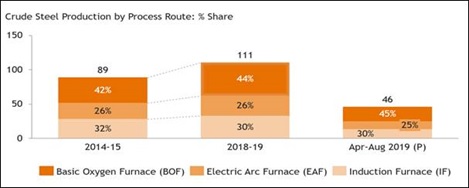
This growth in capacity has been enabled by a vibrant growth
across all three routes of production (BOF, EAF and IF) ensuring the Indian steel
industry remains extremely diverse. One of the key factors for India’s strong growth
rate in crude steel capacity has been the exceptional growth rate in the electrical
route of steel making (EAF and IF), which accounted for 56% of the crude steel production
in 2018-19.
Crude
steel production by process route (2014-19) (Source: JPC)
1.4
Consumption of Steel
·
The per capita consumption of finished steel
in India has been rise from 60.8 kg in 2014-15 to 74.1 kg in 2018-19
|
Description |
2015-16 |
2016-17 |
2017-18 |
2018-19 |
|
Crude
steel Production |
89.790 |
97.936 |
103.13 |
110.921 |
|
Finished
steel Production |
102.904 |
115.91 |
126.855 |
101.287* |
|
Imports |
11.712 |
7.227 |
7.483 |
7.835 |
|
Export |
4.079 |
8.243 |
9.620 |
6.361 |
|
Apparent
Steel Use (ASU) |
81.525 |
84.042 |
90.707 |
98.708 |
|
%
Growth |
5.9% |
3.1% |
11.3% |
17.5% |
|
Population
(MOSPI) in Crores |
128.3 |
129.9 |
131.6 |
133.2 |
|
ASU
per
capita (kg) |
63.54 |
64.70 |
68.93 |
74.11 |
|
% Growth |
4.6% |
1.8% |
8.5% |
14.5% |
Source JPC, *Crude Steel equivalent
·
The per capita consumption of finished steel
in India as per calendar years is given below.
|
Total
Finished Steel |
2015 |
2016 |
2017 |
2018 |
|
ASU
(in million tonnes) |
80.075 |
83.643 |
88.68 |
96.738 |
|
Population
(MOSPI) (in Crores) |
126 |
127 |
129 |
132 |
|
ASU
per capita (kg) |
64 |
66 |
69 |
73 |
|
%
Growth |
4.9% |
3.1% |
4.5% |
6.2% |
1.5 India’s robust steel input industries
India’s strong growth in crude steel and finished steel production
has been supported and enabled by vibrant sponge iron (especially for electrical
routes of steel making) and pig iron industries which serve as crucial inputs for
the steel industry.
India has been the world’s leading producer of sponge iron since
2003, with a host of coal-based units located in the mineral rich states of the
country. Over the years, the coal-based route has emerged as a key contributor and
accounted for 80% of total sponge iron production in the country in 2018-19. Capacity
in sponge iron making has also increased over the years and stood at 46.56 MT in
2018-19.

India’s
sponge iron production (2014-19) (Source: JPC)
India
is also an important producer of pig iron. Post liberalization, with setting up
several units in the private sector, not only have imports drastically reduced,
but India has also turned into a net exporter of pig iron. The private sector has
accounted for 91% of total production of pig iron in the country in 2018-19.
Pig
Iron Domestic Availability Scenario (in million tonnes)
|
Item |
2014-15 |
2015-16 |
2016-17 |
2017-18 |
2018-19 |
Apr-Aug,
2019* |
|
Production |
10.23 |
10.24 |
10.34 |
5.73 |
6.41 |
2.56 |
|
Export |
0.54 |
0.29 |
0.39 |
0.52 |
0.32 |
0.15 |
|
Import |
0.02 |
0.02 |
0.03 |
0.02 |
0.07 |
0.01 |
|
Consumption |
9.06 |
9.02 |
9.04 |
5.19 |
5.09 |
2.46 |
Source:
JPC; *Provisional
1.6
India’s finished steel production and net export/import scenario
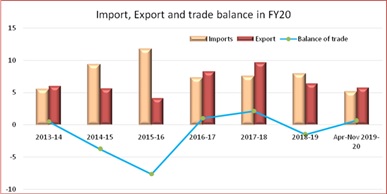
India’s
rising demand and strong growth in crude steel capacity has led to India’s finished
steel production (alloy/stainless + non-alloy) witnessing a 6% CAGR over the past
5 years. Apart from catering to a robust domestic demand, the Indian steel industry
is a global exporter as well and has reduced its import requirements from 9.32 MT
to 7.83 MT over the past 5 years. India was a net exporter in 2016-17 and 2017-18,
however returned to being a net importer in 2018-19. India has been a net exporter
of finished steel in FY20.
|
Trade
of Finished Steel |
|||||||
|
(in
million tonnes) |
|||||||
|
Trade |
2013-14 |
2014-15 |
2015-16 |
2016-17 |
2017-18 |
2018-19 |
Apr-Nov 2019-20 |
|
Imports |
5.45 |
9.32 |
11.712 |
7.227 |
7.483 |
7.834 |
5.077 |
|
Export |
5.985 |
5.596 |
4.079 |
8.243 |
9.62 |
6.361 |
5.753 |
|
Balance
of trade |
0.535 |
-3.724 |
-7.633 |
1.016 |
2.137 |
-1.473 |
0.676 |
|
Import
Intensity |
7.4% |
12.1% |
14.4% |
8.6% |
8.2% |
7.9% |
8.6% |
|
Export
Intensity |
8.1% |
7.3% |
5.0% |
9.8% |
10.6% |
6.4% |
9.7% |
Source:
JPC
Going forward, the Government's vision to achieve a $5 trillion
economy by 2024 entails investments in several steel intensive sectors like Housing
for all, 100% electrification, piped water for all etc. The growth potential for
the sector is thus immense and the domestic steel consumption will increase significantly
in line with this vision. It is therefore important to ensure that this demand is
served through a robust domestic steel industry. The National Steel Policy 2017
laid out a set of key imperatives to create a globally competitive steel sector.
2.
National Steel Policy 2017
The National Steel Policy (NSP) was approved by the Ministry
of Steel and notified on 8th May, 2017 to ensure that the Indian steel
sector is prepared to service the growing requirements of modern India and to promote
a healthy sustainable growth for the sector. The NSP was defined with the vision
“to create a technologically advanced and globally competitive steel industry that
promotes economic growth”. The policy outlined key objectives for the steel sector
and laid down multiple initiatives for the industry.
Key features of the NSP 2017 include establishing self-sufficiency
in steel production by providing policy support & guidance to private manufacturers,
MSME steel producers and CPSEs. It encourages capacity additions, development of
globally competitive steel manufacturing capabilities as well as cost-efficient
production by facilitating domestic availability of iron ore, coking coal &
natural gas, as well as overseas asset acquisitions of raw materials. To support
the sector, it also promotes initiatives to enhance the domestic steel demand.
The policy projects crude steel capacity of 300 million tonnes (MT), production of 255 MT and a robust finished steel
per capita consumption of 160 Kg by 2030-31, as against the current consumption
of 74 Kg. The policy also envisages 100% indigenous fulfilment of demand for high
grade automotive steel, electrical steel, special steels and alloys for strategic
applications along with an increase in domestic availability of washed coking coal
so as to reduce import dependence on coking coal from about 85% to around 65% by
2030-31.
To action the initiatives mentioned as part of the National Steel
Policy, a strategic roadmap is being created by the Ministry of Steel.
Development of a strategic roadmap
The National Steel Policy 2017 outlines a variety of challenges
faced by the industry and potential solutions which the Ministry of Steel should
action. It defined 106 initiatives for the steel sector across 15 different areas:
|
S No |
Focus area |
# Actions |
|
1 |
Steel
Demand |
5 |
|
2 |
Steel
Capacity |
6 |
|
3 |
Raw
Materials |
35 |
|
4 |
Land,
Water and Power |
10 |
|
5 |
Infrastructure
& Logistics |
6 |
|
6 |
Product
Quality |
4 |
|
7 |
Technological
Efficiency |
5 |
|
8 |
MSME
Sector |
3 |
|
9 |
Value
Addition in Alloy, Special and Stainless Steels |
5 |
|
10 |
Environment
Management |
7 |
|
11 |
Safety |
3 |
|
12 |
Trade |
4 |
|
13 |
Financial
Risks |
2 |
|
14 |
Role
of CPSEs & Way Forward |
5 |
|
15 |
Focus
on High-End Research: SRTMI |
6 |
The Indian steel industry will be a key participant in several
of these initiatives. The Indian steel sector is a diverse and vibrant ecosystem
comprising of a multitude of stakeholders across the value chain. Each stakeholder
brings valuable inputs to the sector based on their rich experience. In order to
leverage these experiences and ensure efficient operationalization of the envisioned
initiatives, the Ministry alongside the CPSEs regularly facilitates interaction
with the various stakeholders.