The
EU Carbon Border Adjustment Mechanism: New Green Trade Restrictions to Impact
Businesses in India
The EU Carbon Border
Adjustment Mechanism imposes a fee on the carbon emissions contained in certain
imports. We discuss the roll-out of this new mechanism, implications for
India-based manufacturing entities and exporters, and suggest business actions
to prepare for the implementation of the carbon border tax.
On April 18, 2023, the
European Parliament passed legislation for the implementation of a Carbon
Border Adjustment Mechanism (CBAM) as part of the European Union’s (EU) Green
Deal, aimed at reducing greenhouse gas emissions by 55 percent before 2030.
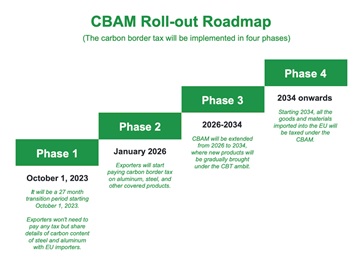
CBAM will be rolled out in four phases and will enable the EU to impose a
Carbon Border Tax (CBT) on specific imports, such as steel, aluminum,
fertilizer, electricity, cement, and hydrogen, from January 2026.
However, CBAM has been
criticized as a trade-restrictive policy, especially by developing countries
like India, which has set a target of becoming carbon neutral by 2070. India
has expressed concerns about CBAM at various international forums, including
the World Trade Organization (WTO), emphasizing the importance of
non-discriminatory treatment for the same products and warning that such
measures could lead to protectionist practices.
What is the EU
carbon border adjustment mechanism and how will it function?
CBAM, or the Carbon
Border Adjustment Mechanism, is designed to ensure fair competition by addressing
the cost of carbon paid by EU installations that follow the EU Emissions Trading
System (ETS), and imported products. It works by applying a fee on the carbon emissions
in certain imports that is equal to the fee imposed on domestic products under the
ETS. By doing so, CBAM helps prevent carbon leakage, where companies relocate their
manufacturing operations outside the EU to avoid the expenses of adhering to climate
regulations.
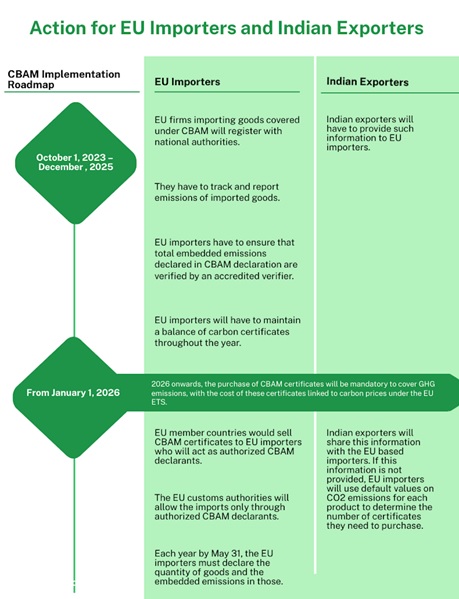
From October 1,
2023, until December 31, 2025, the transitional phase of CBAM will only require
quarterly reports on the greenhouse gas emissions of specific products imported
into the EU, covering both direct and indirect emissions. However, from 2026 onwards,
the purchase of CBAM certificates will be mandatory to cover GHG emissions, with
the cost of these certificates linked to carbon prices under the EU ETS. CBAM will
result in an additional cost for exporting to the EU market, which will be shared
between the exporter or producer and could impact their marketing strategies. It
is expected that other countries may also adopt policies similar to CBAM.
Riccardo Benussi, Head of European Business Development at Dezan
Shira & Associates, notes: “Despite its green intentions, the newly passed CBAM
regulation in the EU Parliament is drawing criticism from countries like China,
India, some US industries, and many industries in developing countries because many
manufacturers in these countries still rely heavily on coal-fired electricity. As
the first carbon import tax law in the world, the regulation means that companies
exporting iron, steel, fertilizers, or cement to EU businesses will have to calculate
and pay for the greenhouse and carbon emissions associated with each product. If
the added cost cannot be absorbed, companies would then have to explore trading
with countries that do not have such a tax or revise their production methods to
emit less greenhouse gases or carbon. While this may be good for the environment,
it could contribute to supply chain fragmentation and increased costs. Therefore,
businesses should carefully assess the potential impact of CBAM on their operations
and explore ways to become more environmentally sustainable in the long term to
avoid potential disruptions to their business activities.”
What products and sectors fall under the scope of
CBAM?
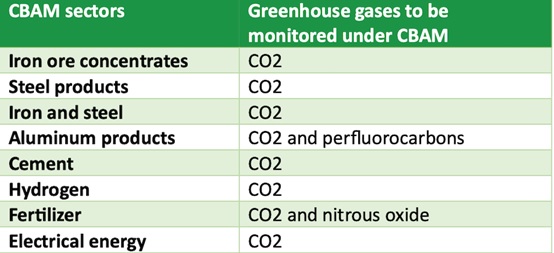
CBAM will initially
apply to particular products within the most carbon-intensive industries, such as
iron and steel, cement, fertilizers, aluminum, electricity,
and hydrogen. It will also include some precursors and a limited number of downstream
products. For cement and fertilizers, only indirect emissions will be considered.
However, the CBAM Regulation requires the European Commission to establish
a timeline to gradually integrate all products covered under the EU ETS, including
indirect emissions, as well as emissions from international transportation, by 2030.
Impact of CBAM on Indian exports to the EU market
and mitigation strategies
The implementation
of the CBAM by the EU is expected to have a significant economic impact on India’s
exports of energy-intensive products such as steel, aluminum,
cement, and fertilizers. Indian exporters are likely to face higher prices, reduced
competitiveness, and lower demand for their goods in the EU market.
The steel industry
is considered a hard-to-abate sector and is responsible for almost eight percent
of global emissions. The International Energy Agency (IEA) reports that carbon emissions
from the iron and steel sector have increased over the past decade, mainly due to
the rise in steel demand and the energy required for its production.
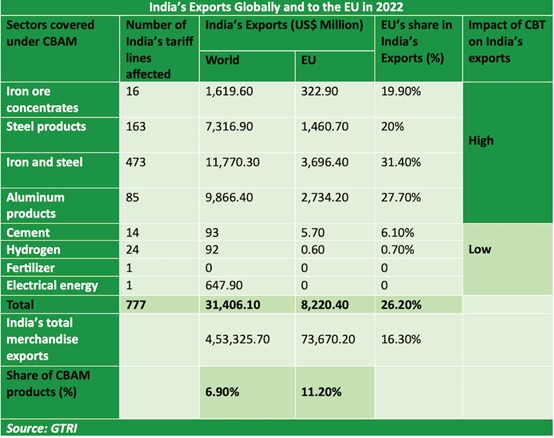
According to a
recent report by the Global Trade Research Initiative (GTRI), the implementation
of the CBAM is expected to pose a significant challenge to India’s metal sector.
In 2022, 27 percent of India’s exports of iron, steel, and aluminum
products worth US$8.2 billion went to the EU. Starting January 1, 2026, the EU will
begin collecting carbon tax on each consignment of steel and aluminum, which will result in Indian firms paying an amount
equivalent to 20-35 percent of tariffs.
Ultimately, the
impact of CBAM on India will depend on the carbon intensity of the exported products
and their substitutes in the EU market. Products with high carbon intensity are
likely to face higher charges, making them less competitive. However, if there are
no low-carbon substitutes for Indian products in the EU market, then the impact
of CBAM on Indian exports may be limited.
One of the major
challenges for India is its lack of an emissions trading system like the EU’s ETS.
Without an ETS, it could be difficult for Indian businesses to demonstrate that
their products are produced using low-carbon technology, resulting in higher CBAM
charges.
To remain competitive
in the global market and mitigate the impact of CBAM, India needs to implement a
carbon pricing mechanism and develop low-carbon technologies. This will help Indian
businesses to comply with the CBAM regulations and reduce the carbon intensity of
their products. Additionally, India needs to review its export strategy and identify
alternative markets where its products can be competitive despite the impact of
CBAM in the EU market.
Impact of CBAM on manufacturing in India and mitigation
strategies
Smart manufacturing
is the use of advanced technologies, such as the Internet of Things (IoT), Artificial
Intelligence (AI), and Big Data Analytics, to optimize manufacturing processes.
It enables companies to reduce costs, improve quality, and increase efficiency.
India’s manufacturing
industry is expected to be significantly affected by the EU’s new carbon border
tax, especially companies that export products to the EU. The policy may affect
the competitiveness of Indian manufacturers, as they may need to pay higher taxes
on their products compared to their EU counterparts. This could lead to a shift
in demand towards EU-made products, affecting the Indian manufacturing industry.
The Indian government
is taking proactive steps to ensure the country’s manufacturing industry remains
competitive by reducing carbon emissions
Indian companies
can adopt several strategies to mitigate the impact of the CBAM on smart manufacturing.
One approach is to invest in renewable energy sources and energy-efficient technologies
to reduce carbon emissions. This will help reduce the amount of tax they need to
pay under the CBAM. Another strategy is to optimize supply chain processes to reduce
the carbon footprint of their products.
Companies can also
diversify their export markets to reduce their dependence on the EU and engage with
policymakers to influence the design and implementation of the CBAM.
Key actions for Indian businesses to prepare for CBAM implementation
·
Indian businesses should assess the potential impact of CBAM on their operations
by examining customs data, purchase data, bill of material, transactional model,
and logistic flows to determine CBAM applicability.
·
To evaluate the potential costs of CBAM, businesses should quantify their
exposure by calculating the potential impact of CBAM costs and expected costs for
administrative governance. They should then analyze the
impact on supply chain and procurement strategies to inform future strategic analysis.
·
Indian businesses must analyze data availability
and quality to ensure they have the necessary data to comply with CBAM requirements.
They should determine which data elements are needed, assess data quality, and close
any respective gaps to prepare for expected administrative obligations.
·
Businesses must review their global value chain and footprint as they relate
to the EU region and CBAM. They should also consider EU ETS implications to determine
cost optimization options and better understand the strategy for investing in manufacturing
installations to reduce emissions and transform to alternative products.
·
Businesses should analyze the impact of CBAM on
their business model and identify opportunities for strategic transformation to
reduce its impact, particularly in terms of their competitiveness in the EU market
and corporate value.
Actionable measures for Indian government to minimize the impact of CBT
India has voiced
its apprehensions regarding the EU Carbon Border Adjustment Mechanism and asserted
that it may act as a trade impediment and could breach WTO regulations. Nevertheless,
India is also committed to reducing its carbon emissions with a goal to achieve net-zero emissions by 2070.
In March 2022,
India’s Commerce and Industry Minister, Piyush Goyal, held talks with his EU counterpart,
Valdis Dombrovskis, to address India’s concerns regarding the implementation of
CBAM. The EU had expressed its willingness to collaborate with India on the issue,
and during the meeting, Goyal had urged the EU to consider alternative solutions
that would not negatively impact Indian industries.
India is currently
in the process of establishing a carbon market, and it is anticipated that the Bureau
of Energy Efficiency (BEE) will announce a Carbon Credits Trading Scheme (CCTS)
by mid-year. The Ministry of Power released a CCTS draft on March 27, which outlines
the institutional framework and operational mechanism for the Indian carbon credit
market.
Meanwhile, the
Indian government is also considering several measures to address the potential
impact of the EU’s carbon border tax:
·
Negotiating with the EU: India’s government plans to engage in discussions with the EU to negotiate
an exemption or a reduced rate for Indian manufacturers. The goal is to ensure that
Indian companies are not unfairly penalized for their emissions.
·
Developing a carbon pricing mechanism: India’s government is also considering the development
of a domestic carbon pricing mechanism to encourage companies to reduce their emissions.
This would help to align India’s policies with the EU’s carbon reduction goals and
make Indian businesses more competitive.
·
Promoting renewable energy: India’s government is already working to promote renewable energy sources,
such as solar and wind power, to reduce carbon emissions. The government plans to
continue to invest in renewable energy infrastructure to help Indian manufacturers
transition to cleaner energy sources.
·
Investing in carbon capture technology: India’s government is also exploring the potential
of carbon capture and storage (CCS) technology to reduce carbon emissions from manufacturing
processes. This technology captures carbon emissions before they are released into
the atmosphere and stores them underground.