Trade Restrictions among G20 Economies Remain
at Historic Highs
The WTO’s new Trade Monitoring Report issued on 21 November shows
that G20 economies from mid-May to mid-October 2019 introduced import-restrictive
measures covering an estimated USD 460.4 billion worth of traded merchandise. This
represents a 37% increase over the previous period going back to mid-October 2018,
and is second only to the USD 480.9 billion coverage of import-restricting measures
reported between mid-May and mid-October 2018. The report notes that with restrictions
accumulating over time, the share of global trade covered by such measures has soared.
WTO Director-General Roberto Azevêdo called on G20 economies
to de-escalate trade tensions to spur investment, growth and job creation.
Commenting
on the report, Director-General Roberto Azevêdo said:
“The
report's findings should be of serious concern for G20 governments and the broader
international community. Historically high levels of trade-restrictive measures
are having a clear impact on growth, job creation and purchasing power around the
world. We need to see strong leadership from G20 economies if we want to avoid increased
uncertainty, lower investment and even weaker trade growth.
"We
have seen how world trade has stalled during the review period. The WTO downgraded
its forecast for merchandise trade growth in 2019 to 1.2%, the slowest since the
crisis a decade ago, much lower than April's estimate of 2.6%. New trade restrictions
and increasing trade tensions will only add to the uncertainty that is dragging
down growth in the world economy. This trend needs to be reversed."
The report
indicates that the slowdown in world trade growth coincided with increasingly negative
forward-looking indicators for world trade and output, including export orders derived
from purchasing managers' indices as well as measures of economic policy uncertainty.
Risks to the forecast are predominantly on the downside and include a further ratcheting-up
of trade-restrictive measures and a sharper slowing of GDP growth in one or more
major economies.
In terms
of numbers, G20 economies implemented 28 new trade-restrictive measures between
mid-mid-May and mid-October 2019, mainly tariff increases, import bans and stricter
customs procedures for imports. The last three monitoring reports, issued in June
2019, November 2018 and July 2018 have seen the shares of G20 trade covered by new
import-restrictive measures fluctuate between approximately 2.5% and 3.5% of imports,
compared to significantly smaller proportions previously.
In addition,
many import restrictions implemented since 2009 are still in force, resulting in
a growing stockpile of measures that in 2018 affected 8.8% of G20 imports (USD 1.3
trillion). The trade coverage of import-restrictive measures in force for the period
January–October 2019 is estimated at USD 1.6 trillion, suggesting that import restrictions
have continued to grow.
Alongside
the trade-restrictive measures, G20 economies also implemented 36 new measures aimed
at facilitating trade during the review period, including the elimination or reduction
of import tariffs and export duties. The trade coverage of the import-facilitating
measures implemented during the most recent review period was estimated at USD 92.6
billion, which is significantly lower than that recorded in the previous report
(USD 397.2 billion). Tariff cuts by G20 members associated with the 2015 expansion
of the WTO's Information Technology Agreement have in addition covered traded merchandise
worth an estimated USD 671 billion during the review period.
During
the review period, the monthly average of trade remedy actions initiated by G20
economies was the highest registered since 2012, and more than double the average
recorded in the previous G20 Report. Initiations of anti-dumping investigations
continue to be the most frequent trade remedy action, accounting for more than four-fifths
of all initiations. Meanwhile, the monthly average of trade remedy terminations
recorded was the second-lowest since 2012. The trade coverage of trade remedy initiations
recorded in this report was estimated at USD 16.7 billion and that of terminations
at USD 3.8 billion.
The WTO
trade monitoring reports have been prepared by the WTO Secretariat since 2009. G20
members are: Argentina; Australia; Brazil; Canada; China; the European Union; France;
Germany; India; Indonesia; Italy; Japan; the Republic of Korea; Mexico; the Russian
Federation; the Kingdom of Saudi Arabia; South Africa; Turkey; the United Kingdom;
and the United States.
Key findings
·
This Report covers new trade and trade-related
measures implemented by G20 economies between 16 May and 15 October 2019. During
the review period, new trade restrictions and increasing trade tensions continued
to add to the uncertainty surrounding international trade and the world economy.
·
World trade growth stalled and the WTO in October
downgraded its forecast for world trade growth in 2019 to 1.2%; down from the April
estimate of 2.6%. The slowdown coincided with more negative forward-looking indicators
for world trade and output, including export orders derived from purchasing managers'
indices and economic policy uncertainty based on the frequency of keywords in press
accounts. Risks to the forecast are predominantly on the downside and include a
further ratcheting-up of trade-restrictive measures and a sharper slowing of GDP
growth in one or more major economies.
·
G20 economies implemented 28 new trade-restrictive
measures during the review period. The trade coverage for the new import-restrictive
measures implemented by G20 economies was estimated at USD 460.4 billion. This represents
an increase of 37% compared to the previous period (USD 335.9 billion) and is only
second to the USD 480.9 billion reported for the period mid‑May to mid-October
2018.
·
The last three Trade Monitoring Reports have seen
the shares of G20 trade covered by new import‑restrictive measures fluctuate
between approximately 2.5% and 3.5% of G20 imports, compared to significantly smaller
shares previously. The trade coverage of import‑restrictive measures over
the last three review periods has soared.
·
The stockpile of import restrictions implemented
since 2009, and still in force, suggests that 8.8% of G20 imports are affected by
import restrictions implemented since 2009. At the end of 2018, USD 1.3 trillion
out of a total USD 15.1 trillion of G20 imports were estimated to be affected by
import restrictions put in place by G20 economies over the last decade. The trade
coverage of import-restrictive measures in force for the period January to October
2019 is estimated at USD 1.6 trillion, suggesting that import restrictions have
continued to grow.
·
G20 economies also implemented 36 new measures
aimed at facilitating trade during the review period. The trade coverage of the
new import-facilitating measures implemented by G20 economies was estimated at USD
92.6 billion which is significantly lower than that recorded in the last Report
(USD 397.2 billion).
·
During the review period, the monthly average
of initiations of trade remedy actions by G20 economies was the highest registered
since 2012, and the monthly average of trade remedy terminations recorded in this
Report was the second-lowest since 2012. The trade coverage of trade remedy initiations
was estimated at USD 16.7 billion and that of terminations at USD 3.8 billion. Both
figures are down from the trade coverage recorded for such measures in the last
G20 Report.
Trade coverage of new import-restrictive measures in each reporting
period (not cumulative) (USD billion)
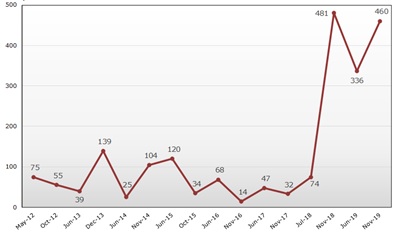
Note:
These figures are estimates and represent the trade coverage of the measures (i.e.
annual imports of the products concerned from economies affected by the measures)
introduced during each reporting period, and not the cumulative impact of the trade
measures.
Source: WTO Secretariat.
Trade coverage of new import-facilitating measures in each reporting
period (not cumulative) (USD billion)

Note:
These figures are estimates and represent the trade coverage of the measures (i.e.
annual imports of the products concerned from economies affected by the measures)
and not the impact of the trade measures. Liberalization associated with the 2015
Expansion of the WTO's Information Technology Agreement is not included in the figures.
Source: WTO Secretariat.
Cumulative trade coverage of G20 import-restrictive measures in
force since 2009
(USD billion and %)

Note:
The cumulative trade coverage estimated by the Secretariat is based on information
available in the TMDB on import measures recorded since 2009 and considered to have
a trade-restrictive effect. The estimates include import measures for which HS codes
were available. The figures do not include trade remedy measures. The import values
were sourced from the UNSD Comtrade database.
Source: WTO Secretariat.
G20 Trade remedy initiations and terminations

Source: WTO Secretariat.
G20 measures, mid-May to mid-October 2019 (by number)

Source: WTO Secretariat.
Trade coverage of G20 measures, mid-May to mid-October 2019 (USD
billion)

Source: WTO Secretariat.