Trump Move on Non-immigrant Visas may not Hit Indian IT Firms Hard
The suspension of non-immigrant visas to the US is
expected to have limited impact on Indian IT services companies, but the move
drew immediate criticism from Indian and several US-based multinationals,
including Google, Amazon and Tesla.
On Monday night, US President Donald Trump suspended the
entry of non-immigrant H-1B and other visas until the end of the year, a
decision Oval Office said will benefit thousands of Americans who have lost
jobs because of the coronavirus pandemic. “During February and April 2020, more
than 20 million US workers lost their jobs in key industries where employers
are currently requesting H-1B and L workers to fill positions,” President Trump
pointed out in his order.
Source: myvisajobs.com
H-1B visa ‘reform’
President Trump is also learnt to have directed his
officials to ‘reform’ the H-1B visa system and move towards merit-based
immigration. Under these reforms, the H-1B programme
will give priority to those who are offered the highest wage to ensure that
only the highest-skilled applicants get an entry into the US.
The executive order valid from June 24 prohibits the
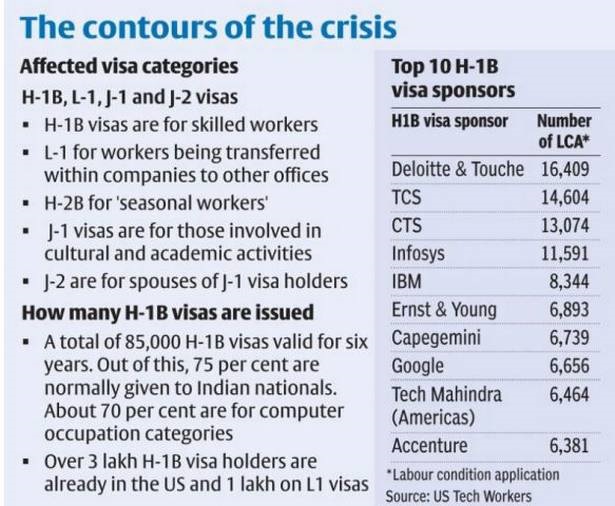
entry of foreign workers coming into the country with H-1B, L-1, J-1, J-2 and H-2B visas. The latest ban is an extension of an
earlier one in April which prohibited a certain category of green card holders
from entering the US for 60 days.
CEO of Alphabet Inc Sundar Pichai was one of the
first to react to the ban. “Immigration has contributed immensely to America’s
economic success, making it a global leader in tech, and also Google the
company it is today. Disappointed by today’s proclamation - we’ll continue to
stand with immigrants and work to expand opportunity for all,” Pichai tweeted, while Amazon said it was a short-sighted
action.
Drag on economy
The Indian IT Services lobby group, Nasscom’s
vice-president & head global trade development Shivendra
Singh said the temporary ban will be a drag on the US economy as those who use
these visas are critical skilled resources. “They are not immigrants and do not
alter the net migration to a country. They bridge a critical requirement. If
they are not able to go there, it means the recovery in the US will get
impacted,” he told BusinessLine. The H-1B visas
are critical for the Indian IT services’ companies as 65-75 per cent of the
total revenues of these companies come from the US clients.
But a pro-visa ban lobby group, US Tech Workers said the
H-1B is nothing more than an “Indian Treaty Work Visa,” programme.
“There is no requirement for employers to prove they first tried searching for
qualified Americans before sponsoring H-1B visas,” it tweeted. However,
according to American Immigration Council quoting a research paper, an increase
in H-1B visas could create an estimated 1.3 million new jobs and add around
$158 billion to the gross domestic product in the US by 2045.
The US Citizenship and Immigration Services had earlier
said the H-1B quota for FY 21, drawn through a lottery system, was already over
with the season kicking off in October. A total of 85,000 H-1B visas (valid for
up to six years) are given out every year, of which 75 per cent normally go to
Indian nationals. About 70 per cent is allocated to computer occupation
categories. However, from 2015, the percentage of H-1B usage has been declining
from about 16,000 to 5,500 for the top seven Indian IT companies, while the
rest is taken up by global and US multinationals.
Executives in Infosys and a few other top IT services
companies said the impact of the proclamation will not be felt immediately
because of the travel ban, with visa processing coming to a halt. A key
executive of one of the IT companies said the impact will be minimal and as
most IT companies have de-risked their business model with more local hires.
Centrum Broking’s IT analyst
Mahesh Babu said there will be hardly any impact on
fresh visas because of the ban. The onsite employees will keep rotating which
is also a chunk of the people. He said most Indians who go on H-1B visa end up
taking up US citizenship which has been one of the major grouses of the US Tech
Workers’ lobby.
Renewal to be
automatic
The Centrum’s analyst pointed out that renewal of visas
of those who are already in the US will happen automatically. “Companies like
Infosys and TCS send a couple of thousands of their employees to the US and on
a base of over two lakh and more employees, the impact will be very less or
nothing.”
Aditya Narayan Mishra, director and CEO of CIEL HR
Services, said the restrictions will hurt the implementation of certain
projects. This, in turn, will hurt the US clients.
But last year, a top Infosys executive told a press
conference that tightening of visa rules over the years has been one of the
reasons for growing employee attrition. Hence, it might look at a “new value
proposition” to retain employees.
Another issue that has surfaced, following the tightening
of the visa curbs, has been that top Indian IT companies have accounted for
two-thirds of the rejections among the top 30 companies, making it tougher for
Indian IT services companies to send their employees to the US.
Nish Bhatt, a founder and CEO of Milwood
Kane International, a US-based investment consulting firm, said one of the
obvious reasons for the ban could be the presidential elections this year as
restriction of foreign workers is one of the top agendas of the Trump
administration. He also expected the landscape of immigration to change as IT
companies might prefer near-shore operations out of countries which have favourable immigration programmes.