WTO Report says Restrictive Trade
Measures Continue to Rise in G-20 Economies
Restrictive
trade measures introduced by G-20 economies since 2008 continue to rise,
according to the latest WTO report on recent trade developments issued on 6 November
2014. Given the continuing uncertainties in the global economy, the report
stresses the need for countries to show restraint in imposing new measures and
to eliminate more of the existing measures.
The report says that of the 1,244 restrictive measures
recorded since the onset of the crisis in 2008, only 282 have been removed.
Over the past year, the number of restrictive measures in place has increased
by 12 per cent. However, the number of restrictive measures affecting exports
declined significantly from mid-May to mid-October 2014. The report also
underlines that the overall trade policy response to the crisis has been
significantly more muted than originally expected.
Key Findings of WTO Report on
G-20 Trade Measures
·
This
report shows that the stock of restrictive trade measures introduced by G-20
economies since 2008 continues to rise despite the pledge to roll back any new
protectionist measures that may have arisen.
·
Continuing
uncertainties in the global economy underline the need for G20 economies to
show restraint in the imposition of new measures and to effectively eliminate
existing ones.
·
Of
the 1,244 restrictive measures recorded by this exercise since the onset of the
crisis in 2008, only 282 have been removed. The total number of restrictive
measures still in place now stands at 962 – up by 12% from the end of the
reporting period in November 2013.
·
G-20
economies applied 93 new trade‑restrictive measures during the period
between mid‑May and mid-October. This equates to over 18 new measures per
month, which is unchanged compared to the previous period. A positive
development saw the number of restrictive measures affecting exports decline
significantly during the period.
·
G-20
economies introduced 79 trade‑liberalizing measures during the period
under review. Measured per month this figure is also unchanged compared to the
previous period.
·
Greater
transparency is needed from G-20 members in order to improve the understanding
of the operation and effects of non-tariff barriers to trade. These
behind-the-border measures include regulatory measures and subsidies.
·
While
this report shows that the stock of new trade‑restrictive measures has
continued to rise, it also supports the conclusion that the overall trade policy
response to the 2008 crisis has been significantly more muted than expected
based on previous crises. The multilateral trading system has acted as an
effective backstop against protectionism.
Chart 1 Trade restrictions
since October 2008
Number of measures
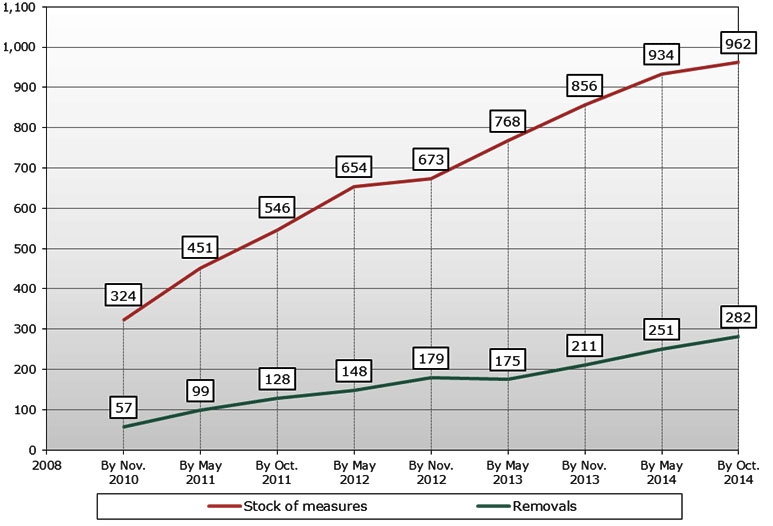
Note: The monitoring of the accumulation
of restrictions and the removals started at end-2010. Information on trade
restrictions and distortions in place before October 2008 is not available.
Source: WTO Secretariat.
Chart 2 Stockpile of
restrictive measures
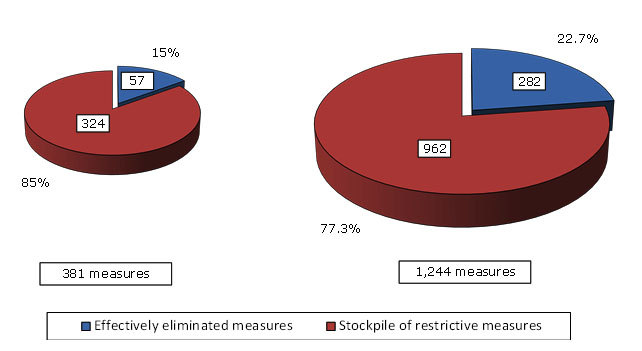
Source: WTO Secretariat.
Executive Summary of WTO
Report
This is the twelfth report on G-20
trade measures. With continuing global economic uncertainty and sluggish trade
growth, it remains of concern that the stock of restrictive trade measures
introduced by G-20 economies since 2008 has continued to increase during the
period between mid-May 2014 and mid-October 2014. Prevailing global economic
conditions mean that this is not a time for complacency in the international
trading system. The G-20 economies must take decisive action to reduce this
stock of trade restrictions by showing restraint in the imposition of new
measures and by effectively eliminating existing ones.
Of the 1,244 restrictions
recorded by this exercise since the onset of the crisis in 2008, only 282 have
been removed. Thus, the total number of those restrictive measures still in
place now stands at 962 – up by 12% from the end of the reporting period in
November 2013. Of course, this report does not capture the restrictive measures
which were in place before the crisis and those subsequently removed.
Nevertheless, the combination of the continuing addition of new restrictive
measures and a relatively low removal rate runs counter to the G-20 pledge to
roll back any new protectionist measures that may have arisen. An interesting
question will also arise in the years ahead regarding how trade remedy measures
will be affected by the operation of sunset clauses that provide for reviews of
such measures after five years.
The report finds that the pace
of introduction of new trade‑restrictive measures by the G-20 in the
period between mid-May and mid-October remained unchanged from the previous
reporting periods. More encouragingly, G-20 economies have adopted
significantly fewer restrictive export measures. On a similar positive note,
looking specifically at tariff measures, the number of import tariff
liberalization measures introduced by G-20 economies during the period far
exceeded the number of tariff increases.
G-20 economies applied 93 new
trade‑restrictive measures during this five-month period, compared with
112 during the previous six months. As in previous periods, trade‑remedy
measures account for more than 50% of these measures, followed by other
restrictive import measures and restrictive measures affecting exports. In
terms of trade coverage, the trade remedy actions and other restrictive import
measures applied by G-20 economies during the period under review constitute
0.8% of the value of G-20 merchandise imports and 0.6% of the value of world
merchandise imports. This amounts to around US$ 118 billion. Further, the
import‑restrictive measures recorded since October 2008 that remain in place cover around 4.1% of the value of world
merchandise imports and around 5.3% of the value of G-20 imports. This amounts
to US$ 757.0 billion.
G-20 economies also applied 79
trade‑liberalizing measures, both temporary and permanent in nature,
during the period under review. In terms of trade coverage, import‑liberalizing
measures account for 2.6% of the value of G-20 merchandise imports and 2.0% of
the value of world merchandise imports. This amounts to some US$ 370 billion –
almost three times the trade value of the new trade‑restrictive measures.
This relatively positive development in the area of trade‑liberalizing
measures should not distract from the concerns about the accumulation of trade
restrictions.
In addition, adequate
information on behind-the-border measures, including regulatory measures and
subsidies, is still lacking. Non-tariff measures applied by a number of G-20
economies have been the subject of recent debate in various WTO bodies. Some
consider that these types of measures have become more prominent in recent
years, compared to conventional border measures, and therefore the need to
increase the quality of the information available is paramount. To deliver on this
and enhance our understanding of the operation and effects of non-tariff
barriers to trade, G-20 Members should look to provide greater transparency in
this area.
Overall, this report supports
the conclusion that despite the continuing increase in the stock of new trade‑restrictive
measures recorded since 2008, the trade policy reaction to the 2008 global
economic and financial crisis has been more muted than expected based on
previous crises. This shows that the multilateral trading system has acted as an
effective backstop against protectionism. However, it is clear that the system
can do more to drive economic growth, sustainable recovery and development.
World trade has grown more slowly than expected since the June 2014 report, due
largely to slow and uneven economic growth in both developed and developing
economies. On current forecasts trade growth will remain below average in 2014
and 2015. The removal of remaining trade‑restrictive measures combined
with further multilateral trade liberalization would be a powerful policy
response.
Joint
Summary on G-20 Trade and Investment Measures
We recall that G-20 Leaders, at their last Summit meeting
in St. Petersburg, Russia on 5-6 September 2013, delivered a strong statement
of commitment to free trade and investment as crucial for restoring global
growth. Their message on the importance of the multilateral trading system in
guaranteeing free and rules-based trade and fostering economic opportunities
reiterated the Group's emphasis on trade and investment as fundamental for
economic growth, sustainable development and job creation globally and at
national level. Recognizing the continued risks of economic slowdown and trade
and investment weakening posed by protectionism, G-20 governments extended
until the end of 2016 their standstill commitment with respect to measures
affecting global trade and investment and their commitment to roll back new
protectionist measures. Finally, Leaders also stressed the significance of a
positive outcome at the WTO Ministerial Conference in Bali in December 2013 as
a stepping stone towards further multilateral trade liberalization and
conclusion of the Doha Development Round and urged all WTO Members to show the
necessary flexibilities towards that goal.
With continuing global economic uncertainty and sluggish
trade growth, it remains of concern that the stock of restrictive trade
measures introduced by G-20 economies since 2008 has continued to increase
during the period between mid-May 2014 and mid-October 2014. Prevailing global
economic conditions mean that this is not a time for complacency in the
international trading system. The G-20 economies must take decisive action to
reduce this stock of trade restrictions by showing restraint in the imposition of
new measures and by effectively eliminating existing ones. Of the 1,244
restrictions recorded by this exercise since the onset of the crisis in 2008,
only 282 have been removed. Thus, the total number of those restrictive
measures still in place now stands at 962 – up by 12% from the end of the
reporting period in November 2013. The combination of the continuing addition
of new restrictive measures and a relatively low removal rate runs counter to
the G-20 pledge to roll back any new protectionist measures that may have
arisen.
G-20 economies applied 93 new trade-restrictive measures
during this five-month period, compared with 112 during the previous six
months. As in previous periods, trade remedy measures account for more than 50%
of these measures, followed by other restrictive import measures and
restrictive measures affecting exports. In terms of trade coverage, the trade
remedy actions and other restrictive import measures applied by G-20 economies
during the period under review constitute 0.8% of the value of G-20 merchandise
imports and 0.6% of the value of world merchandise imports. This amounts to
around US$ 118 billion. Further, the import restrictive measures recorded since
October 2008 that remain in place cover around 4.1% of
the value of world merchandise imports and around 5.3% of the value of G-20
imports. This amounts to US$ 757.0 billion.
Despite the continuing increase in the stock of new trade
restrictive measures recorded since 2008, the trade policy reaction to the 2008
global economic and financial crisis has been more muted than expected based on
previous crises. This shows that the multilateral trading system has acted as
an effective backstop against protectionism. However, it is clear that the
system can do more to drive economic growth, sustainable recovery and
development. World trade has grown more slowly than expected since the June
2014 report, due largely to slow and uneven economic growth in both developed
and developing economies. On current forecasts trade growth will remain below
average in 2014 and 2015. The removal of remaining trade-restrictive measures
combined with further multilateral trade liberalization would be a powerful
policy response.
The findings regarding investment are more encouraging
and testify to the value that governments attach to open international
investment policies as an important contributor to growth. The investment
policy measures introduced by G-20 members between May and October 2014 tended,
for the most part, to enhance openness and transparency for international
investment. Also, four of the five G-20 Members that have changed their
policies with respect to Foreign Direct Investment (FDI) have further opened
their infrastructure sectors to foreign capital, thus reinforcing policies that
promote long-term financing for investment – especially in infrastructure –
that G-20 Leaders have committed to. In this connection, it is worth recalling
the importance that G-20 governments send policy messages that boost public and
investor confidence by adopting measures that serve genuine public policy goals
(e.g. protecting national security) and that are not used as a cover for hidden
protectionism.