WTO Report Shows Members Moving to
Facilitate Imports even as Trade Restrictions remain High
While import-restrictive measures introduced by WTO members continued
to affect a growing share of global trade, the Director-General’s latest mid-year
report on trade-related developments presented to members on 24 July also indicates
a shift towards import-facilitating measures, including products related to the
COVID-19 crisis. Between mid-October 2019 and mid-May 2020, WTO members implemented
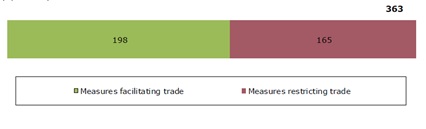
363 new trade and trade-related measures, 198 of them trade-facilitating and 165
trade-restrictive. Most of them, 256 (about 71 per cent) were linked to the pandemic.
"The report makes clear that a substantial share of world
trade continues to be affected by new and accumulated import-restrictive measures,
which is cause for concern at a time when economies will need trade to rebuild from
the effects of the COVID-19 crisis," said Director-General Roberto Azevêdo, who presented the report to WTO members. "On a
more positive note, the report shows that members also introduced import-facilitating
measures on an impressive scale, and have started to scale back trade restrictions
introduced earlier in the pandemic,” he added.
The report, which was reviewed at a meeting of the WTO’s Trade
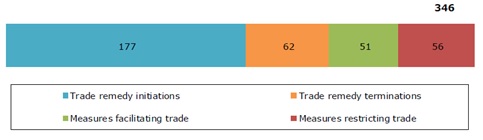
Policy Review Body, notes that 56 new trade-restrictive measures not related to
the pandemic were implemented between mid-October 2019 and mid-May 2020 - mainly
tariff increases, import bans, exports duties and stricter exports customs procedures.
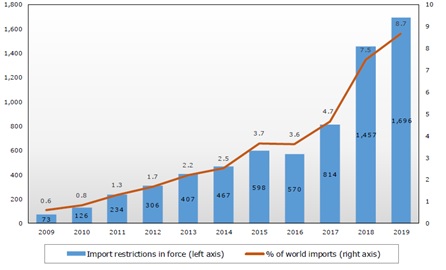
The new import restrictions covered traded merchandise worth an estimated USD 423.1
billion, the third-highest value since October 2012. WTO estimates indicate that
the cumulative trade coverage of import-restrictive measures implemented since 2009,
and still in force, amounts to USD 1.7 trillion or 8.7 per cent of world imports.
This figure has grown steadily since 2009, both in value terms and as a percentage
of world imports.
Even if trade restrictions remain widespread, the report also
finds evidence of WTO members moving towards trade-facilitating policies across
sectors during the review period, with 51 new trade-facilitating measures not related
to COVID-19 implemented. These measures mainly included the elimination or reduction
of import tariffs, the elimination of import taxes, the simplification of customs
procedures and the reduction of export duties.
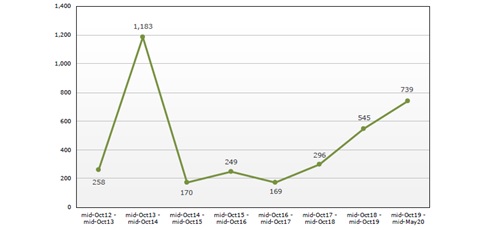
The trade coverage of non COVID-19 related import-facilitating
measures was estimated at USD 739.4 billion, which is significantly higher than
the USD 544.7 billion recorded in the previous report (from mid-May to mid-October
2019) and represents the second-highest figure since October 2012.
The report shows that by mid-May 2020 WTO members implemented
256 trade and trade-related measures explicitly linked to the COVID-19 pandemic,
with export bans accounting for the totality of the pandemic-related export restrictions
recorded. These COVID-19 related measures appeared to have come in two clearly identifiable
waves. In the early stages of the pandemic, several of the measures introduced restricted
the free flow of trade but as of mid-May 2020, 57 per cent of all measures were
of a trade-facilitating nature. In early May, some members began to phase out export
constraints, targeting products such as surgical masks, gloves, medicine and disinfectant.
There is further evidence that a roll-back of other trade and trade-related measures
taken in the early stages of the pandemic is also taking place. For instance, around
28 per cent of the COVID-19-specific trade-restrictive measures implemented by WTO
members and observers had been repealed by mid-May.
Prepared against the backdrop of COVID-19, the report does not
yet reflect the full impact of the pandemic on trade. According to WTO data
published on 22 June, estimates for the second quarter of 2020 indicate a year-on-year
drop in world trade of around 18 per cent.
Regarding general economic support measures, only 21 per cent
of WTO members notified these actions in response to the Director-General's request
for information. From the limited information received, and from the research undertaken
by the WTO, the current review period confirmed that WTO members appeared to continue
to implement such measures as part of their overall trade policy.
Separate from these longstanding policies, the review period
saw an unprecedented number of emergency support measures introduced by members
in response to the economic and social turmoil caused by the COVID-19 pandemic.
Most of these measures appeared to be of a temporary nature. These include grants,
monetary, fiscal and financial measures, measures targeting
micro, small and medium-sized enterprises (MSMEs), loans, credit guarantees and
stimulus packages. Several measures were one-off grants while others included disbursements
staggered over a few months and up to three years. Some of these measures form part
of larger emergency rescue programmes worth several trillion
US dollars.
Key
findings
·
This report covers new trade and trade-related
measures implemented by WTO members between 16 October 2019 and 15 May 2020. This
period included the start of the COVID-19 pandemic, which has already delivered
an almost unprecedented shock to the global economy and caused significant social
disruption. Although the full impact of the pandemic is not yet reflected fully
in trade statistics, it is expected to be very substantial.
·
In its trade forecast of 8 April 2020, the
WTO considered two scenarios for the crisis, one relatively optimistic and the other
more pessimistic. Under the optimistic scenario, the volume of world merchandise
trade would fall by 12.9 per cent and world GDP would decline by 2.5 per cent. Under
the pessimistic scenario, trade would contract by 31.9 per cent and GDP would shrink
by 8.8 per cent. As at mid-June, preliminary trade data and trade-related indicators
for the first half of 2020 were more consistent with the optimistic scenario than
the pessimistic one, but actual outcomes could easily fall within or even outside
of the forecast range, depending on how the crisis unfolds.
·
World trade was already slowing before the
pandemic struck, weighed down by heightened trade tensions and slowing global economic
growth. Merchandise trade was down 0.1 per cent in volume terms in 2019, marking
the first decline since 2009. Trade growth also slowed in nominal terms in 2019,
as the dollar value of merchandise exports fell by 3 per cent to USD 18.89 trillion.
Although commercial services exports increased by 2 per cent to USD 6.03 trillion
in 2019, the pace of growth was down sharply from 9 per cent in the previous year.
·
Overall, WTO members and observers implemented
363 new trade and trade-related measures during the review period, of which 198
were of a trade-facilitating nature and 165 were trade-restrictive. Seventy per
cent of these measures (256 in total) were linked to the COVID-19 pandemic. Of these
256 measures, 147 facilitated trade and 109 restricted trade. In the early stages
of the pandemic, several of the measures introduced by WTO members and observers
restricted the free flow of trade, principally for exports. But as at mid-May 2020,
57 per cent of all COVID-19-related measures were trade-facilitating. Around 28
per cent of the COVID-19-specific trade restrictions implemented by WTO members
and observers had been repealed by mid-May.
·
Excluding COVID-19-related measures, WTO
members and observers implemented 107 trade and trade-related measures during the
review period. These included 51 new measures aimed at facilitating trade. The trade
coverage of these non-COVID-19-related import-facilitating measures implemented
during the review period was estimated at USD 739.4 billion, the second-highest
figure for such measures since October 2012. WTO members and observers also put
in place 56 new trade-restrictive measures unrelated to the pandemic. The trade
coverage for these new import-restrictive measures was estimated at USD 423.1 billion,
the third-highest value recorded since October 2012. The trade coverage of import-restrictive
measures implemented since 2009, and still in force, continues to increase. It is
estimated that 8.7 per cent of world imports (USD 1.7 trillion) is affected by import-restrictive
measures implemented since 2009 and still in force.
·
All WTO issues regularly covered by this
report saw significant activity both before and after the outbreak of the pandemic.
During the review period, 239 trade remedy actions were recorded for WTO members.
The monthly average of trade remedy actions initiated was slightly higher than the
average for the last eight years, while the monthly average of trade remedy terminations
was the lowest over the same time span. During the review period, initiations of
anti-dumping investigations accounted for around 80 per cent of all trade remedy
initiations, which also includes safeguards and countervailing actions.
·
In services, most of the new measures introduced
by WTO members and observers between mid-October 2019 and mid-May 2020 were trade-facilitating,
but a number of new policies appeared to be trade-restrictive, including in areas
related to foreign investment and in areas considered strategic or linked to national
security. Most of the 99 services measures adopted by WTO members and observers
in response to the pandemic appeared to be trade-facilitating.
·
WTO members continued to implement general
economic support measures as part of their overall trade policy, a fact confirmed
by WTO Secretariat analysis despite governments' low response rate with respect
to these measures. In addition, WTO members and observers also implemented a large
number of emergency support measures in response to the economic and social turmoil
caused by the COVID-19 pandemic. Most of the 468 COVID-19-related general economic
support measures identified, including monetary, fiscal and financial measures as
well as preferential loans, credit guarantees and stimulus packages, collectively
worth several trillion US dollars, appeared to be temporary in nature. These emergency
support measures are central to governments’ strategies to address the pandemic-induced
economic downturn and to prepare the ground for a strong recovery. Regular monitoring
of support measures introduced in the context of the pandemic will be important
for members to be able to track their evolution and effects as the world exits the
health crisis and enters a recovery period.
·
WTO members were very active in the Sanitary
and Phytosanitary Measures (SPS) and Technical Barriers
to Trade (TBT) Committees during the review period, and notified a higher volume
of SPS and TBT measures compared to the previous period. Most of the new notifications
were submitted by developing members. From 1 February to 15 May 2020, 19 members
notified 29 SPS measures taken in response to the pandemic. The nature of most of
these measures shifted, from initial restrictions on animal imports and/or transit
from affected areas and additional certification requirements, to from April trade-facilitating
measures such as the use of electronic certificates for checks. As at 15 May 2020,
14 WTO members had submitted 53 TBT notifications/communications on standards and
regulations in response to the COVID-19 pandemic, covering a wide range of products
including personal protective equipment, medical equipment, medical supplies, medicines
and food.
·
WTO members continued to extensively use
the Committee on Agriculture review process, and raised a total of 298 questions
in relation to members' individual notifications and on specific implementation
matters. In relation to the COVID-19 pandemic, three WTO members informed the Committee
of four temporary measures to respond to food security threats.
·
The report also covers developments in WTO
members in trade-related aspects of intellectual property rights (TRIPS). Several
members implemented specific IP-related measures aimed at facilitating the development
and dissemination of COVID-19-related health technologies, as well as at relaxing
procedural requirements and extending deadlines for administrative IP matters.
·
Work continued in the first months of 2020
to advance negotiations, particularly on fisheries subsidies, building on the decision
taken by members at the 11th Ministerial Conference (MC11). Groups of members also
continued to pursue their discussions on other issues, including electronic commerce,
investment facilitation, women's economic empowerment, domestic regulation in services,
and micro, small and medium-sized enterprises (MSMEs). However, the delegations'
ability to engage in detailed negotiations has been constrained by restrictions
on movement and the refocusing of priorities to address the COVID-19 pandemic.
Trade-facilitating and trade-restrictive measures by WTO Members
and Observers, mid-October 2019 to mid-May 2020
(By number)
Note:
Including COVID-19 trade and trade-related measures.
Source: WTO Secretariat.
COVID-19
trade and trade-related measures, by mid-May 2020
(By number)

Source: WTO Secretariat.
Trade
and trade-related measures, mid-October 2019 to mid-May 2020
(By number)
Note:
COVID-19 trade and trade-related measures are not included.
Source: WTO Secretariat.
Trade
coverage of trade and trade-related measures, mid-October 2019 to mid-May 2020
(USD billion)

Note: COVID-19 trade and trade-related measures are not included.
Source: WTO Secretariat.
Trade coverage of new import-facilitating
measures in each reporting period (not cumulative)
(USD billion)
Note: These figures are estimates, and represent the trade coverage
of the measures (i.e. annual imports of the products concerned from economies affected
by the measures) and not the cumulative impact of the trade measures. Liberalization
associated with the 2015 Expansion of the WTO's Information Technology Agreement
is not included in the figures. COVID-19 trade and trade-related measures are not
included.
Source: WTO Secretariat.
Trade
coverage of new import-restrictive measures in each reporting period (not cumulative)
(USD billion)

Note:
These figures are estimates, and represent the trade coverage of the measures (i.e.
annual imports of the products concerned from economies affected by the measures)
introduced during each reporting period, and not the cumulative impact of the trade
measures. COVID-19 trade and trade-related measures are not included.
Source: WTO Secretariat.
Cumulative trade coverage of WTO import-restrictive
measures in force since 2009
(USD billion and % of world merchandise imports)
Note: The cumulative trade coverage estimated by the Secretariat
is based on information available in the Trade Monitoring
Database (TMDB) on import measures recorded since 2009 and considered to have a
trade-restrictive effect. The estimates include import measures for which HS codes
were available. The figures do not include trade remedy measures. COVID-19 trade
and trade-related measures are not included. The import values were sourced from
the UNSD Comtrade database.
Source: WTO Secretariat.