WTO, OECD Launch Dataset on Bilateral Trade in
Services
The WTO and the Organisation
for Economic Co-operation and Development (OECD) on 13 January jointly launched
a new dataset covering bilateral services trade of over 200 economies from 2005
to 2019. The WTO-OECD Balanced Trade in Services (BaTIS)
dataset, which provides detailed data for 12 services sectors in addition to total
commercial services, offers a complete and balanced matrix that reconciles previously
asymmetrical export and import data.
At present, bilateral data are available for less
than 70% of world trade in services. For individual services sectors, data coverage
can be much lower. Moreover, the availability of statistics on bilateral trade in
services varies significantly across countries and regions. More than 90% of Europe's
services trade can be captured on a bilateral basis. However, this share drops to
only 36% for Asia. No bilateral services transactions are currently reported by
African or Middle Eastern economies.
The BaTIS experimental
dataset, which uses both official statistics and estimates for missing data, provides
users with a complete and balanced matrix covering virtually all economies in the
world. It covers the following sectors in the 2010 Extended Balance of Payments
Services Classification (EBOPS): manufacturing services on physical inputs owned
by others; maintenance and repair services n.i.e.; transport;
travel; construction; insurance and pension services; financial services; charges
for the use of intellectual property n.i.e.; telecommunications,
computer and information services; other business services; personal, cultural and
recreational services; and government goods and services n.i.e,
as well as total commercial services. It
is thus a valuable tool for economic analysis, policy-making and trade negotiations.
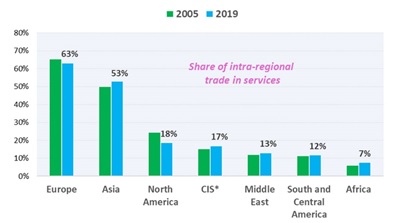
BaTIS data, show, for example, that the share of intra-regional trade in
services is very low in Africa (only 7%) even if it comprises more than 50 economies.
Intra-regional services flows are also modest in South and Central America and the
Caribbean, another large region. The share, in contrast, is highest in Europe and
Asia (see chart).
BaTIS estimates also reveal that, in 2019, 12.0% of commercial services
exports of least-developed countries (LDCs) were delivered to the United States,
followed by China (9.8%) and India (6.0%), largely relating to international travellers' expenditure and transport. Overall, Europe and Asia
were the main regional destinations of LDCs' services exports (see chart).
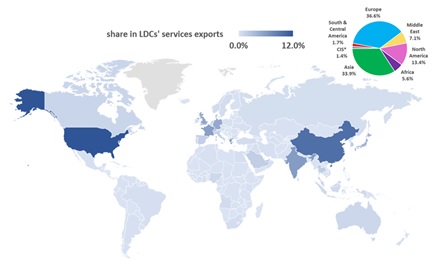
* Commonwealth of Independent States, including certain
associate and former member states.
DISCLAIMER: The colours,
boundaries and names shown and the designations used on this map do not imply any
judgment, official endorsement or acceptance by the World Trade Organization as
to the legal status or frontier of any territory. This map intends to make information
on WTO members more accessible by organizing such information visually. The map
does not intend to show WTO members' non-metropolitan/overseas territories or the
status of such territories in regard to the WTO Agreement.