World Trade Crashes by 60% in 2012, Grows only 2% Compared to 5.2%
in 2011
·
Weak
Europe Pulls Demand Down
·
2013
Forecast 3.3% Based on US Growth
·
India
Clocks Highest Fall of -3% in Exports and Largest Rise of 5% in Imports, Gains
Three Ranks to Become 10th Largest Importer in the World
World
trade growth fell to 2.0% in 2012 — down from 5.2% in 2011 — and is expected to
remain sluggish in 2013 at around 3.3% as the economic slowdown in Europe
continues to suppress global import demand, WTO economists reported on 10 April
2013. “The events of 2012 should serve as a reminder that the structural flaws
in economies that were revealed by the economic crisis have not been fully
addressed, despite important progress in some areas. Repairing these fissures
needs to be the priority for 2013,” Director-General Pascal Lamy
said.
The abrupt deceleration of trade in 2012 was
attributed to slow growth in developed economies and recurring bouts of
uncertainty over the future of the euro. Flagging output and high unemployment
in developed countries reduced imports and fed through to a lower pace of
export growth in both developed and developing economies.
Improved economic prospects for the United States
in 2013 should only partly offset the continued weakness in the European Union,
whose economy is expected to remain flat or even contract slightly this year
according to consensus estimates.
China’s growth should continue to outpace other
leading economies, cushioning the slowdown, but exports will still be
constrained by weak demand in Europe. As a result, 2013 looks to be a near
repeat of 2012, with both trade and output expanding slowly, below their
long-term average rates (Chart 1).
Chart1: Growth in the volume of world merchandise trade and
GDP, 2005-14a
Annual % change
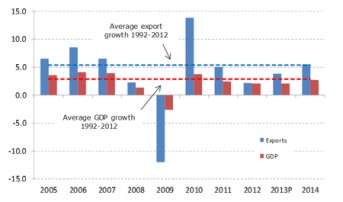
a Figures for 2013 and 2014 are
projections.
Source: WTO Secretariat.
The preliminary estimate of 2.0% growth for world trade
in 2012 is 0.5 points below the WTO’s most recent forecast of 2.5% from
September 2012. The deviation is mostly explained by the worse than expected
second-half performance of developed economies, which only managed a 1%
increase in exports and a 0.1% decline in imports for the year. The growth of
exports from developing economies (which for the purposes of this analysis
includes the Commonwealth of Independent States) was in line with earlier
predictions, but the rate for imports was less than expected. WTO economists
cautioned that their trade forecasts for 2013 and 2014 were difficult to gauge
due to divergent outlooks for the US and EU.
These figures refer to merchandise trade in volume
terms, i.e., adjusted to account for inflation and exchange rate movements, but
nominal (dollar-value) trade flows for both merchandise and commercial services
display similar trends.
In 2012, the dollar value of world merchandise
exports only increased two tenths of one per cent (i.e. 0.2%) to $18.3
trillion, leaving it essentially unchanged. The slower growth in the dollar
value of world trade compared to trade in volume terms is explained by falling
prices for traded goods. Some of the biggest price declines were recorded for
commodities such as coffee (–22 %), cotton (–42%), iron ore (–23%) and coal
(–21%), according to IMF commodity price statistics.
The value of world commercial services exports
rose just 2% in 2012 to $4.3 trillion, with strong differences in growth rates
across countries and regions. For example, the US saw its exports of commercial
services climb 4% while those of Germany dropped 2% and France’s tumbled 7%. On
the import side, several European countries recorded sharp declines, including
Italy (–8%), France (–10%), Portugal (–16%) and Greece (–18%).
The trade forecast for 2013 assumes 2.1% growth in
world output at market exchange rates (unchanged from 2012) based on a
consensus of economic forecasters. Risks to the forecast are firmly rooted on the
downside and are mostly linked to the sovereign debt crisis in Europe.
Accelerated fiscal consolidation in the US could
also undermine the forecast if brinksmanship over budget negotiations between
the executive and legislative branches leads to miscalculation. As always,
unexpected events such as geopolitical tensions and natural disasters could
also intrude to disrupt trade.
On a more positive note, some factors that held
back trade growth in 2012 may subside in 2013, including the recent territorial
dispute that soured trade relations between Japan and China.
Indicators of production, business sentiment and
employment in the first quarter of 2013 paint a mixed picture of current
economic conditions. Purchasing managers’ indices suggest that the euro-zone
downturn may have accelerated despite continued resilience in Germany. At the
same time, the US recorded a strong rise in manufacturing, Japan’s production
growth was less negative, and China and the Republic of Korea showed modest
improvements.
Unemployment in the US recently fell to its lowest
level since before the economic crisis at 7.6%, whereas the rate for the euro
area stands at close to 12%. Together, these indicators point to weak import
demand in Europe even as conditions gradually improve elsewhere. In light of
the large weight of the EU in world imports (32% in 2012 including trade within
the EU, 15% excluding it), this suggests slow growth for trade in the early
part of 2013.