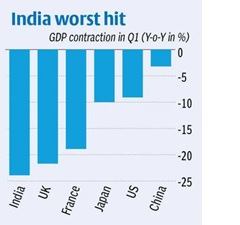
At -23.9% in Q1, Worst-ever GDP Contraction as Lockdown Bites
Industry,
services hit badly, but agriculture bucks the trend; Govt
sees V-shaped recovery
The economy suffered its steepest contraction at 23.9 per
cent in the first quarter (April-June) of 2020-21 when the country was in a lockdown
due to the Covid pandemic. This is perhaps the first contraction
in a quarter since GDP data started to be collected in the 1950s. If the trend continues
and the economy contracts on a full-year basis, too, that will be a first since
1979-80.
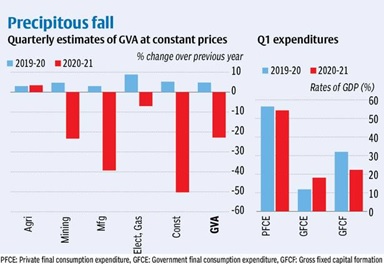
The latest data show that the industry and services sectors
shrank 38.1 per cent and 20.6 per cent, respectively. The silver lining was provided
by the farm sector, which grew 3.4 per cent during first three months. But agriculture’s
share in GDP (Gross Domestic Product) is just 17 per cent, while services and industry
account for 54 per cent and 29 per cent, respectively.
According to the data, manufacturing and construction are
in deep recession, which means job creation will be affected
further.
Chief Economic Advisor Krishnamurthy V Subramanian said the
poor April-June quarter economic performance is primarily due to the exogenous shock
that has been felt globally. Economies world over, including India, went into a
lockdown in the April-June period.
“Just to give a comparison, the UK, where the lockdown was
less stringent than in India... the contraction there was 22 per cent. So, given
the higher intensity of the lockdown (in India), this is actually along expected
lines,” he said.
‘Better performance’
However, according to Subramanian, what is important is that
India is experiencing a V-shaped recovery after the economy started unlocking. For
instance, the core sector has been picking up, steadily improving from (-)38 per cent in May to (-)13 per cent in June and to (-)9.6 per
cent in July.
Similarly, Railway freight traffic has reached 95 per cent
of the level that it was at the same time last year. “It is in fact 6 per cent higher
in the first 26 days of August compared to the same time last year,” he said, adding
that power consumption is only 1.9 per cent lower than last year and e-way bill
generation in August almost at the same level.
“India is definitely experiencing a V-shaped recovery, so
we should expect better performance in the subsequent quarters,” Subramanian concluded.
Recovery in second half
CII Director-General Chandrajit
Banerjee said that even as the first half of the current fiscal is expected to remain
weak, “We can expect a recovery in the second half led by supportive fiscal and
monetary policies. We have already started to see a discernible improvement in the
many high-frequency indicators, which are expected to pick up further, going forward.
In this context, the localised lockdowns being imposed
by State and district administrations may be avoided so that the economic recovery
can be kept on track.”
Chief Economist & Head Research at Knight Frank India
Rajani Sinha felt that with the economy unlocking in the
last few months, most parameters have improved to 70-90 per cent levels of the corresponding
period of the previous year. However, “a sustainable recovery would depend on the
time taken to contain the spread of the Covid virus. It
is very important for consumer sentiments and consumer spending to improve for the
economy to bounce back. Increased infrastructure investment by the government and
demand-boosting measures are very much required at this point for the economy to
recover,” she said.