Buenos Aires Declaration on
Women and Trade Outlines Actions to Empower Women
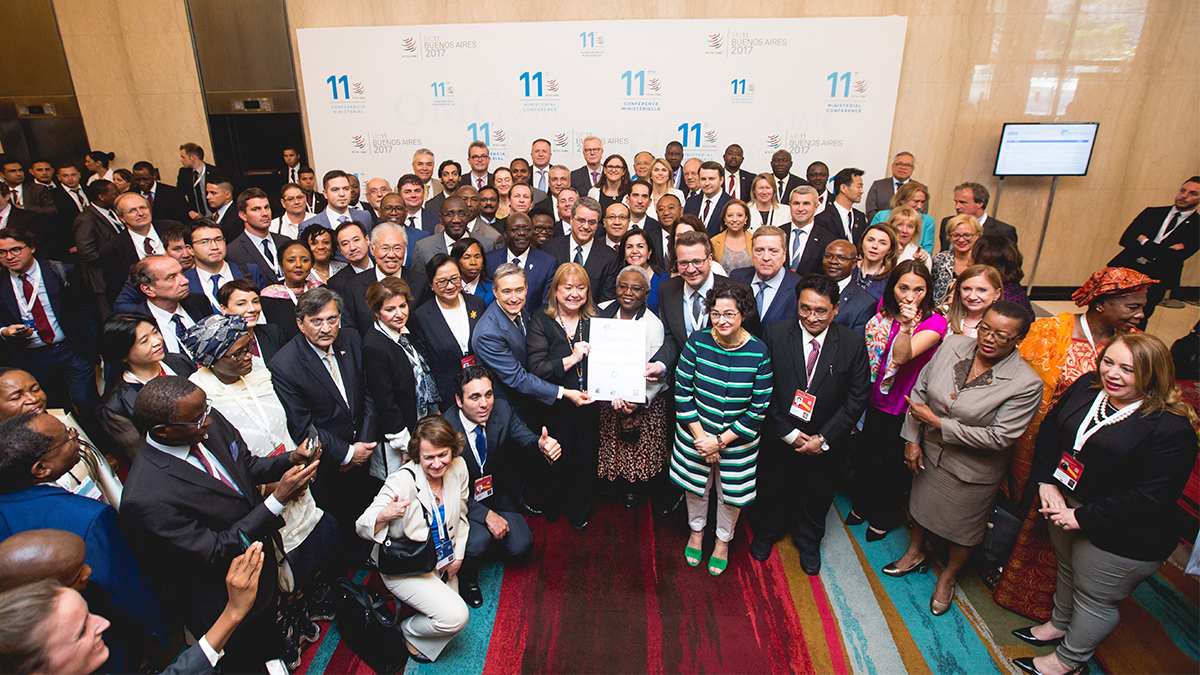 For the first time in the
history of the World Trade Organization, WTO members and observers have
endorsed a collective initiative to increase the participation of women in trade.
In order to help women reach their full potential in the world economy, 118 WTO
members and observers agreed to support the Buenos Aires Declaration on Women
and Trade, which seeks to remove barriers to, and foster, women’s economic
empowerment.
For the first time in the
history of the World Trade Organization, WTO members and observers have
endorsed a collective initiative to increase the participation of women in trade.
In order to help women reach their full potential in the world economy, 118 WTO
members and observers agreed to support the Buenos Aires Declaration on Women
and Trade, which seeks to remove barriers to, and foster, women’s economic
empowerment.
Actions
outlined in the Declaration
will ultimately boost economic growth worldwide and provide more and better
paid jobs for women. These actions will also contribute to UN Global
Development Goals, including the Sustainable Development Goal to achieve gender
equality through the empowerment of women and girls (SDG 5).
Supporting
WTO members and observers have specifically agreed to explore and find ways to
best tackle barriers to trade, lack of access to trade financing and
sub-optimal participation of women in public procurement markets. Participating
members will exchange information about what has worked – and what has not – in
their attempts to collect gender-disaggregated economic data and to encourage
women’s participation in the economy. Within the WTO context, members will
scrutinize their own policies through a gender lens and find ways to work
together to increase women’s participation in the world economy. They will also
seek to ensure that trade-related development assistance pays better attention
to its focus and impact on women. Progress will be reported in 2019.
Currently,
many women worldwide stand on the sidelines of the economy. While women
comprise about half of the global population, they generate only 37% of gross
domestic product (GDP) and run only about a third of small and medium-sized
enterprises. In some developing countries, female business ownership can dip as
low as 3-6%. An International Trade Centre survey in 20 countries found that
just one in five exporting companies is owned by women. In more than 155
countries, there is at least one law impeding economic opportunities for women.
No country has managed to close the gender gap on economic participation and
opportunity; progress is so slow it would take, at the current rate, 170 years
to reach gender equality. It is also apparent that international trade and
trade agreements affect women and men differently.
The
Buenos Aires Women and Trade Declaration was spearheaded by the governments of
Iceland and Sierra Leone, as well as the International Trade Centre. It stemmed
from efforts made by the Trade Impact Group of the International Gender
Champions, a leadership network that brings female and male decision-makers
together to break down gender barriers.
With
over 100 Heads of Delegation present, the Chair of the WTO’s 11th Ministerial
Conference (MC11), Susana Malcorra, and the WTO
Director-General Roberto Azevêdo received the Declaration
today on the margins of the Conference. This is the first time members
attending a WTO Ministerial Conference have issued a declaration calling for
greater inclusion of women in trade.
Director-General Roberto Azevêdo
said: ‘This joint declaration is a very welcome step in promoting women's
economic empowerment and in building the more inclusive trading system we all
want to see. I am proud to support this initiative, and to help launch it here
in Buenos Aires at the WTO's 11th Ministerial Conference.’
Gudlaugur Thór Thórdarson,
Iceland’s Minister for Foreign Affairs and External Trade, said: ‘Trade can
help advance women’s economic empowerment and is also good for the economy.
Therefore focusing on women and trade is not only the right thing to do, it
also makes economic sense.’
Arancha González, ITC’s Executive
Director, said: ‘Lowering the barriers facing women entrepreneurs, at home and
internationally, would bolster growth and make it more socially inclusive. It
would mean more and better-paid jobs for women – not least since women-owned
firms hire more women, especially at higher levels. And it would go a long way
towards realizing Goal 5 of the 2030 Agenda on Sustainable Development on
achieving gender equality and empowering all women and girls.’
Cecilia Malmström,
the European Commissioner for Trade, said: ‘For us to truly reap the benefits
of trade, women’s independence and entrepreneurship need to take centre-stage in our policies. We need to transform ideas
into action.’
Ann Linde, Sweden’s Minister
for EU Affairs and Trade, said: ‘Getting more women involved in trade is sound
economic policy for all countries, regardless of their level of development.
Gender inequality is something none of us can afford.’
Kamina Johnson Smith,
Jamaica’s Minister of Foreign Affairs and Foreign Trade, said: ‘Greater
participation of women in international trade will generate sustainable jobs
and boost global growth. I support the Women and Trade Declaration because
trade policy is critical in making that possible.’
Heraldo Muñoz, Chile’s Minster
of Foreign Affairs, said: ‘Economic empowerment of women is a priority in the
negotiation of trade policies and export promotion actions conducted by our
government. This is why I support the Declaration on Women and Trade.’
François-Philippe Champagne,
Canada’s Minister for International Trade, said: ‘Canada has been a leader in
advancing the Declaration on Women and Trade. We encourage countries to
champion inclusive, progressive approaches to trade.’
Ambassador Yvette Stevens,
Sierra Leone’s Head of Delegation to MC11, said: ‘The structural imbalances
which contribute to an unequal distribution of the benefits from trade must be
acknowledged and acted upon.’
Members and observers supporting the Buenos Aires Declaration
on Women and Trade: Afghanistan,
Albania, Argentina, Australia, Austria, Barbados, Belgium, Benin, Brazil,
Bulgaria, Burundi, Cambodia, Canada, Chad, China, Chile, Colombia, Costa Rica,
Côte d'Ivoire, Croatia, Cyprus, Czech Republic, Democratic Republic of the
Congo, Denmark, Dominica, Dominican Republic, Ecuador, El Salvador, Estonia,
Ethiopia, Fiji, Finland, France, Gabon, Gambia, Germany, Greece, Grenada,
Guatemala, Guinea, Guinea Bissau, Guyana, Haiti, Honduras, Hungary, Iceland,
Indonesia, Ireland, Israel, Italy, Jamaica, Japan, Kazakhstan, Kenya, Republic
of Korea, Kyrgyzstan, Lao People's Democratic Republic, Latvia, Lesotho,
Liberia, Liechtenstein, Lithuania, Luxembourg, Madagascar, Malawi, Malaysia,
Mali, Malta, Mauritius, Mexico, Moldova, Mongolia, Montenegro, Myanmar,
Namibia, Netherlands, Nepal, New Zealand, Niger, Nigeria, Norway, Pakistan,
Panama, Paraguay, Peru, Philippines, Poland, Portugal, Republic of Korea,
Romania, Russian Federation, Rwanda, Saint Kitts and Nevis, Saint Vincent and the
Grenadines, Samoa, Senegal, Sierra Leone, Slovakia, Slovenia, Somalia, Spain,
South Sudan, Swaziland, Sweden, Switzerland, Tajikistan, Chinese Taipei, the
former Yugoslav Republic of Macedonia, Togo, Tonga, Tunisia, Turkey, Uganda,
Ukraine, United Kingdom, Uruguay, Vanuatu, Viet Nam, Zambia.