MINISTERIAL CONFERENCES
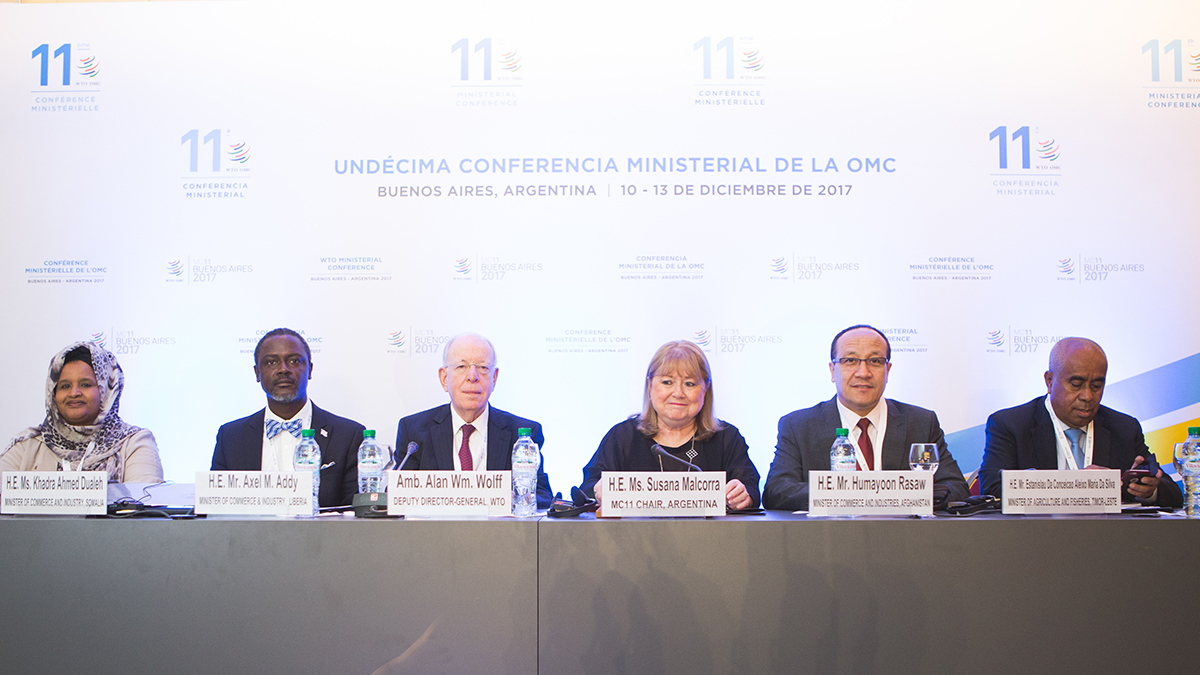
Conflict and Fragile Economies Group Speak
Up in WTO
Just hours
before the opening of the 11th WTO Ministerial Conference (MC11) in Buenos
Aires, WTO members launched the g7+ WTO Accessions Group, a new platform
designed to help post-conflict and fragile economies through WTO membership.
The Chair of MC11, Minister Susana Malcorra of
Argentina, presided over the launch, which included the participation of the
Ministers of Commerce of Afghanistan, Liberia, Somalia, Timor-Leste and Yemen,
as well as ambassadors from Comoros, Sierra Leone and South Sudan.
The g7+ WTO
Accessions Group will aim to facilitate the integration of post-conflict
and fragile economies into the multilateral trading system through WTO
accession-related reforms, including the establishment of credible economic and
trade policy frameworks and institutions, and the promotion of transparency and
good governance, based on international best practices. It also aims to support
the efforts of the WTO acceding governments in the Group, including through
information and experience sharing.
The g7+ WTO
Accessions Group is a sub-group of the larger g7+ group, which is an
association of 20 fragile and conflict-affected states. Its motto is “Nothing
about us without us" and it was formed in 2010 in response to the gaps
identified by conflict-affected states in the achievement of Millennium
Development Goals (MDGs). Advancing to the next development stage in order to
forge pathways out of fragility and conflict, and enabling peer learning on how
to achieve resilience and support between member
countries are its main objectives.
In her
opening remarks at the launch, Ms Malcorra
said: "The WTO is probably the most democratic institution within the
United Nations architecture. It is an institution that belongs to all of us and
where all of us define rules and the way we want to work together in the
international trade arena. Your decision to access or to apply for accession to
the WTO proves that, as much as the system is perfectible, it is worth being
part of it. It also proves that the future of the system is going to be bigger,
broader, and even more democratic. It means that you clearly understand that
this opportunity around trade will make a difference for your people," she
added.
WTO Deputy
Director-General Alan Wolff moderated the session. He said that "conflict
or post-conflict status is not the usual topic for WTO members, not even at
Ministerial Conferences. However, the pursuing by these countries of WTO
membership despite the challenges reminds us of the critical contribution of
the multilateral trading system to the peace and stability of nations . The commitment shown by the g7+ countries with WTO
accession reconfirms the attraction and strength of the system whose principles
and values continue to serve as a suitable foundation for national economies,
regardless of level of development, policy orientation or size."
Twelve of
the g7+ group are original WTO members: Burundi, Central African Republic, Chad Cote d'Ivoire, Democratic Republic of Congo, Guinea,
Guinea-Bissau, Haiti, Papua New Guinea, Sierra Leone, Solomon Islands and Togo.
Currently, Sierra Leone is the coordinator of the group. Three are recently acceded members (Afghanistan, Liberia,
Yemen), four are acceding least-developed countries (Comoros, Sao Tome and
Principe, Somalia and Timor-Leste) and one is a non-observer who has submitted
an application for WTO accession to the 11th Ministerial Conference (South
Sudan).
Afghanistan
and Liberia acceded to the WTO in July 2016, and Yemen acceded to the WTO in
June 2014. Comoros has been in the process of accession to the WTO since
October 2007, Sao Tome and Principe since May 2005, and Somalia and Timor-Leste
started their accession processes in December 2016.
Mr
Humayoon Rasaw, Minister of
Commerce and Industries of Afghanistan, underlined that "the purpose of
establishing the g7+ WTO Accessions Group is not seeking to launch new
negotiations or to replace existing groups or committees". Rather,
"it aims at better structuring and strengthening our work to facilitate
the integration of post-conflict and fragile economies into the multilateral
trading system through WTO accessions and to support the efforts of WTO
governments, including through information and experience sharing," he
said.
Speaking about the challenges that arise after WTO accession,
Mr Axel Addy, Minister of Commerce and Industry of
the Republic of Liberia, stressed that technical support coordination and
experience sharing are crucial elements of the accession process, especially in
the first stages: "If you think that accession is difficult,
post-accession implementation is just as difficult. The lesson we have learned
and can share with others is that you have to be open to learn and reach out
for help. There is a lot of goodwill out there that is willing to help us. Even
after accession, member states continue to lend us their technical expertise,
including members of the LDC group. Having access to this network to navigate
the accession process is very critical," he said.