Data Centers and Undersea
Cables Tangle in Geopolitics and Climate
·
The
‘cloud’ is, in reality, created by stacks upon stacks of servers in hot, dark
warehouses.
·
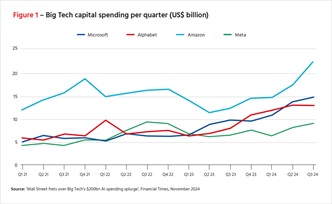
Amazon,
for one, now expects about US$75 billion in capital spending in 2024, up from
US$48 billion in 2023, with the majority on data centers.
Microsoft and Google, two of the world’s biggest cloud providers, are also
engaged in a spending spree on the architecture that supports their AI ambition.
· Countries worldwide are competing to crowd into the physical location of data centers, putting land-scarce economies at risk.
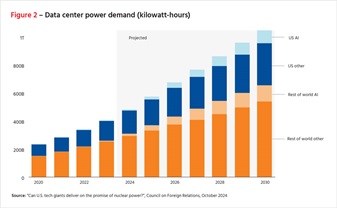
· Enormous demand for energy from these data centers is driving Big Tech companies to unconventional strategies, such as nuclear power
[ABS
News Service/28.11.2024]
The
future of the digital economy now hangs on an increasingly fractious
competition for energy and space. For the first time since the internet’s
inception, global geopolitics and climate imperatives are imperiling
the physical backbone of the internet that underlies trade and the modern
interconnected economy. As a key battleground for influence between China and
the US, these effects will be felt first in Southeast Asia.
The
modern internet is often imagined as a disembodied medium. The ‘cloud’ is, in
reality, created by stacks upon stacks of servers in hot, dark warehouses.
While in the past it had been easy to overlook the role data centers, power lines, and subsea cables play in enabling
the modern economy, the advent of artificial intelligence, the exponential
growth in the creation of data, and the growing strategic value of data mean it
is no longer tenable to ignore the physicality of the virtual world.
Investments
among Big Tech companies on these infrastructures are projected to continue to
rise. Amazon, for one, now expects about US$75 billion in capital spending in
2024, up from US$48 billion in 2023, with the majority on data centers. Microsoft and Google, two of the world’s biggest
cloud providers, are also engaged in a spending spree on the architecture that
supports their AI ambition.
But
tech providers are already running into energy and geopolitical challenges. In
the Asia-Pacific, subsea cables cannot be laid along cost-effective routes due
to the international contest over the South China Sea. Countries worldwide are
competing to crowd into the physical location of data centers,
putting land-scarce economies at risk. The enormous demand for energy from
these data centers is driving Big Tech companies to unconventional
strategies, such as nuclear power, raising yet another set of environmental
risks.
In
Southeast Asia, the rollout of new internet infrastructure has double-edged
impacts. Massive investments in renewable and clean energy to power data centers are coming online and can be expected to help
underwrite a strengthening of the electricity grid, thereby creating spillover benefits. Geopolitical factors weighing on the
locations of subsea cables could benefit the region and increase the importance
of hubs like Singapore. They could also turn just as quickly into a
geopolitical minefield.
The
routing of subsea cables and development of data centers
underscore real-world obstacles for the digital economy. Since 2010, the number
of internet users worldwide has more than doubled, while global internet
traffic has expanded 25-fold. If the combination of the physical limitations is
not addressed, the rapid advancement of the digital economy, as well as the
more basic adoption of the internet in Asia and other developing regions, will
be slowed. This would have consequences for the evenness and equality of global
economic development, writes Kieran Thompson of Dragoman, a Melbourne-based
international strategic advisory firm.