ICRIER Release Report to
Make Turmeric Global
·
Testing
and Multiple Standard by Official Barriers in Exports
Executive
Summary
Introduction
 Known
as the 'Golden Spice of India', turmeric, due to its preventive, therapeutic
and curative properties, has been integral to Indian and many South Asian
cultures, cuisines, and traditional systems of medicine like Ayurveda and
Unani. It is commonly used as a condiment, dye, drug and key raw material for
the cosmetic industry, and in traditional medicine and religious ceremonies.
The turmeric market value was around USD 58.2 million in 2020 and is projected
to grow at a CAGR of 16.1 per cent from 2020 to 2028. Rising awareness of
curcumin's medicinal benefits has fuelled an increase in turmeric demand.
Consequently, in 2023, global turmeric trade was valued at USD 587 million,
with exports at USD 320 million. The export value increased by 13.56 per cent
between 2017 and 2023.
Known
as the 'Golden Spice of India', turmeric, due to its preventive, therapeutic
and curative properties, has been integral to Indian and many South Asian
cultures, cuisines, and traditional systems of medicine like Ayurveda and
Unani. It is commonly used as a condiment, dye, drug and key raw material for
the cosmetic industry, and in traditional medicine and religious ceremonies.
The turmeric market value was around USD 58.2 million in 2020 and is projected
to grow at a CAGR of 16.1 per cent from 2020 to 2028. Rising awareness of
curcumin's medicinal benefits has fuelled an increase in turmeric demand.
Consequently, in 2023, global turmeric trade was valued at USD 587 million,
with exports at USD 320 million. The export value increased by 13.56 per cent
between 2017 and 2023.
Turmeric
is produced in various regions, such as Africa (Tanzania, Nigeria, and
Ethiopia), Asia (China), South Asia (India, Bangladesh, Sri Lanka, Myanmar) and
South America (Brazil, Peru), with these regions also being the largest
consumers. Emerging markets like the United States of America (USA) and the
European Un ion (EU) are rapidly adopting turmeric for nutraceuticals and food
applications, especially after COVID-19, as consumers seek healthier options.
India, as the leading producer, consumer and exporter, accounted for 73.40 per
cent of global production in FY 2022-23. India's export value rose from USD
182.53 million (2017) to USD 212.65 million (2023). The de mand for
high-curcumin and organic varieties of turmeric has also been rising because of
its diverse end-uses and affordability. Developed markets like the EU and the
USA are emerging as key hubs for high-quality turmeric that meets stringent SPS
and quality standards. In this context, India can become a turmeric pro
duction hub and widen its consumer base by expanding exports to destination
countries other than South Asia.
Overview
of the Turmeric Sector in India vis-a-vis Global Turmeric Sector
In
2022, global turmeric exports reached 238.81 thousand tonnes, up from 157.68
thousand tonnes in 2017. Turmeric exports peaked in 2020, reflecting a surge in
demand for curcumin-based products during the COVID-19 pandemic.
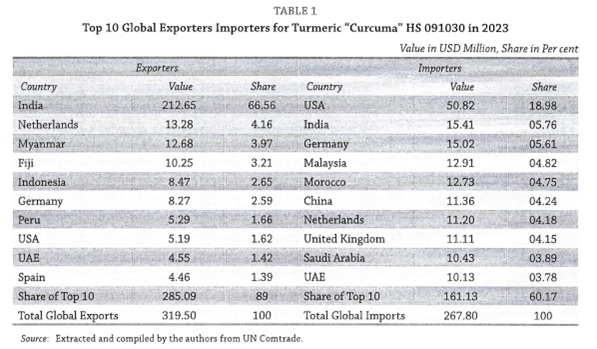
India,
being the largest producer and exporter, has solidified its market dominance by
increasing its export value from USD 182.53 million in 2017 to USD 212.65
million in 2023 (see Table 1), with its global market share rising from 71.55
per cent to 73.40 per cent during the period.
The
overall production of turmeric in India in creased from 2012-13 to 2022-23,
with fluctuating trends. Demand and production rose after the pandemic, but
price fluctuation led to output fluctuation. Although there was an increase in
cultivated area, turmeric yield per hectare declined by a CAG R of approximately
3.24 per cent between 2012-13 and 2022-23.
This
reflects the challenge of maintaining yield efficiency.
According to the Ministry of
Agriculture and Farmers ' Welfare 2024 (Third Advance Estimate of FY 2023-24),
297,460 hectares of land is under turmeric cultivation in India, with an
expected production of 1, 041, 730 MT.
As
the Government of India aims to make India the global turmeric production hub,
the Ministry of Commerce and Industry projects that India's turmeric exports
will reach USD 1 billion by 2030.
- State-wise Turmeric Production
Between
2012-13 and 2022 -23, India's turmeric production and cultivation across states
has undergone significant changes. Maharashtra, Telangana, Tamil Nadu,
Karnataka, Madhya Pradesh, Andhra Pradesh and Odisha are some of the top
turmeric-producing states. While Gujarat, Haryana, and Manipur have dropped out
of the top 10 turmeric producing states, Maharashtra and Odisha have emerged as
key producers as of 2022-23. Over 30 varieties of turmeric are cultivated in
India across more than 20 states, with both local and improved varieties
developed by agricultural research institutions.
Local
varieties possess certain qualities and characteristics based on the specific
geographical location. These varieties vary in curcumin content, yield and
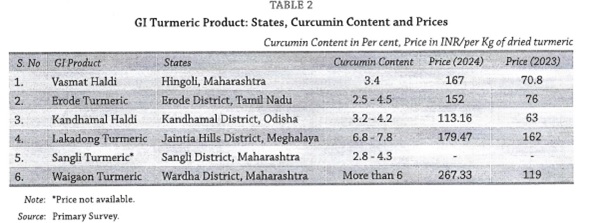
disease resistance. To protect and promote the reputation and unique ness tied
to the respective region, they get a geographical indication (GI) tag. India
has six GI tags for turmeric (see Table 2).
To
maintain India's global dominance, it needs to evolve from being just a raw
turmeric supplier by innovating, ensuring quality, and adopting sustainable
practices. Several companies have already taken strides in this direction and
produce curcumin extracts for pharmaceuticals and nutraceuticals. Products like
Vicco Turmeric Cream merge turmeric with modern cosmetics, linking Ayurvedic
traditions with contemporary personal care. High-curcumin variants like
Alleppey and Lakadong turmeric are gaining international attention for their
medicinal benefits.
Methodology
The
study is based on secondary data and information analysis, and a primary survey
of diverse stakeholders in the turmeric value chain. The stakeholder s included
farmers, farmer producer organisations (FPOs), companies, certification
bodies, laboratories, government agencies, and non-governmental organisations
(NGOs) across six states, namely Telangana, Tamil Nadu, Maharashtra, Meghalaya,
Odisha, and Madhya Pradesh. There were two stake holder consultations,
multiple case studies and key informant interviews, and a semi-structured
questionnaire -based survey, ensuring a comprehensive representation of the
perspectives of over 500
stakeholders.
Key
Findings of the Primary Survey
The
semi-structured questionnaire-based sur vey covered 262 farmers, 45 FPOs, and
69 companies engaged in the turmeric value chain.
-
Farmer Survey
The
survey revealed that most turmeric farmers (80 per cent) earned less
than 50 per
cent of their annual income from turmeric. This is largely due to their
reliance on cultivating multiple crops like paddy, soybean, maize, sugarcane,
and cotton.
The decline in turmeric production
in recent years is due to fluctuating prices and gaps in market access,
highlighting the need for targeted support to stabilise turmeric cultivation.
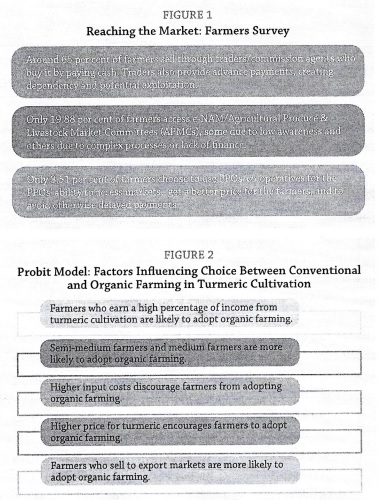
Farmers
also reported a decline in turmeric cultivation in the last three years,
stating several reasons, like a sudden fall in prices, inadequate
infrastructure, unfavourable weather conditions, pest infestations, inability
to connect to the right buyers and issues related to soil fertility. Some other
findings are given in Figure 1.
Farmers are either
conventional farmers or organic farmers. Organic farmers can be (a) default
organic/natural, (b) third-party certified organic farmer under National Pro
gramme for Organic Production (NPOP) of Agricultural and Processed Food
Products Export Development Authority (APEDA), and (c) self-certified under the
Participatory Guarantee System of India (PGS-India) of the National Centre of
Organic Farming (NCOF).
A
probit model was used to identify the primary determinants that influence the
farmer's choice between conventional and organic farming in turmeric
cultivation.1 The dependent variable is a binary variable representing the
choice of farming method adopted by a turmeric farmer. The key findings are
presented in Figure 2.
While
the farmland holding varies across states, most turmeric farmers in India are
small and marginal farmers. There are state-wise differences in farming
methods, reflecting the state's socio-economic and institutional dynamics. For
example, turmeric farmers in Meghalaya practice co-operative farming, while
farmers in Tamil Nadu, Madhya Pradesh, Maharashtra, and Odisha are either doing
their own farming or contract farming. These farmers highlighted the following
multiple benefits of contract farming:
·
Security and support in
agricultural practices from companies
·
Access to quality seeds, fertilisers
and other inputs, reasonable pricing and reduced risk exposure
·
Training and knowledge sharing
like free integrated pest management (IPM) kits
·
Guidance on efficient
fertiliser application to help optimise crop yield and quality.
Various
factors, including curcumin content, market demand, and GI, influence the
market price of turmeric. For example, in Meghalaya, the Lakadong variety is
renowned for its high curcumin content, market value, and GI tag. In 2024, this
variety sold at an average price of INR 32.14 per kilogram for raw turmeric,
while its dried and powdered forms fetched INR 179.47 per kilogram and INR
266.66 per kilogram, respectively. The Erode Manjal variety, GI-tagged but with
lower curcumin content ranging from 2.5 to 4.5 per cent, sold for INR 152 per
kilo- gram for dried turmeric in 2024 (see Table 2).
Furthermore,
global value chains are reshaping themselves as consumer demand shifts to
wards organically cultivated turmeric with high curcumin content. Although
organic turmeric fetches a higher price in the market, the transition from
conventional to organic farming is often a rigorous and expensive process. This
creates financial strain and uncertainty for farmers, discouraging them from
making the switch.
Enhancing finance, marketing,
co-operatives, and regulated market access is essential to empower farmers and
boost output
-
FPO Survey
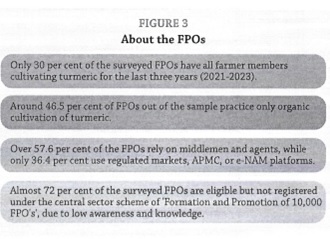
The
survey highlighted the essential support FPOs offer to farmers, especially
small and marginal ones (over 80 per cent of FPO members), by providing inputs,
post-harvest processing, aggregation, marketing and better price negotiations.
Some key findings are presented in Figure 3.
FPOs
attributed the decline in turmeric production to frequent market price
fluctuations. De spite government assistance to FPOs through different schemes
at both the central and state levels, the number of FPOs registered and re
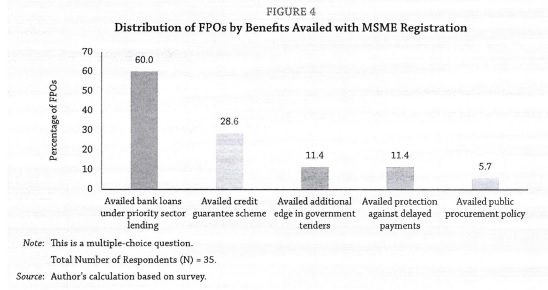
ceiving assistance under the schemes was less than 10. Most of the surveyed
FPOs, registered as MSMEs, receive several benefits, as shown in Figure 4.
FPOs need comprehensive support to bolster
their operations, expand their market reach, and boost their overall
sustainability.
However,
they continue to face the following constraints:
i. Market linkages and information/knowledge
gap
ii. Visibility to buyers since they are not
listed under spices or turmeric on government portals
iii.
Getting credit and accessing benefits/ subsidies.
- Company Survey
The
surveyed companies encompass manufacturers, wholesalers, exporters, retail and
contract farming companies, and companies handling turmeric products (whole
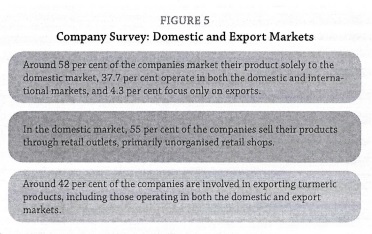
turmeric, turmeric powder and turmeric extracts). Some of the key findings of
the company survey are presented in Figure 5.
Companies
source turmeric through multiple channels, including farmers, FPOs, organic
clusters, e-NAM, regulated market s and traders, with over 50 per cent of the
companies re lying on mandi agents,
commission agents and local traders, sourcing both organic and conventional
turmeric.
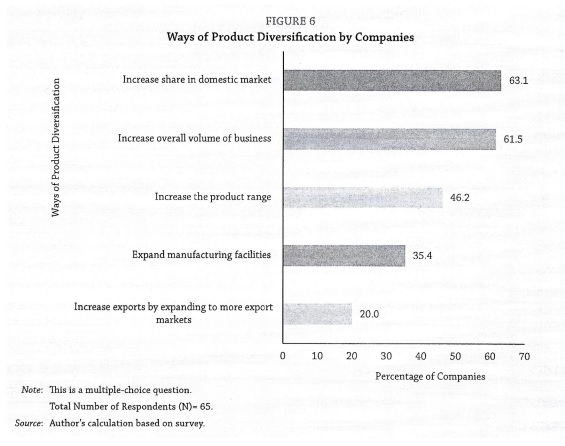
With
an expected growth rate of more than 15 per cent, the companies also intend to
diversify their turmeric portfolio in the next five years (see Figure 6).
The
survey highlighted that the use of turmeric has expanded globally, with foreign
firms sourcing turmeric from India and Indian firms growing internationally.
Some
Roadblocks to India's Leadership in Turmeric Production
Despite
holding a commanding share exceeding 62 per cent of global turmeric trade,
India faces challenges that impede further growth, ranging from the rejection
of spices in key export markets to price fluctuations leading to farmers
withdrawing from the cultivation of turmeric to not meeting the desired
curcumin levels re quired by companies (see Figure 7).
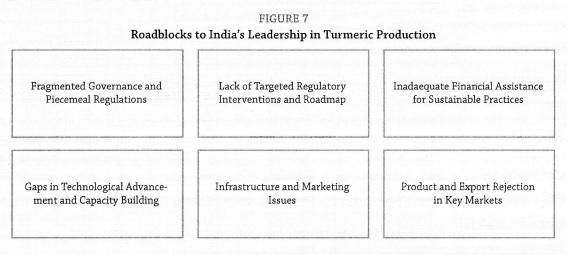
We
are only able to supply 10 per cent of turmeric products with the high curcumin
content required by global clients. Fragmented supply chains, lack of uniform
quality of produce, lack of access to high-quality inputs, gaps in testing and
certification, lack of traceability, targeted subsidies and support, and
infrastructure gaps are some of the issues that stem from the complex institutional
structure for governance. With varying end-uses of turmeric, there exist
multiple organisations, each with its own regulations, policies and governance,
depending on end-use and production. There are different regulatory bodies for
domestic markets and exports. Multiple agencies, such as the Spices Board
India, APEDA, Food Safety and Standards Authority of India (FSSAI) and Bureau
of Indian Standards (BIS), set standards for agricultural produce. The Spices
Board India looks at processed turmeric, while APEDA covers fresh turmeric.
Each of these agencies have onboarded different laboratories and ask for
different compliance requirements. Additionally, although domestic turmeric may
align with international standards such as the CODEX Alimentarius, it is low on
curcumin (2 per cent), which does not meet the global demand for turmeric
varieties of high curcumin content (5 per cent or more). We do not have mutual
recognition agreements with key markets for processed organic produced.
Globally,
rising consumer awareness regarding food safety and standards has resulted in
strict er border review processes and requirements in export partners.
Recently, border refusals of Indian spices have become more frequent and
non-compliance with safety standards has become a major issue. Instances of
adulteration in turmeric by manufacturers seeking to profiteer by using
low-cost raw materials and additives have also resulted in the rejection of
turmeric by global buyers.
Pathways
to a Resilient Future: How Can India Retain its Leadership Position and Move up
the Value Chain?
The
Government of India is aware of the issues, and the Honourable Prime Minister
announced the setting up of the National Turmeric Board to resolve some of the
issues related to regulatory gaps, quality and standards, research and product
development, etc. Establishing a single nodal agency like the National Turmeric
Board can ensure quality standards, traceability and streamline certification
and testing processes. Once the domestic quality and standards are in order,
signing mutual recognition agreements for standards and certification for both
fresh and processed turmeric with key export markets can reduce the compliance
burden and enhance trade. Subsidies should be linked to help develop high -end
product value chains. For example, there can be subsidies for third -party
certification, cultivation of high curcumin varieties, research and development
(R&D) for value-added turmeric products and for promoting GI products.
Investments in post-harvest infrastructure, scaling up turmeric FPOs and
fostering knowledge sharing through R&D and global collaborations are
crucial for maintaining competitiveness.
Promoting
high-curcumin varieties and leveraging international platforms can solidify
India's position as a leading turmeric exporter.
To
help India retain its leadership position, it is urgent to replicate the
different collaborative models and best practices discussed in this re port.
Collaborative platforms involving policymakers, traders, corporations and
processors are instrumental in developing effective strategies. Industry events
such as the World Spice Congress and Global Turmeric Conference pro vide
valuable opportunities for knowledge sharing, networking and identifying market
trends. International platforms such as these can also be used to market India
's success in turmeric, as well as disseminate information about importing
country requirements. Capacity building for farmers, processors and exporters
can significantly enhance the industry's global competitiveness. By aligning
production practices with international benchmarks and fostering a
collaborative ecosystem, India can solidify its position as a reliable and
preferred supplier of high quality turmeric in the global market.